
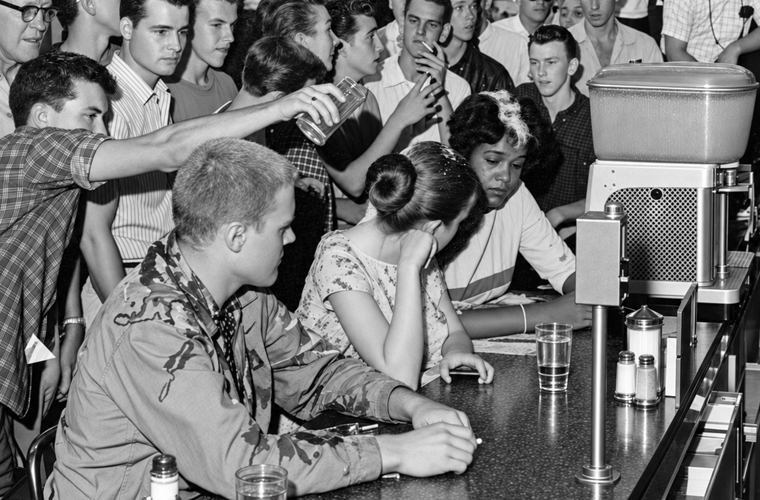
The Woolworth Lunch Counter Sit-in in Jackson, Mississippi, on May 28, 1963, was one of the most violent and widely publicized sit-ins of the Civil Rights Movement. Students and faculty from Tougaloo College staged a nonviolent protest at the whites-only lunch counter of the F.W. Woolworth variety store in downtown Jackson. What began as a quiet request for service escalated into a three-hour ordeal of physical assault, humiliation, and racial hatred by a white mob, while police largely stood by. The event produced an iconic photograph, intensified the Jackson Movement, and helped galvanize national attention on segregation in Mississippi.
By 1963, the sit-in tactic—popularized by the 1960 Greensboro, North Carolina, Woolworth protest—had spread across the South as a form of nonviolent direct action against Jim Crow segregation in public accommodations. Mississippi lagged behind many other states in such protests, with activists often favoring boycotts and voter registration due to the extreme risk of violence. In Jackson, tensions were high. Black leaders, including NAACP Field Secretary Medgar Evers, had negotiated with Mayor Allen Thompson for desegregation of public facilities, fair employment, and other reforms. When the mayor refused most demands, leaders walked out and launched the Jackson Movement, which included a boycott of white-owned downtown businesses.
The sit-in occurred eight days after a U.S. Supreme Court ruling that state enforcement of restaurant segregation violated the 14th Amendment. Woolworth’s official policy was to follow “local custom,” meaning segregation in the South. Tougaloo College, a private historically Black institution just outside Jackson known for its progressive stance and interracial faculty and student body, became a key base for activism. John Salter (later known as Hunter Bear Gray), a sociology professor of Native American and Scottish descent, worked closely with Evers and students to plan actions.
The protest was carefully coordinated. At approximately 11:15 a.m., three Black Tougaloo-affiliated activists—Pearlena Lewis (president of the NAACP North Jackson Youth Council), Anne Moody (a Tougaloo student who later chronicled the event in her memoir Coming of Age in Mississippi), and Memphis Norman (another Tougaloo student)—entered the store, made small purchases, and sat at the whites-only lunch counter, requesting service. They were refused and directed to the “colored” section at the back. They remained seated.
A diversionary picket line was planned nearby on Capitol Street; those picketers were quickly arrested. Spotters, including white Tougaloo student Joan Trumpauer (later Mulholland) and teaching assistant Lois Chaffee, monitored events and reported back. As the situation escalated, an integrated group joined or supported the original three: Trumpauer, Chaffee, Salter, Walter Williams, George Raymond (a CORE activist), and others. Tougaloo President A.D. Beittel and Chaplain Rev. Ed King also became involved. The protesters emphasized they sought only equal service and planned to stay nonviolently.
Waitresses ignored or refused the group. A crowd quickly gathered, including students from nearby Central High School on lunch break, local businessmen, onlookers, FBI agents (who observed without intervening), an undercover policeman, and white toughs. Racial epithets filled the air. Violence erupted when a man knocked Memphis Norman from his stool and repeatedly kicked him on the floor; Norman was bloodied, and both he and his primary attacker were eventually arrested by the undercover officer.
The remaining protesters endured sustained assault. Crowds poured sugar, salt, pepper, mustard, ketchup, hot coffee, and other condiments and food over them. They were slapped, punched (Salter was struck with what appeared to be brass knuckles, cut by broken glass sugar containers, and burned with cigarettes), yanked from seats, dragged by the hair, and spat upon. Trumpauer’s presence as a white woman particularly enraged the mob. Photographers, including Fred Blackwell of the Jackson Daily News, captured the scene; one famous image shows Salter, Trumpauer, and Moody seated stoically amid the chaos, covered in food, with a hostile crowd behind them.
Police remained largely outside or passive for much of the time, citing the legal status of sit-ins, though some attackers were arrested. The ordeal lasted roughly three hours. Around 2 p.m., Woolworth’s regional management closed the store, ending the sit-in. The protesters left under the protection of Beittel and others. That evening, a firebomb was thrown at Medgar Evers’s home.
Anne Moody later described the experience vividly: after initial refusal of service and a period of tense waiting, “all hell broke loose.” She and the others were beaten, kicked, dragged, and smeared with “ketchup, mustard, sugar, pies and everything on the counter.” She noted that about ninety policemen watched through the windows without intervening. The group refused Evers’s suggestion to call off the protest once violence began; they were determined to stay.
The sit-in did not immediately desegregate Jackson’s lunch counters—many stores removed seats or closed counters in subsequent days to avoid further protests—but it electrified the local Black community and drew national media coverage. It is widely regarded as the most violent of more than 300 sit-ins of the era. Demonstrations continued in Jackson. Two weeks later, on June 12, 1963, Medgar Evers was assassinated by white supremacist Byron De La Beckwith in his driveway, further intensifying the movement and national outrage.
The Jackson protests contributed to the momentum that led to the Civil Rights Act of 1964, which outlawed segregation in public accommodations. Woolworth’s and other chains eventually desegregated their Southern stores in compliance with the law. Participants such as Anne Moody (whose memoir became a classic), Joan Trumpauer Mulholland (who continued civil rights work), and John Salter remained active. The event highlighted both the courage of nonviolent protesters and the depth of white resistance in Mississippi.
Today the site is commemorated by a Mississippi Freedom Trail historical marker detailing the events. The iconic Blackwell photograph appears in history books and exhibits worldwide. Survivors and historians have reflected on the sit-in in documentaries, books (including M.J. O’Brien’s We Shall Not Be Moved), oral histories, and anniversary commemorations. It stands as a stark illustration of the personal risk involved in challenging segregation and the power of determined, nonviolent resistance to force moral and political reckoning. The protesters’ refusal to yield under extreme provocation helped expose the brutality of Jim Crow and advanced the broader struggle for equality.