
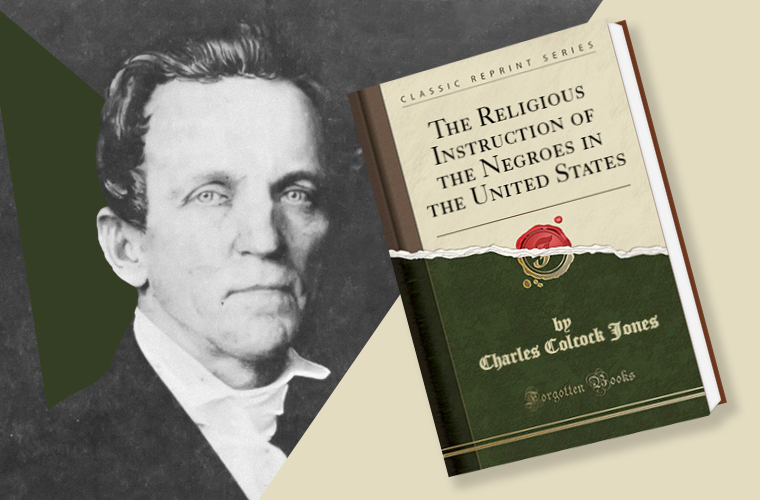
Charles Colcock Jones Sr. (1804–1863) was a Presbyterian minister, teacher, missionary, and plantation owner based in Liberty County, Georgia. While living in the North, he wrestled with the ethics of slaveholding, yet he ultimately returned south, where he combined the management of his estates with sustained evangelistic work among the enslaved population.
He briefly served as pastor of Savannah’s First Presbyterian Church (1831–32). He then taught church history and polity at Columbia Theological Seminary in South Carolina (1835–38), resumed full-time missionary labors in 1839, and returned to the seminary faculty for a second term (1847–50). Thereafter he devoted himself to overseeing his three plantations—Arcadia, Montevideo, and Maybank—while continuing his efforts to bring Christian teaching to the people held in bondage on those and neighboring properties.
Among his published works are The Religious Instruction of the Negroes in the United States (1842) and the posthumous History of the Church of God (1867). His Catechism of Scripture Doctrine and Practice (1837) was later rendered into Armenian and Chinese. In 1972, the literary scholar Robert Manson Myers issued a massive edition of Jones-family correspondence under the title The Children of Pride (more than 1,800 pages); the volume received the National Book Award the following year. In 2005, the historian Erskine Clarke drew on an even larger body of the same family’s papers for Dwelling Place: A Plantation Epic, which won the Bancroft Prize in 2006.
Jones’s own 1842 volume surveys the history of religious instruction among Black Americans from 1620 to his own day, describes their moral and spiritual condition, argues that the churches were obligated to supply them with the gospel, and outlines practical schemes for doing so. He carefully answers common objections on biblical grounds, making it difficult for any minister or lay Christian to read the work without feeling challenged. Addressing Southern churches, he insisted they could not criticize Catholics for withholding Scripture from the laity while themselves denying the Bible to enslaved people and refusing to arrange for its reading and explanation. He also urged Northern Christians to extend the gospel to free Black residents in their own communities. Such conscience-driven appeals, many contemporaries believed, helped prepare the ground for the eventual dismantling of slavery.