
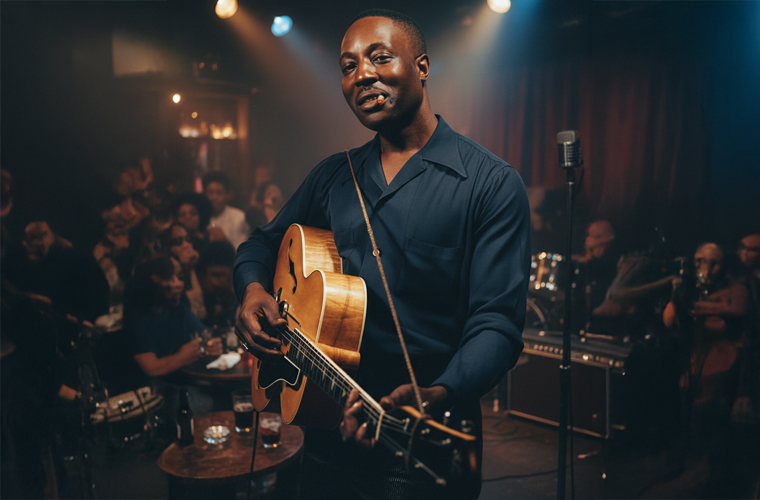
Big Bill Broonzy (born Lee Conley Bradley; June 26, 1893 or 1903 – August 14/15, 1958) was one of the most influential American blues singers, songwriters, and guitarists of the pre-World War II era. A towering figure in both Chicago blues and the emerging folk revival, he bridged country blues traditions with urban styles and helped pave the way for later rock ‘n’ roll developments.
Born in the Mississippi Delta region (he claimed Scott, Mississippi, though research points to near Lake Dick, Arkansas), Broonzy grew up in a large family as one of 17 children. He learned to play the fiddle from his uncle and began performing at social gatherings, churches, and local events in the Pine Bluff, Arkansas, area. He briefly served as a pastor before moving north after World War I, where he had served in the U.S. Army.
Settling in Chicago in the 1920s, Broonzy switched to guitar and became a leading figure in the city’s vibrant blues scene. He recorded prolifically from the late 1920s onward (over 250 songs between 1925 and 1952), often for labels such as Vocalion. His early work featured a lively, ragtime-influenced country blues style, and he was a key session player and composer, backing artists and writing hits for others.


Broonzy’s signature songs include classics like “Key to the Highway”, “Black, Brown and White” (a powerful commentary on racial inequality), “Just a Dream”, “Romance Without Finance”, and “When Will I Get to Be Called a Man”. His witty, storytelling lyrics often addressed everyday life, love, hardship, and social issues, delivered with a warm, engaging vocal style and distinctive guitar work.
In the late 1930s, he gained wider recognition, performing as a featured soloist at the landmark “From Spirituals to Swing” concerts at Carnegie Hall in 1938 and 1939. After World War II, as electric Chicago blues rose with younger artists like Muddy Waters (whom Broonzy had influenced and recorded with), he adapted by shifting toward folk-blues for international audiences. He toured Europe extensively in the 1950s, where he was celebrated as an authentic folk-blues master, and collaborated on his autobiography Big Bill Blues (1955).
Diagnosed with throat and lung cancer after his final tours, Broonzy continued performing until he died in Chicago in 1958. His legacy endures as a versatile, prolific artist who connected rural Delta roots to urban sounds and global folk traditions—often called an unsung hero of the blues boom.