
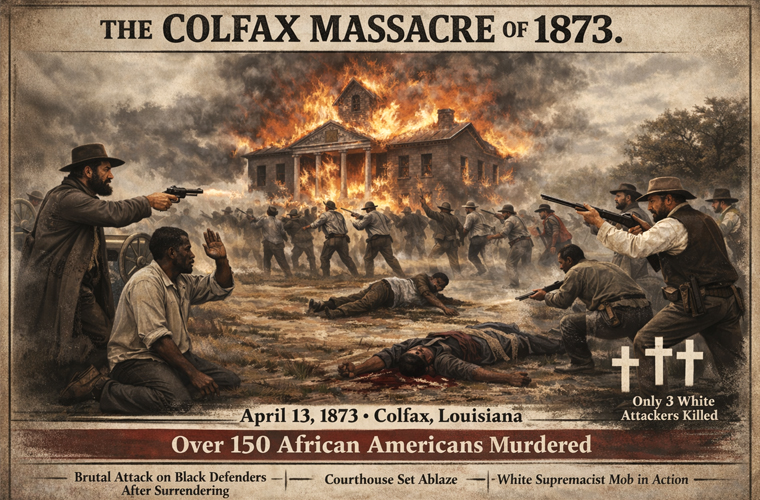
On Easter Sunday, April 13, 1873, in Colfax, Louisiana, a large mob of white men launched a violent assault on the Grant Parish courthouse, resulting in the deaths of approximately 150 Black people. Most of the victims were killed in cold blood after they had surrendered or while attempting to flee. Only three white attackers died in the clash. The violence stemmed directly from the bitterly contested 1872 Louisiana gubernatorial election during Reconstruction. As newly freed Black Americans increasingly engaged in politics and voting, white supremacist groups responded with campaigns of intimidation and terror to reassert control.
Following the election, a federal judge ruled that Republican William Kellogg had won and began appointing local officials. However, Democrat John McEnery and his supporters rejected the outcome and claimed victory for themselves. In the resulting tensions, Black residents who backed Kellogg peacefully occupied the courthouse and other government buildings in Colfax to stop McEnery’s allies from seizing them.


In response, more than 300 armed white men advanced on the courthouse to dislodge the occupiers by force. The attackers brought up a cannon and fired on the building. Some of the roughly 60 Black defenders fled immediately; others surrendered as the structure was set ablaze. Despite their capitulation and lack of weapons, many unarmed Black men were executed on the spot by the mob—some shot while trying to escape. Federal authorities later charged more than 100 participants in the attack under the Enforcement Act of 1870, a Reconstruction-era law designed to safeguard Black voting rights against threats from groups like the Ku Klux Klan and other white militants. Only three men were convicted, and they appealed their cases.
On March 27, 1876, the U.S. Supreme Court ruled in United States v. Cruikshank that the charges should be dismissed. The Court determined that the Fourteenth Amendment restricted only state actions, not violence committed by private individuals—even when racially motivated—unless the racial intent was explicitly proven in a particular way. This interpretation effectively excluded most acts of political and racial terror from federal jurisdiction.
The Cruikshank decision sharply curtailed the federal government’s ability to protect Black citizens’ civil rights in the South. It cleared the way for white supremacist groups to continue using voter intimidation, violence, and terrorism to suppress Black political participation and restore white dominance during and after Reconstruction.
For decades, the official historical marker at the Colfax site described the event as the “end of carpetbag misrule in the South.” That wording remained in place until 2021.