
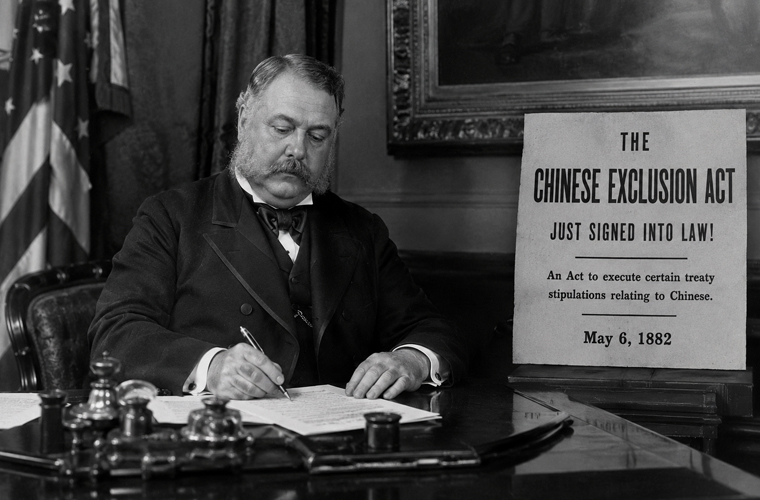
America’s First Major Immigration Restriction
On May 6, 1882, President Chester A. Arthur signed the Chinese Exclusion Act into law, marking a pivotal and controversial turning point in U.S. immigration history. It was the first federal legislation to significantly restrict voluntary immigration to the United States based on nationality and race, rather than individual qualifications. The Act suspended immigration from China for ten years, barred Chinese nationals already in the country from naturalizing as American citizens, and imposed strict controls on the entry and re-entry of Chinese laborers and other nationals.
Historical Context and Rising Tensions
The roots of the Act trace back to the mid-19th century. Following the California Gold Rush of 1849, large numbers of Chinese immigrants—primarily young men from Guangdong province—arrived on the West Coast seeking economic opportunity. They worked in gold mines, on railroads (notably the Transcontinental Railroad), in agriculture, and in service industries such as laundries and restaurants. Chinese workers were often willing to accept lower wages and harsher conditions, which made them attractive to employers but created fierce competition with white laborers.
As economic conditions fluctuated in the 1870s—marked by recessions, unemployment, and wage stagnation—resentment grew. Many white Americans, particularly in California and other Western states, viewed Chinese immigrants as an economic threat. Racist ideologies portrayed Chinese people as racially and culturally inferior, incapable of assimilation, and a danger to American society. Labor unions, politicians, and media outlets amplified these sentiments, blaming Chinese workers for depressing wages, taking jobs, and contributing to social ills. Anti-Chinese agitation, including the rise of groups like the Workingmen’s Party of California, created intense political pressure for restrictive measures.
Key Provisions and Immediate Impact
The 1882 Act specifically targeted “skilled and unskilled laborers” from China, though it included exemptions for merchants, diplomats, students, and their families. In practice, enforcement was harsh and often arbitrary. The law not only halted new arrivals but also made it extremely difficult for Chinese residents to leave the U.S. and return, effectively separating families and disrupting communities. Chinese immigrants were also denied the path to citizenship, leaving them politically powerless and vulnerable to discrimination.
The legislation legitimized and intensified existing prejudices. Chinese communities faced widespread hostility, including discriminatory local laws (such as special taxes and restrictions on housing and employment), verbal abuse, and physical violence. In the years following the passage, anti-Chinese incidents escalated. Notable outbreaks occurred in places like Rock Springs, Wyoming (1885), where a mob killed dozens of Chinese miners and drove others from their homes, and in smaller communities across Idaho and Washington Territory. Many Chinese Americans lived in fear, retreating into segregated Chinatowns for safety.
Extensions and Entrenchment
What began as a temporary measure became deeply embedded in American law. In 1892, Congress passed the Geary Act, extending the exclusion for another ten years and introducing new requirements, such as mandatory registration certificates for Chinese residents (with deportation as punishment for non-compliance). Then, in 1902, lawmakers made the exclusion permanent and expanded its discriminatory scope. Subsequent legislation and court rulings further tightened restrictions, creating a comprehensive system of anti-Chinese immigration controls that lasted for decades.
The ban was partially eased during World War II, when China became a U.S. ally against Japan. The Magnuson Act of 1943 repealed the core exclusion provisions, allowed a small annual quota of Chinese immigrants (just 105 per year), and permitted Chinese residents to naturalize. However, meaningful large-scale Chinese immigration only resumed with the landmark Immigration and Nationality Act of 1965, which abolished the old national-origins quota system in favor of family reunification and skills-based criteria. This shift dramatically transformed U.S. demographics and revitalized Chinese-American communities.
Legacy and Broader Significance
The Chinese Exclusion Act stood as a stark example of how economic fears, racial prejudice, and political opportunism could shape national policy. It set a precedent for future immigration restrictions based on nationality or ethnicity and reflected deeper contradictions in America’s identity as a nation of immigrants. While Chinese immigrants and their descendants endured decades of systemic discrimination, they also built resilient communities, contributed enormously to American society in fields ranging from science and technology to culture and entrepreneurship, and fought successfully for civil rights.
Today, the Act serves as a reminder of the challenges immigrants continue to face. Many groups throughout history—and in the present—have encountered similar barriers rooted in economic anxiety, cultural fears, and racial or ethnic bias. Understanding this chapter encourages reflection on how societies balance border security, economic needs, and the principles of fairness and opportunity that define the American experiment. The repeal and reform of these laws in the mid-20th century ultimately strengthened the United States by embracing greater diversity and talent from around the world.