
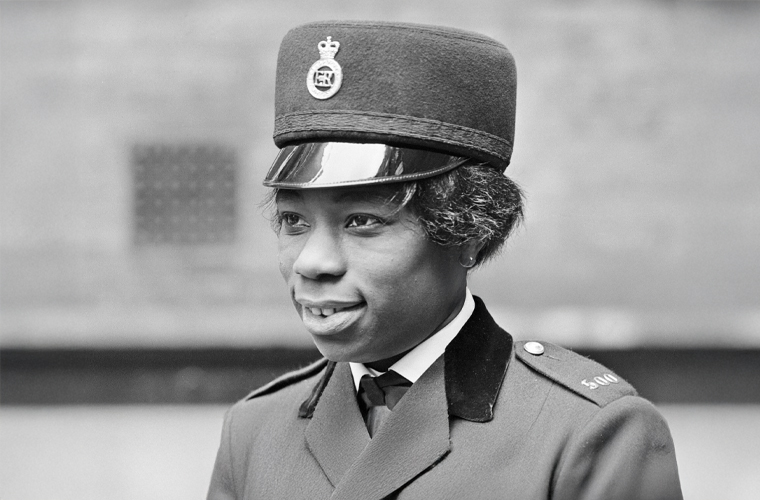
Sislin Fay Allen (née Patterson; 20 March 1938 – 5 July 2021), commonly known as Fay Allen, was a pioneering British-Jamaican police officer. She became the first Black woman to serve as a police constable in the United Kingdom, joining the Metropolitan Police Service (the Met) in London in 1968. Her recruitment marked a significant milestone in the diversification of British policing during a period of social change and increasing Commonwealth immigration. After four years with the Met, she continued her law enforcement career with the Jamaica Constabulary Force. In 2020, she received a lifetime achievement award from the National Black Police Association for her trailblazing contributions. A police training centre in the UK was later named in her honour.
Sislin Fay Allen was born in St. Catherine Parish, Jamaica (then part of the British West Indies), on 20 March 1938 (some sources cite 1939). She was the second youngest of 10 children. Growing up in Jamaica, she developed a sense of resilience and community that would later define her professional path. In 1961 or 1962, as part of the Windrush Generation, Allen moved to the United Kingdom. Like many Caribbean migrants invited to help rebuild post-war Britain, she settled in the London area and initially worked as a nurse at Queen’s Hospital in Croydon, south London. She was a mother of two at the time she decided to change careers.
Joining the Metropolitan Police (1968)
While working as a nurse, Allen spotted a newspaper advertisement recruiting male and female police officers. At age 29–30, she applied and was accepted. In February 1968, she began training and soon made national headlines as Britain’s first Black female police constable. Her appointment generated significant media attention, both positive and challenging, reflecting the racial dynamics of late-1960s Britain.
She was based at Croydon police station. Allen later reflected that she “didn’t set out to make history” but simply wanted to serve the community. She described herself as an ordinary person doing her job, despite the extra scrutiny she faced as a visible pioneer. During her service with the Met (1968–1972), she encountered both support and instances of racism, inside and outside the force. Her presence helped normalize the idea of Black women in British policing and inspired future generations. She served for four years before returning to Jamaica.


.
Later Career and Return to Jamaica
After leaving the Metropolitan Police, Allen joined the Jamaica Constabulary Force (JCF), where she continued her law enforcement career. Details of her specific roles and tenure in the JCF are less well documented, but her transition underscored her lifelong commitment to public service. She eventually retired and lived in Jamaica. In later years, she received recognition for her groundbreaking role. In 2020, the National Black Police Association presented her with a lifetime achievement award. Her story has been featured in Black History Month celebrations, educational resources, and media profiles highlighting diversity in UK institutions.
Sislin Fay Allen died on 5 July 2021 at her home in Ocho Rios, Jamaica, aged 83 (or 81–82 depending on the exact birth year cited). Her family described her as an inspiration who paved the way for others without seeking the spotlight.
Her legacy endures through several tributes:
- In 2022, the College of Policing named a new training centre the Sislin Fay Allen Training Centre in her honour, recognizing her as the first Black female police officer in the UK.
- She is frequently profiled during Black History Month as a symbol of courage and progress in British law enforcement.
- Archival materials, including letters and documents from her training period, are preserved by institutions like The National Archives.
- Her story appears in educational resources, documentaries, and articles that explore the experiences of Black pioneers in the UK.
Allen’s career demonstrated quiet determination amid societal barriers. As a former nurse turned police officer, she bridged healthcare and public safety while challenging racial and gender norms in a traditionally white, male-dominated profession.
Allen was married (hence the surname Allen) and had at least two children by the time she joined the police. She maintained ties to both the UK and Jamaica throughout her life, embodying the transnational identity common among Windrush-era migrants. She preferred to be seen as a dedicated public servant rather than a “civil rights icon,” though history has rightly celebrated her pioneering status.
At a time when the British police force was overwhelmingly white and male, Sislin Fay Allen’s entry in 1968 was a visible step toward inclusivity. Her recruitment came amid broader social shifts, including the Race Relations Act and the growth of Commonwealth communities in urban Britain. While she faced prejudice, her professionalism helped open doors for subsequent Black and minority ethnic officers, particularly women. Today, her name is invoked in discussions of diversity in policing, representation, and the contributions of Caribbean migrants to British society. The naming of a training centre after her ensures that new generations of officers learn about the barriers broken by early pioneers like Fay Allen.
Sislin Fay Allen remains a powerful example of how one individual’s decision to apply for a job advertised in the newspaper can ripple through history, inspiring change long after the uniform is hung up. Her life illustrates the intersection of migration, public service, and social progress in 20th-century Britain and Jamaica.