
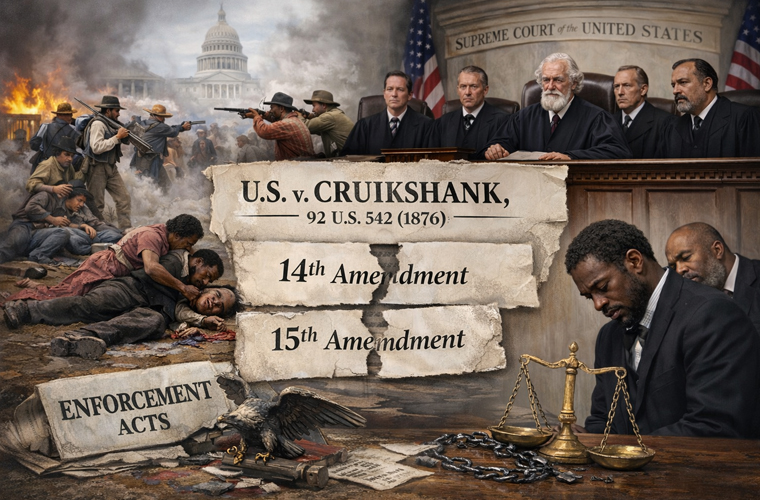
United States v. Cruikshank, 92 U.S. 542 (1876) is a landmark U.S. Supreme Court decision from the Reconstruction Era that significantly limited federal authority to protect the civil rights of African Americans against private violence, particularly in the South. It arose directly from the Colfax Massacre and represented a major setback for federal enforcement of the Fourteenth and Fifteenth Amendments and the Enforcement Acts.
Historical Background and the Colfax Massacre
The case stemmed from the contested 1872 Louisiana gubernatorial election, in which Republican candidates (supported by Black voters) claimed victory amid widespread fraud and violence by white Democratic paramilitary groups, including the White League and remnants of the Ku Klux Klan. In majority-Black Grant Parish, Louisiana, disputes over local control led Black Republicans and freedmen to occupy the parish courthouse in Colfax to defend their elected officials.
On Easter Sunday, April 13, 1873, a large armed white militia—estimated at around 150–300 men, far better equipped and led by figures including William J. Cruikshank—surrounded the courthouse. After a battle, the Black defenders (roughly 150–300, including women and children seeking refuge) surrendered under a flag of truce. Many were then massacred as they disarmed: estimates of Black deaths range from 62 to over 150 (some bodies were thrown into the Red River or hidden in mass graves), with reports of executions of prisoners hours later. Three white attackers died. It is often called the bloodiest single act of violence during Reconstruction.
Federal authorities responded under the Enforcement Act of 1870 (also known as the Ku Klux Klan Act), which criminalized conspiracies by two or more persons to deprive citizens of rights secured by the U.S. Constitution or laws. U.S. Attorney James Beckwith indicted 97 men; nine were arrested and tried amid extraordinary security challenges, including threats and violence against witnesses and officials. Only three—William J. Cruikshank, John Hadnot, and William Irwin—were convicted by a mostly white jury on counts related to conspiring to deprive victims (specifically Levi Nelson and Alexander Tillman) of rights, including peaceable assembly (First Amendment), bearing arms (Second Amendment), due process and equal protection (Fourteenth Amendment), and voting rights.
The convictions occurred in the federal circuit court. Defendants moved for an arrest of judgment, arguing the indictments were insufficient and that the federal government lacked jurisdiction. Circuit Judge William B. Woods and Supreme Court Justice Joseph P. Bradley (sitting as circuit justice) split: Bradley’s influential circuit opinion held that the Enforcement Act did not reach private conspiracies absent clear state action or specific federal rights violations, emphasizing the state action doctrine. This led to certification to the full Supreme Court.
The Supreme Court Decision
On March 27, 1876, the Supreme Court unanimously reversed the convictions in an opinion by Chief Justice Morrison R. Waite (joined by the full Court, though some nuances existed in concurrences or alignments). The Court held that the indictments were defective and that the federal charges failed because the rights allegedly violated were not ones the federal government could directly enforce against private individuals in this manner.
Key Holdings and Reasoning (from Waite’s opinion):
- Dual Citizenship and Limited Federal Power: There are distinct state and national citizenships. The U.S. government protects only rights expressly or impliedly under its jurisdiction; others remain with the states. “The Government of the United States… can neither grant nor secure to its citizens rights or privileges which are not expressly or by implication placed under its jurisdiction.”
- First Amendment (Assembly): The right to peaceably assemble existed pre-Constitution and is protected against federal infringement, but the First Amendment does not limit state governments or private actors. Protection against private interference lies with the states.
- Second Amendment (Bear Arms): “The right… to bear arms… is not a right granted by the Constitution. Neither is it in any manner dependent upon that instrument for its existence. The second amendment declares that it shall not be infringed; but this… means no more than that it shall not be infringed by Congress. This is one of the amendments that has no other effect than to restrict the powers of the national government…” The Court viewed it as a pre-existing right for lawful purposes, not created by the Constitution.
- Fourteenth Amendment (Due Process and Equal Protection): These clauses restrict state action only (“No State shall…”), not private individuals. “It simply furnishes an additional guaranty against any encroachment by the States upon the fundamental rights which belong to every citizen as a member of society. The duty of protecting all its citizens in the enjoyment of an equality of rights was originally assumed by the States, and it remains there.” The Amendment does not empower Congress to punish private violations directly.
- Fifteenth Amendment and Voting: It prohibits racial discrimination in voting by states but does not create a general federal right to vote (which comes from states) or directly punish private interference without specific allegations of racial motivation tied to federal enforcement. The indictments were too vague and general, failing to specify that the conspiracy targeted rights “granted or secured by the Constitution or laws of the United States” with the required intent.
The Court did not reach the full merits in a way that addressed race explicitly in the opinion, treating it as a matter of federalism and pleading deficiencies.
Significance and Legacy
Cruikshank was a devastating blow to Reconstruction. By narrowing the v and adopting a strict “state action” requirement for the Fourteenth Amendment, it effectively left Black citizens in the South vulnerable to white supremacist violence, as hostile Democratic state governments rarely prosecuted such acts. It contributed to the end of federal intervention, the rise of Jim Crow, disenfranchisement, and lynchings in the following decades. Historians like Eric Foner describe it as enabling further terrorism.
Jurisprudentially, it reinforced the Slaughter-House Cases (1873) narrow reading of the Fourteenth Amendment’s Privileges or Immunities Clause and established precedents against direct incorporation of most Bill of Rights protections against the states (later partially overturned). The First Amendment assembly right was incorporated in De Jonge v. Oregon (1937); the Second Amendment in McDonald v. Chicago (2010), which overruled Cruikshank’s non-incorporation holding while citing its view of the right as pre-existing.
Modern discussions, especially in Second Amendment cases like District of Columbia v. Heller (2008), reference Cruikshank for the idea that the right to bear arms is not dependent on the Constitution but pre-existing, though its state-action limits no longer fully control.
Critics, including some legal historians, argue that Cruikshank (along with the Civil Rights Cases of 1883) betrayed the Reconstruction Amendments’ promise, prioritizing federalism and states’ rights over protecting freedmen’s lives and liberties. It remains a symbol of the Supreme Court’s retreat from civil rights enforcement in the late 19th century.
United States v. Cruikshank highlighted the tension between federal power and states’ rights in the post-Civil War era. While framed in terms of constitutional structure, its practical effect was to undermine protections for African Americans, accelerating the demise of Reconstruction and shaping American race relations for generations. It stands as a pivotal, if sobering, chapter in the ongoing struggle to define the scope of the Fourteenth Amendment and federal civil rights enforcement.