
A Complex Historical Relationship
The relationship between enslaved people and Christianity spans two millennia and is marked by profound tension. Christianity emerged in a world where slavery was widespread and largely unquestioned. Over time, the faith was used both to justify bondage and to inspire resistance, conversion, community, and eventual abolitionist movements. Enslaved people themselves often adopted and reshaped Christianity into a distinctive tradition that offered spiritual freedom amid physical oppression.
Slavery in the Biblical and Early Christian World
Slavery existed across ancient Near Eastern, Greek, Roman, and Jewish societies long before Christianity. The Hebrew Bible regulated rather than abolished it. Israelite (Hebrew) slaves were to be released after six years or in the Jubilee year and treated more like hired workers, while non-Israelite slaves could be held permanently and passed as property (Exodus 21; Leviticus 25:39–46). The narrative of Israel’s own enslavement in Egypt and liberation by God became a foundational story of divine deliverance.
In the New Testament, Jesus does not directly condemn the institution of slavery, which was a pervasive social reality. The Apostle Paul instructs slaves to obey their earthly masters “with sincerity of heart and reverence for the Lord” (Ephesians 6:5–8; Colossians 3:22–25) while also commanding masters to treat slaves justly and without threats (Colossians 4:1; Ephesians 6:9). He affirms the spiritual equality of all believers: “There is neither Jew nor Gentile, neither slave nor free, nor is there male and female, for you are all one in Christ Jesus” (Galatians 3:28). In the short letter to Philemon, Paul urges a master to receive the runaway slave Onesimus “no longer as a slave, but better than a slave, as a dear brother.” Early Christians included many slaves and freed people; the faith’s emphasis on the equal value of every soul before God attracted them even as the institution itself continued.
Church Fathers such as Augustine viewed slavery as a consequence of sin in a fallen world rather than a natural or ideal state. Christianity did not abolish Roman slavery, but it gradually contributed to its decline in late antiquity through emphasis on human dignity, charity, manumission (especially of Christian slaves), and changing economic and demographic conditions.
Medieval and Early Modern Developments
In medieval Europe, slavery persisted in various forms (including serfdom), and Christians both held and were held as slaves—particularly in the Mediterranean, where Muslim corsairs enslaved hundreds of thousands of European Christians between the 16th and 18th centuries. The Church sometimes regulated or mitigated the practice and occasionally condemned the enslavement of fellow Christians, while also justifying the enslavement of non-Christians captured in “just wars.”
With the Portuguese and Spanish expansion into Africa and the Americas from the 15th century, Christian authorities issued mixed signals. Some papal documents permitted the enslavement of non-Christians; others, such as those of Eugenius IV (1435), Pius II (1462), and Paul III (1537), condemned the enslavement of certain peoples or demanded better treatment and conversion. In practice, European Christian powers became deeply involved in the Atlantic slave trade. Baptism of the enslaved was sometimes encouraged as a means of “civilizing” them, yet colonial laws quickly clarified that conversion did not confer legal freedom.
Christianity and the Enslaved in the Americas
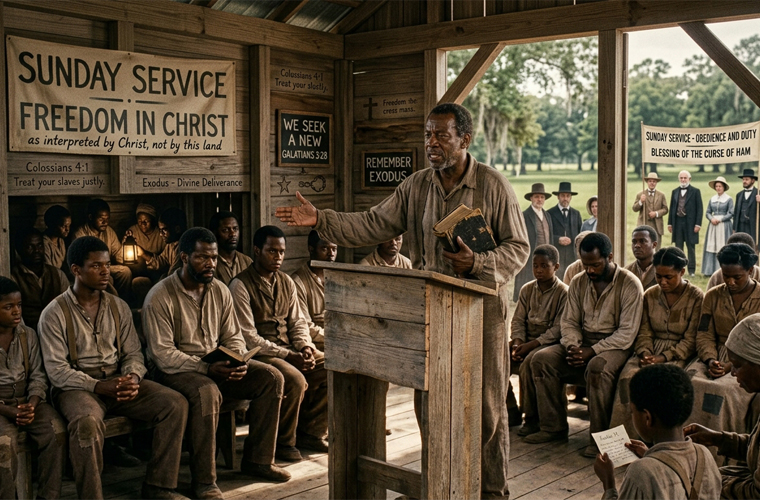
In British North America and the Caribbean, planters initially resisted the conversion of enslaved Africans. They feared that baptism might imply equality or freedom under English law, and they associated Christianity with English identity. By the early 18th century, colonial legislatures passed laws declaring that baptism did not alter a slave’s status. Missionaries then developed “slave catechisms” that stressed obedience, the Curse of Ham (a distorted reading of Genesis 9 that falsely linked blackness with perpetual servitude), and passages such as Ephesians 6:5.
The First and Second Great Awakenings changed the dynamic. Evangelical Protestantism—emphasizing personal conversion, emotional experience, and the equality of souls—spread among the enslaved. Many Africans and their descendants encountered Christianity under coercion, yet large numbers embraced it. They found in the Bible stories of liberation (the Exodus, Daniel in the lions’ den, the suffering and resurrection of Jesus) that resonated with their own condition. Spirituals blended African musical forms with Christian themes, expressing sorrow, hope, coded messages of resistance, and a theology of divine deliverance.
Enslaved people created “invisible institutions”—secret gatherings for worship—and, where possible, independent Black congregations. These spaces fostered literacy, leadership, mutual aid, and sometimes plans for revolt. Figures such as Nat Turner drew on apocalyptic biblical imagery. After emancipation, the independent Black church became a central institution of African American life, culture, and political organization.
Slaveholders and pro-slavery clergy continued to defend the institution as biblically sanctioned and even benevolent, arguing that it brought the gospel to Africans. Southern denominations split from their Northern counterparts over the issue. Abolitionists, many of them devout Christians (Quakers early on, later Methodists, Baptists, Presbyterians, and evangelicals), countered with the Golden Rule, the spiritual equality of Galatians 3:28, the Exodus narrative, and the conviction that American chattel slavery—race-based, hereditary, and often brutal—violated the spirit of the gospel. Black Christians such as Frederick Douglass sharply distinguished “the Christianity of Christ” from the “slaveholding… hypocritical Christianity of this land.”
Dual Legacy
Christianity did not invent slavery, nor did it uniquely sustain it; the institution was nearly universal in the ancient and early modern worlds. Yet Christian texts and institutions were widely used to rationalize Atlantic slavery. At the same time, the same faith supplied the moral language, organizational networks, and eschatological hope that fueled major abolitionist campaigns in Britain and the United States. Enslaved people were not passive recipients. They selectively appropriated Christian teachings, fused them with African spiritual traditions, and forged a resilient, liberation-oriented Christianity that endured long after formal emancipation.
The history of the enslaved and Christianity therefore resists simple narratives of pure oppression or pure liberation. It is a story of accommodation and resistance: texts used for control and texts reclaimed for freedom, and a faith that both reflected the hierarchies of its time and contained resources that ultimately helped undermine them.