
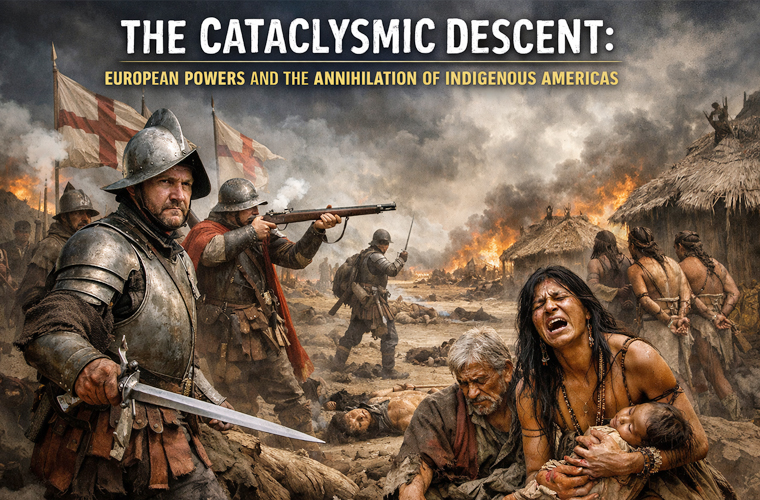

European Powers and the Annihilation of Indigenous Americas
In 1492, Christopher Columbus’s voyages marked the dawn of European colonization in the Americas, unleashing a torrent of destruction upon indigenous civilizations that had flourished for millennia. What followed was not mere exploration but a systematic onslaught that decimated populations through three intertwined forces: catastrophic disease, deliberate genocide, and mass displacement. Pre-Columbian estimates place the indigenous population at 50-100 million across the continents, a vibrant mosaic of societies from the urban empires of the Aztecs and Incas to the diverse tribes of North America. By the 19th century, this number had plummeted to under 250,000 in North America alone, with losses in Central and South America reaching 90% or more. This article examines these mechanisms, drawing on historical records to illuminate the human cost and enduring legacy of this era.
The Invisible Reaper: Disease as Demographic Catastrophe
The most devastating weapon in Europe’s arsenal was unintentional—or in some cases, intentional—biological warfare. Indigenous peoples, isolated from the Old World for 15,000 years, possessed no immunity to Eurasian pathogens. Smallpox, measles, influenza, typhus, and diphtheria arrived with the first ships, spreading like wildfire through trade networks and conquests.
Epidemics ravaged populations before armies could fully engage. In 1518, smallpox struck the Caribbean, killing up to 90% of the Taíno people within decades; by 1520, it had reached the Aztec Empire, weakening it just as Hernán Cortés arrived. Waves followed: typhus in 1546, influenza and measles in 1558, and diphtheria in 1614. Historians estimate 10-100 million deaths from disease alone, reducing the Americas‘ population by 80-95% by 1650. In North America, where pre-contact numbers hovered around 10 million, smallpox epidemics in the 17th and 18th centuries erased entire villages, fracturing alliances and easing European encroachment.
Compounding this, colonial practices accelerated mortality. Forced labor in mines and plantations, such as Spain’s Potosí silver works, exposed survivors to famine and overwork, killing more through exhaustion than infection. Even deliberate acts emerged: In 1763, British forces under Jeffery Amherst distributed smallpox-infected blankets to Delaware and Shawnee tribes, a tactic echoing later U.S. Army bounties for Native scalps. Disease did not merely kill; it destabilized societies, paving the way for conquest by sowing chaos in kinship networks and leadership.
Blades and Bullets: Genocide Through Conquest and Policy
Beyond microbes, European powers wielded violence with genocidal intent, as defined by the UN Genocide Convention: acts to destroy, in whole or in part, national, ethnic, or racial groups. Spanish conquistadors set the template, blending religious zeal with imperial greed.
In 1519-1521, Cortés’s 600 men, allied with rival indigenous groups, toppled the Aztec Empire. The siege of Tenochtitlan claimed 240,000 lives—100,000 in combat alone—through artillery, steel, and horses alien to Mesoamerica. Disease had already halved the Aztecs’ 25 million, but massacres like those at Cholula (3,000-6,000 killed) were premeditated. Similarly, Francisco Pizarro’s 1532 betrayal of Inca emperor Atahualpa led to the empire’s fall; executions, enslavement, and civil wars engineered by the Spanish reduced the Inca population from 10 million to under 1 million by 1600.
In North America, British and French colonists exploited tribal rivalries, fueling wars like the Beaver Wars (1640-1701), where Iroquois forces, armed by Dutch traders, decimated Huron populations. The 1637 Pequot War saw English Puritans burn 700 Pequots, including women and children, in a single night at Mystic, Connecticut—a massacre justified as divine retribution. U.S. expansion under Manifest Destiny escalated this: The California Genocide (1846-1873) killed 9,000-16,000 Native Californians through bounties and militias, while the Sand Creek Massacre (1864) slaughtered 200 Cheyenne and Arapaho, mostly non-combatants.
Policies institutionalized death. Spain’s encomienda system bound indigenous labor to settlers under the guise of “protection,” devolving into slavery; the 1542 New Laws curbed abuses but were evaded. France’s Jesuit missions in New France converted thousands but isolated communities, fostering vulnerability. Portugal’s Brazilian bandeirantes raided inland tribes for slaves, while Russia’s Alaskan fur trade forced Aleuts into lethal labor. These acts were not anomalies but the machinery of empire, targeting cultural erasure alongside bodies—burning codices, toppling pyramids, and imposing Christianity.
Uprooted and Erased: Displacement and Cultural Exile
Displacement weaponized geography against survival, severing ties to ancestral lands essential for identity and sustenance. The 1494 Treaty of Tordesillas divided the Americas between Spain and Portugal, ignoring indigenous sovereignty and igniting land grabs.
In the U.S., the 1830 Indian Removal Act epitomized this horror. The Trail of Tears forcibly marched 60,000 from the “Five Civilized Tribes” (Cherokee, Choctaw, Chickasaw, Creek, Seminole) from southeastern homelands to Oklahoma. Harsh winter conditions, inadequate supplies, and guard brutality killed 15,000—25% of the Cherokee alone. This was no isolated tragedy; over 100,000 faced similar “removals” in the 1830s-1840s, with treaties routinely broken for gold rushes and railroads. The Long Walk of the Navajo (1864) echoed it, displacing 8,500 to Bosque Redondo, where 2,000 perished from disease and starvation.
Southward, Spanish reducciones herded tribes into missions, like California’s 21 Franciscan outposts (1769-1833), where 60,000 were confined; mortality hit 80% from overwork and abuse. Reservations became prisons: Barren plots stripped resources, as when U.S. hunters slaughtered 30 million bison (1830-1880) to starve Plains tribes. Cultural genocide persisted via boarding schools, where 100,000 children endured “Kill the Indian, save the man” policies—forced assimilation, abuse, and thousands of unmarked graves.
Legacy: Resilience Amid Ruins
The European descent reshaped the Americas irreversibly, birthing settler states on indigenous graves. Global repercussions included the Little Ice Age, as reforestation from depopulation cooled the planet. Today, 570 federally recognized tribes in the U.S. number 5.2 million, while Latin America’s 50 million indigenous people endure disparities in health, land rights, and violence. Yet resilience endures—from the Zapatista uprising in Mexico to land-back movements in Canada. Acknowledging this history demands not just remembrance but reparative justice, honoring the civilizations that predated and outlasted the invaders.
This era’s scars remind us: Conquest’s true cost was human, measured in lost languages, songs, and futures. As historian Andrés Reséndez notes, it was violence and extraction, not just germs, that forged the modern world.