
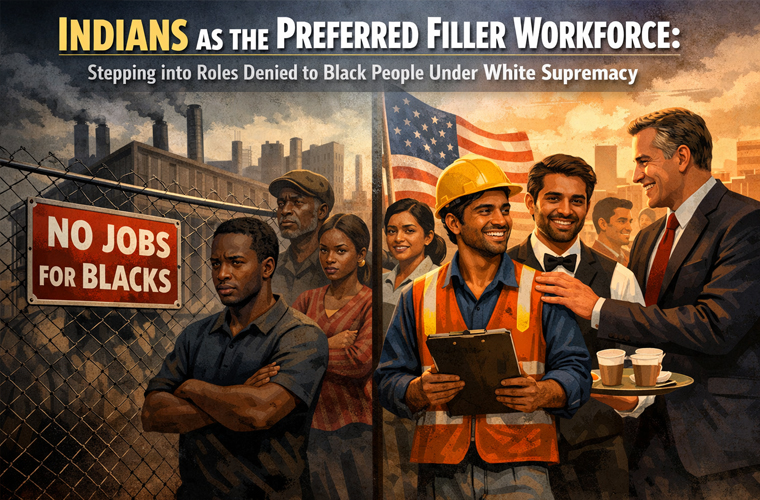

Stepping into Roles Denied to Black People Under White Supremacy
Throughout colonial and post-colonial history, Indians have repeatedly been positioned as the “go-to” or filler group for labor needs that white supremacist systems refused to grant equitably to Black communities. When freed Black people resisted exploitative conditions after slavery’s abolition, colonial powers turned to India for a controllable, cheap alternative—importing Indians to fill the exact roles Black workers were marginalized from accessing. This pattern of using Indians as strategic fillers persisted from indentured servitude in the Caribbean and Africa to modern skilled migration in Europe and North America. Indians endured harsh exploitation in these roles, but their recruitment often reinforced anti-Black hierarchies by undermining Black economic power and bargaining leverage.
The Caribbean: Indians Replacing and Undermining Freed Black Labor
After the British Empire abolished slavery in 1833 (with full emancipation by 1838), sugar plantations in the Caribbean faced a crisis: freed Black workers refused to return to the fields under the same brutal, low-wage conditions. They demanded fair pay, land ownership, or independence through subsistence farming—options colonial authorities and planters actively blocked through vagrancy laws, restricted land access, and wage suppression.
Instead of reforming the system to include Black communities fairly, planters explicitly recruited Indians as indentured laborers to flood the market, drive down wages, and crush Black resistance. Between 1838 and 1917, over half a million Indians were transported to colonies like Trinidad, British Guiana (Guyana), and Jamaica—primarily to perform the fieldwork, harvesting, and estate labor that Black people had done under slavery but now resisted or were denied equitable entry into.
Indians were bound by rigid five- to ten-year contracts with penal sanctions for “idleness” or desertion, making them a more “reliable” and controllable workforce in colonial eyes. Planters viewed Indians as more docile or industrious compared to freed Blacks, who were stereotyped as unreliable. This influx directly diminished Black bargaining power: with a surplus of indentured Indian labor, wages stayed low, and Black communities remained economically marginalized. Separate housing and ethnic divisions further prevented solidarity, allowing white planters to maintain dominance while Indians filled the labor void. Black people were prevented from dominating on fair terms.
In Africa: Indians as Intermediary Fillers in Plantations and Infrastructure
The dynamic repeated in Africa. In Natal (South Africa), starting in 1860, over 150,000 Indians arrived for sugar plantations when local Black Africans were deemed “unfit” for disciplined labor under racist stereotypes or displaced by land seizures and pass laws.
Indians filled agricultural and later commercial roles that segregationist policies blocked Black Africans from accessing. In East Africa, thousands of Indians built the Kenya-Uganda Railway (1895–1902), performing dangerous construction and operational work while granted intermediary privileges—like urban trading rights—denied to Black populations.
Colonizers preferred Indians for these tasks, positioning them as a buffer or middleman class in commerce, clerical jobs, and supervision. This filler role advanced colonial infrastructure and economy, but reinforced hierarchies: Indians occupied economic niches that Black people were systematically excluded from, perpetuating divisions that sustained white control.
Gandhi’s Early Role: Embracing the Intermediary Filler Position
Mahatma Gandhi’s time in South Africa (1893–1914) exemplifies how some Indians internalized this filler dynamic. Early on, Gandhi advocated for Indian rights by contrasting Indians with Africans, using derogatory terms like “kaffirs” and arguing Indians should not be “degraded” to the level of Black people, whom he described as “troublesome, very dirty,” and living “like animals.” He sought separate facilities and aligned with views of racial gradation, positioning Indians above Africans but below whites.
This reflected a tendency among some Indian elites to accept limited elevation within the system—gaining perks by reinforcing anti-Black racism—while still facing discrimination themselves. Gandhi later evolved beyond these views, but his early stance highlights how the filler role could lead to complicity in dividing non-white groups.
Modern Europe and North America: Skilled Indians Filling Selective Gaps
In contemporary times, Indians continue to be fillers through selective immigration policies favoring educated professionals. In North America (US and Canada) and Europe (UK, Germany), millions of Indians dominate tech, engineering, medicine, and finance via visas like H-1B or points-based systems.
These policies handpick skilled Indians—often upper-caste and highly educated—to fill labor shortages in high-growth sectors. While thriving (with high labor participation and earnings), this echoes historical patterns: Western economies recruit Indians for innovation and growth roles sometimes underserved domestically, where systemic barriers in education, hiring, and networks limit Black access.
Indians thus occupy “model minority” positions in desirable fields, sustaining economic utility but reviving debates about displacement and inequality rooted in selective criteria that bypass broader inclusion.
The Enduring Pattern of Indians as Fillers
Indians have consistently been tapped as the reliable, controllable alternative—whether indentured replacements for emancipated Black labor or skilled migrants addressing modern shortages. This was a calculated element of white supremacist frameworks: exclude and marginalize Black communities while exploiting another group to extract profit and maintain divisions.
Though Indians suffered coercion, abuse, and racism in these roles, the pattern often bolstered anti-Black structures. Confronting this history means acknowledging how racial capitalism pits marginalized groups against each other—and building solidarity to end such divisions once and for all.