
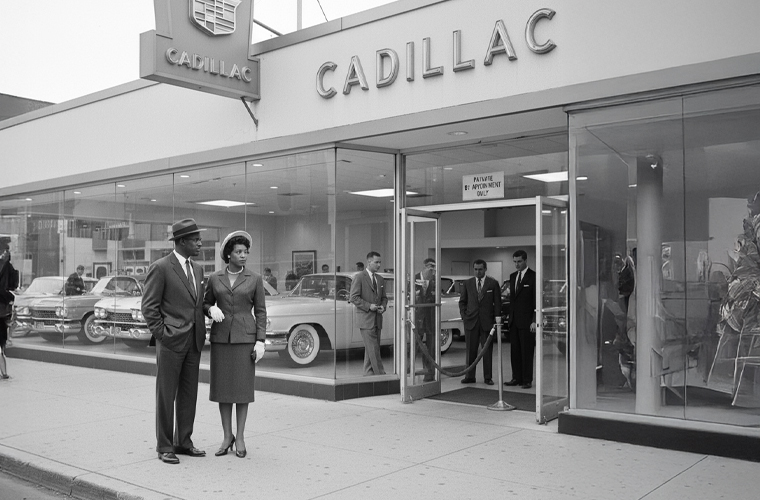
In the early to mid-20th century, racial discrimination permeated nearly every aspect of American life, including the automotive industry. During the Jim Crow era and beyond, luxury car brands like Cadillac often maintained policies—formal or informal—that limited or outright discouraged sales to Black Americans. Cadillac, as General Motors’ flagship luxury division, positioned itself as a symbol of prestige and exclusivity aimed primarily at affluent white buyers. To protect that image, the company and many of its dealers enforced practices that effectively barred Black customers from purchasing vehicles directly.
Cadillac’s discriminatory approach was not always codified in explicit company rules but operated as an unwritten policy or “de facto” guideline. Dealers were discouraged—even potentially penalized—for completing sales to Black buyers. The rationale was rooted in the era’s racism: executives feared that widespread visibility of Black owners would diminish the brand’s perceived status among white consumers. This reflected broader societal norms where luxury goods and status symbols were heavily segregated.
Affluent Black Americans—including entertainers, boxers, doctors, lawyers, and business owners—still coveted Cadillacs as one of the few attainable markers of success in a world that denied them access to exclusive neighborhoods, resorts, or other luxuries. Undeterred by the barriers, many resorted to workarounds: they paid white intermediaries (sometimes called “front men” or “straw buyers”) substantial premiums—often hundreds of dollars—to purchase the cars on their behalf. These vehicles would then appear for routine service at Cadillac dealerships, where service staff observed a surprising number of Black-owned Cadillacs despite the sales restrictions.
This phenomenon caught the attention of Nicholas Dreystadt, a German immigrant who rose to become head of Cadillac’s service operations in the early 1930s. As he traveled the country visiting dealership service departments during the Great Depression, Dreystadt noticed the pattern. Cadillac sales had plummeted—from over 41,000 units in 1928 to just around 6,700 by 1933—placing the division on the brink of discontinuation by General Motors.
Dreystadt saw an untapped opportunity. He argued that Black buyers were already demonstrating strong demand and willingness to pay extra to own Cadillacs. Why let middlemen profit when Cadillac could sell directly? In a bold move, he reportedly interrupted a high-level GM executive meeting to present his case. He urged the company to drop its discriminatory stance and encourage dealers to sell openly to Black customers.
GM executives, facing few better options amid the economic crisis, agreed. Around 1933–1934, Cadillac officially stopped discouraging sales to Black buyers, making it one of the earlier American car brands to shift away from such exclusionary practices. Dealers were instructed to lift any “white only” sales barriers. Sales reportedly surged by about 70% in 1934, helping the division break even and avoid shutdown. Dreystadt was promoted to head the entire Cadillac Division in June 1934.
However, change was uneven and incomplete. While the corporate policy shifted, individual dealers—especially in the segregated South—often continued discriminatory practices well into later decades. Personal accounts from the 1950s and 1960s describe Black customers in places like New Orleans being turned away or treated as unwelcome, sometimes only entering dealerships as janitorial staff. Full integration of sales practices lagged behind the initial policy change, mirroring the slow erosion of Jim Crow laws nationwide.
This chapter in Cadillac’s history highlights a complex intersection of racism, economics, and resilience. Black consumers’ determination to claim symbols of achievement helped force a corporate pivot that benefited the brand during its darkest hour. Over time, Cadillac became strongly associated with Black culture and aspiration—from mid-century status symbols to modern icons like the Escalade—transforming a once-exclusionary luxury marque into one with deep ties to African American identity.
The story underscores how systemic barriers persisted in everyday commerce long after legal segregation began to crumble, and how consumer demand could sometimes challenge entrenched prejudice when corporate survival was at stake.