
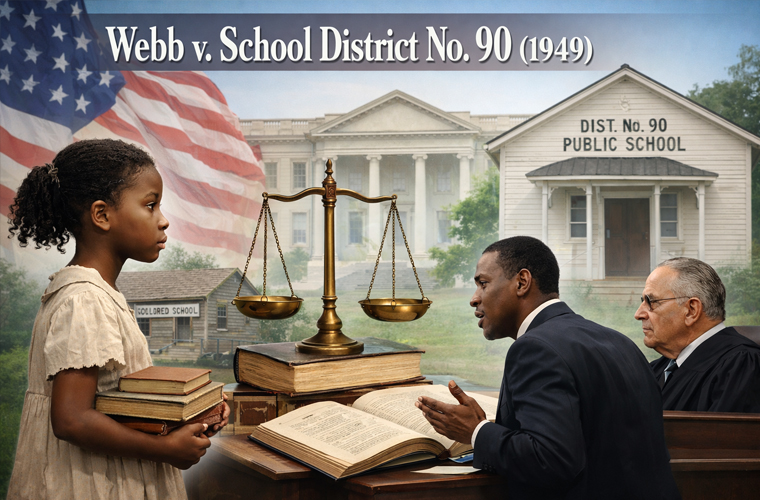
A Landmark Step Toward School Desegregation in Kansas
In the post-World War II era, as suburban communities in the United States grew rapidly, issues of racial segregation in public education remained deeply entrenched in many parts of the country, including states like Kansas that permitted segregation under certain conditions. One significant but often underrecognized legal challenge to this system occurred in Johnson County, Kansas, near the town of Merriam (now a suburb of Kansas City). The case, Webb v. School District No. 90, decided by the Kansas Supreme Court in 1949, marked an important local victory for educational equality and helped pave the way for the national desegregation movement that culminated in Brown v. Board of Education five years later.
Background: Segregation in Johnson County Schools
School District No. 90 in Johnson County operated under Kansas law, which allowed segregation in elementary schools in certain cities (like Topeka) but required that separate facilities be equal. In the South Park area near Merriam, African American children had long attended the outdated Walker School (also known as Madam C.J. Walker School), built in 1888. This one-room schoolhouse was poorly maintained, lacked modern facilities, and stood in stark contrast to the educational opportunities provided to white students.
After World War II, population growth prompted the district to construct a new, modern elementary school—South Park Elementary—for $90,000. Completed in 1947, the school was intended for white children only. When African American families attempted to enroll their children, they were denied admission solely based on race. This exclusion highlighted the inequality: Black students were relegated to an inferior, century-old facility while a brand-new school remained off-limits to them.
The Plaintiffs and the Fight Begins
Led by parents, including members of the Webb family, a group of 39 African American students and their guardians refused to accept the status quo. They withdrew their children from Walker School, hired its teacher, Corinthian Nutter, and established a makeshift “home school” to continue their education. The effort gained crucial support from Esther Brown, a white Jewish housewife from Merriam who became a tireless advocate for racial justice in education. Brown worked closely with the families, helped raise funds, and urged legal action.
Attorney Elijah Scott took the lead in filing the lawsuit. The case was brought as an original action in mandamus in the Kansas Supreme Court, seeking to compel the school district to admit the Black students to South Park Elementary School or provide truly equal facilities.
The Kansas Supreme Court’s Decision
In 1949, the Kansas Supreme Court ruled in favor of the plaintiffs (*Webb v. School District No. 90*, 167 Kan. 395). The court found that the school district had unlawfully denied admission based on race and that the separate facilities at Walker School were not equal to those at the new South Park School. While the decision did not declare segregation itself unconstitutional (that would come later with *Brown*), it enforced the “equal” part of “separate but equal” under Kansas law and precedent.
The ruling required the district to provide equal educational opportunities for all children, regardless of race. Following the decision, the school board admitted Black students to South Park Elementary, effectively integrating the facility.
Significance and Legacy
Webb v. School District No. 90 stands as a precursor to the broader civil rights struggle in education. The case demonstrated that challenges to unequal facilities could succeed even in states with permissive segregation laws. Esther Brown’s involvement bridged racial divides and inspired continued activism; she later supported the NAACP’s efforts in Topeka that led to Brown v. Board of Education.
The victory in Johnson County showed that community organizing, legal persistence, and cross-racial alliances could force change. The South Park case is now recognized as part of the pre-*Brown* desegregation efforts. In recent years, efforts have been made to incorporate its history into the Brown v. Board of Education National Historical Park, highlighting its role in the fight against segregated schooling.
Today, the legacy endures through historic markers, community remembrance, and the descendants of the Webb family and others involved. The 1949 ruling remains a powerful reminder that local battles for equality often lay the groundwork for national transformation.
This case underscores a key truth in American civil rights history: progress frequently begins with ordinary families refusing to accept injustice in their children’s education.