
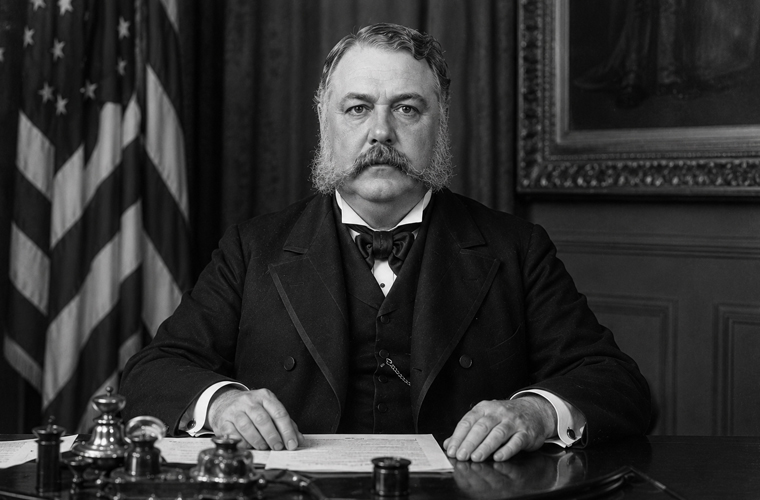
Chester A. Arthur (1829–1886) served as the 21st President of the United States from 1881 to 1885. He is often remembered as one of the most unexpected and surprisingly effective presidents in American history. This machine politician rose to the highest office after an assassination and then championed civil service reform. Born on October 5, 1829, in Fairfield, Vermont, Chester Alan Arthur was the son of a Baptist minister from Ireland and a Vermont mother. He graduated from Union College in Schenectady, New York, in 1848, taught school briefly, and then studied law. Arthur was admitted to the bar in 1854 and built a successful legal practice in New York City, where he became active in Republican politics.
During the Civil War, Arthur served as quartermaster general for the New York militia, efficiently supplying and equipping thousands of troops. After the war, he became a key figure in the Republican Party’s Stalwart faction, which supported the patronage (spoils) system. In 1871, President Ulysses S. Grant appointed him Collector of the Port of New York—one of the most powerful and lucrative federal positions at the time. Arthur held the post until 1878, when President Rutherford B. Hayes removed him as part of an effort to clean up customs corruption. This episode made Arthur a symbol of the old patronage system. In 1880, the Republican National Convention nominated James A. Garfield for president. To balance the ticket between the Stalwart and Half-Breed factions, Arthur was chosen as the vice-presidential candidate. The Garfield-Arthur ticket won the election.
Presidency (1881–1885)
On July 2, 1881, Garfield was shot by Charles Guiteau, a deranged office-seeker. Garfield lingered for weeks before dying on September 19. Arthur was sworn in as president the next day. Many reformers feared Arthur would protect the corrupt patronage machine. Instead, he surprised the nation by distancing himself from the Stalwarts and supporting reform. In 1883, he signed the Pendleton Civil Service Reform Act, which created a merit-based system for federal jobs and sharply curtailed the spoils system. He also enforced the law vigorously, even firing officials from his own party.
Other notable actions during his presidency include:
- The Chinese Exclusion Act of 1882 was the first major law to restrict immigration based on nationality.
- Beginning the modernization of the U.S. Navy, replacing outdated wooden ships with steel vessels.
- Vetoing a large pork-barrel rivers and harbors bill, demonstrating fiscal restraint.
- Supporting efforts to protect federal lands and improve the postal service.
Arthur was known for his elegant style—he owned over 80 pairs of trousers, redecorated the White House lavishly, and hosted refined social events. This earned him the nickname “Gentleman Boss” or “Elegant Arthur.” Arthur ran for re-election in 1884 but was not renominated; the Republicans chose James G. Blaine instead. After leaving office, his health declined rapidly due to Bright’s disease (a kidney ailment). He died on November 18, 1886, at age 57, in New York City.
Though often overlooked in popular memory, historians have increasingly viewed Chester A. Arthur favorably. He entered office with low expectations but left a lasting mark through civil service reform, helping to professionalize the federal government. His transformation from patronage politician to reformer remains one of the more remarkable chapters in presidential history.
Notable Quote: I may be President of the United States, but my private life is nobody’s damned business.” — Chester A. Arthur
A stylish, dignified Vermonter-turned-New Yorker who exceeded expectations when given the ultimate responsibility.