
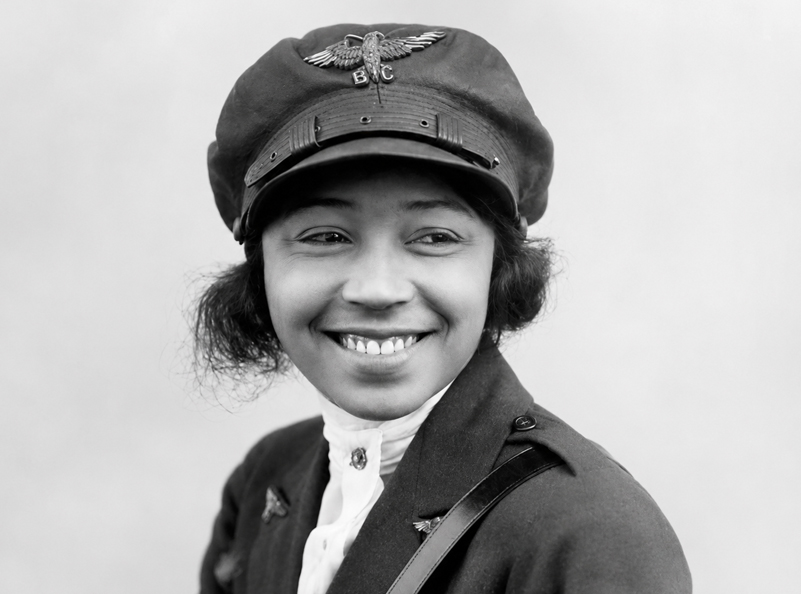
Bessie Coleman (January 26, 1892 – April 30, 1926) was a pioneering American aviator. She became the first African American woman and the first Native American woman to earn an international pilot’s license, as well as the earliest known Black person to do so. Elizabeth “Bessie” Coleman was born on January 26, 1892, in Atlanta, Texas, the tenth of thirteen children born to George and Susan Coleman. Her father was a sharecropper of African American and Native American (likely Cherokee or Choctaw) descent, while her mother was African American. The family faced poverty and racial discrimination in the post-Reconstruction South.
When Bessie was young, the family moved to Waxahachie, Texas. She helped pick cotton and do laundry to support the household. Her father eventually left for Indian Territory (Oklahoma), seeking better opportunities, but her mother stayed in Texas with the younger children. Bessie walked four miles each way to a one-room segregated school, often lacking basic supplies, yet she excelled academically and graduated from eighth grade. At age 23 (around 1915), Bessie moved to Chicago to live with older brothers and seek better prospects. She worked as a manicurist in a barbershop and later managed a chili parlor. In 1917, she briefly married Claude Glenn, but the couple separated soon after.


Path to Aviation
Coleman’s interest in flying was sparked by stories from her brother John, who had served in World War I in France and teased her that French women could fly while she could not. At the time, no U.S. flight schools accepted African Americans or women. With encouragement and financial support from Robert Abbott, publisher of the Chicago Defender, and another Black entrepreneur, she learned French at a Berlitz school and sailed to France in November 1920. She enrolled at the Caudron Brothers’ School of Aviation in Le Crotoy. After seven months of rigorous training, she earned her Fédération Aéronautique Internationale (FAI) license on June 15, 1921—making her the first Black woman (and first Native American woman) to achieve this internationally recognized credential. She was the first American of any race or gender to receive it directly from the FAI. She continued training in Europe, studying advanced aerobatics and stunt flying in France, the Netherlands, and Germany.
Career as a Barnstormer
Upon returning to the United States, Coleman faced ongoing racism and sexism. Unable to secure a commercial pilot job, she became a barnstormer (stunt pilot), performing daring aerial exhibitions, parachute jumps, and tricks at airshows. She billed herself as “Queen Bess.” On September 3, 1922, she made the first public flight by a Black woman in America at an event in Long Island, New York. She performed across the country, drawing large crowds, especially in Black communities. Her shows often included motivational speeches promoting aviation and racial progress. Coleman refused to perform at venues that segregated audiences and used her fame to advocate for equality. Her dream was to open a flying school for African Americans to train the next generation of Black pilots.
Personality, Quotes, and Impact
Bessie was known for her determination, charisma, and fearlessness.
She once said:
“I decided Blacks should not have to experience the difficulties I had faced, so I decided to open a flying school and teach other Black men and women to fly.”
Another notable quote: “You’ve never lived till you’ve flown.”
After a 1923 crash in California that left her injured, she telegrammed from her hospital bed: “TELL THEM ALL THAT AS SOON AS I CAN WALK I’M GOING TO FLY! AND MY FAITH IN AVIATION… ISN’T SHAKEN AT ALL.”
Death and Legacy
On April 30, 1926, while preparing for an airshow in Jacksonville, Florida, Coleman was a passenger in a Jenny biplane piloted by mechanic William Wills. A loose wrench reportedly jammed the controls, causing the plane to nosedive and spin. Thrown from the aircraft at about 2,000 feet, she died instantly at age 34. Wills also perished in the crash. She was buried at Lincoln Cemetery in Cook County, Illinois. Her funeral drew thousands.
Though her flying school dream was unrealized in her lifetime, her legacy endured. In 1929, friend William Powell founded the Bessie Coleman Aero Club. She inspired the Tuskegee Airmen, later generations of Black aviators, and figures like NASA astronaut Dr. Mae Jemison and U-2 pilot Merryl Tengesdal.
Bessie Coleman broke multiple barriers in an era of Jim Crow laws and widespread sexism. Her courage, skill, and advocacy for representation in aviation continue to inspire, symbolizing perseverance against systemic obstacles. Airports, scholarships, a U.S. postage stamp (1995), and numerous honors bear her name today.