
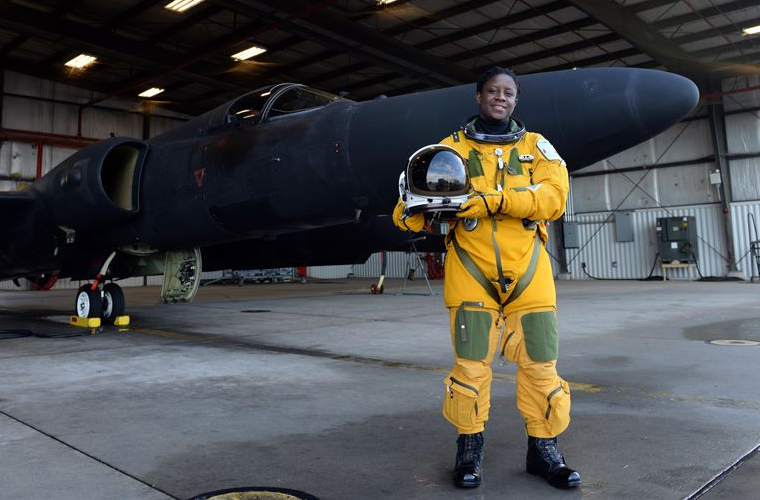
In the annals of American military aviation, few names resonate with the force of quiet determination and historic breakthrough as Colonel Merryl Tengesdal (Ret.). Born in 1971 in the bustling heart of The Bronx, New York, Tengesdal rose from the concrete confines of a public housing project to command the skies in the U-2 “Dragon Lady,” the Air Force’s legendary high-altitude spy plane. As the first—and to date, only—Black woman to pilot this iconic aircraft, she not only defied gravity but also shattered glass ceilings, amassing over 3,400 flight hours, including more than 1,000 in the U-2 and 330 in combat. Her story is one of unyielding ambition, where the roar of jet engines drowned out the doubters, proving that dreams launched in urban grit can soar to 70,000 feet.
Merryl David—later Tengesdal—entered the world amid the vibrant chaos of New York City’s borough of dreams deferred. Raised in a single-parent household after her parents’ divorce, she found solace and inspiration in the stars, declaring at age seven her aspiration to become an astronaut. “I always knew that I wanted to boldly go where no one has gone before,” she later reflected, channeling the spirit of *Star Trek* amid the realities of inner-city life. A pivotal figure emerged in junior high: her science teacher, who became a surrogate father figure, nurturing her fascination with math and flight. This mentorship fueled her resolve, turning playground wonder into a lifelong pursuit. As she chronicled in her 2021 memoir *Shatter the Sky: What Going to the Stratosphere Taught Me About Self-Worth, Sacrifice, and Discipline*, these early years in The Bronx were a forge for resilience, where she learned to “fight with the Dragon, to dance with the Lady”—a nod to the U-2’s fierce nickname.
Tengesdal’s academic journey was as disciplined as her future flights. In 1994, she graduated from the University of New Haven with a Bachelor of Science in electrical engineering, one of only three women in her program. There, she balanced rigorous coursework with ROTC drills and basketball games, honing the teamwork and tenacity that would define her career. “Don’t listen to adults who tell you it’s never going to happen. They’re friggin’ idiots,” she quipped in a later interview, a mantra born from navigating skepticism as a young Black woman in STEM.


Her path to the cockpit began with the U.S. Navy. Commissioned as an Ensign on September 9, 1994, after Officer Candidate School at Naval Air Station Pensacola, she earned her “wings” in 1996 following helicopter flight training in Corpus Christi, Texas. She advanced swiftly: Lieutenant Junior Grade in 1996, full Lieutenant in 1998. Deployed aboard the USS Simpson out of Naval Station Mayport, Florida, she piloted the SH-60B Seahawk helicopter on missions across the Middle East, South America, and the Caribbean, logging critical experience in high-stakes environments. By 2004, as a Major, she had transitioned to instructor roles, training the next generation of pilots in the T-34C and T-6A aircraft at Moody Air Force Base, Georgia. Her commanding officer, Commander Ron Robinson, praised her as “one of my best flight students,” a testament to her innate skill.
In a move that would etch her name in aviation lore, Tengesdal transferred to the U.S. Air Force in 2004, becoming the first African American woman to qualify for the U-2 program at Beale Air Force Base, California. One of just eight women—and the only Black female pilot—in the aircraft’s storied history, she joined a lineage that included Cold War icons like Francis Gary Powers. The U-2S, a single-seat marvel capable of gliding at stratospheric altitudes for reconnaissance, signals intelligence, and imagery, demanded precision and poise. “You can’t mess with perfection. It’s a great platform, that’s why it stuck around,” Tengesdal said of the plane that had served since 1956.
Her U-2 tenure was marked by daring operations: Olive Harvest, Enduring Freedom in Afghanistan, Iraqi Freedom, and Horn of Africa. Flying solo at 70,000 feet, she once marveled at a shooting star streaking below her in the night sky—a poetic counterpoint to the combat below. Promotions followed: Lieutenant Colonel in 2010, Colonel in 2015. She commanded Detachment 2 at Plant 42 in Palmdale, California (2008–2010), served on NORAD/NORTHCOM staff (2010–2013), and as Deputy Operations Group Commander at the 9th Reconnaissance Wing (2013–2015). Her final role, Director of Inspections for the Air Force Inspector General (2015–2017), capped a career of leadership amid the fog of war.
Tengesdal’s accolades are as lofty as her flights: Legion of Merit, Air Medal, Meritorious Service Medal (with two oak leaf clusters), and the 2008 ACC Aerospace Physiologist of the Year award. Rated a Command Pilot, she mastered an arsenal of aircraft, from the TH-57 to the T-38.
After 23 years of service, Tengesdal retired in November 2017, opting out of a non-voluntary deployment to Afghanistan shortly after the birth of her son, Flynn Obari Tengesdal (“Obari” meaning “mighty” in Nigerian). Married to Kjell Tengesdal—a health physicist at Lawrence Livermore National Laboratory pursuing a doctorate in Strategic Intelligence—for over two decades by 2025, she and her husband have nurtured a family grounded in support and shared dreams. Their daughter, with a “tender heart for animals,” aspires to veterinary medicine, while son Flynn channels his energy into acting.
Post-retirement, Tengesdal has channeled her stratosphere-scaling spirit into inspiration. A certified personal trainer, leadership consultant, and motivational speaker, she empowers underprivileged youth through storytelling and mentorship, echoing her Bronx roots. Her memoir Shatter the Sky (2021) weaves triumphs and trials—from deployments to motherhood—with “unerring honesty and lively wit,” offering lessons on self-worth and sacrifice. In 2021, she tested her mettle on CBS’s Tough as Nails, competing as part of Team Savage Crew and emerging as a symbol of endurance. That same year, the University of New Haven honored her with an honorary Doctor of Engineering.
Even Hollywood sought her expertise. During the 2015 filming of *Bridge of Spies*, Steven Spielberg requested she walk an active runway for a shot; she demurred for safety, instead piloting a chase vehicle at 100 mph behind a taxiing U-2 to deliver the dramatic footage. “I wanted to be an astronaut, so I wanted to see how high I could actually go. I didn’t make it, but man, the journey was incredible,” she mused, encapsulating a philosophy of intentional challenge.
Colonel Merryl Tengesdal’s trajectory—from Bronx dreamer to Dragon Lady commander—transcends aviation. She embodies the audacity to claim space in skies once deemed unreachable, urging the next generation: Embrace the mission, shatter the limits, and dance with the stars. As of 2025, her influence continues to ripple, proving that true altitude is measured not in feet but in the heights of human potential.