
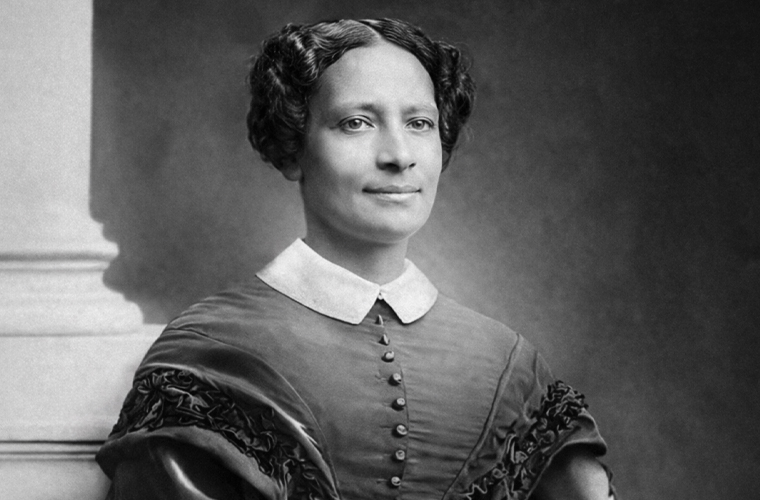
Sarah Parker Remond (also spelled Redmond in some accounts) was a pioneering African American abolitionist, lecturer, women’s rights advocate, and physician. Born on June 6, 1826, in Salem, Massachusetts, into a prominent free Black family, she grew up in a household deeply committed to education, business success, and the fight against slavery. Her parents, John and Nancy Lenox Remond, operated thriving catering and hairdressing businesses, and the family actively supported anti-slavery efforts. Remond’s older brother, Charles Lenox Remond, was already a well-known abolitionist lecturer, and the entire family instilled in her a strong sense of justice and equality from an early age.
A defining moment in Remond’s life occurred on May 4, 1853, at the Howard Athenaeum in Boston. She and a group of companions, including her sister Caroline and abolitionist William Cooper Nell, had purchased tickets by mail for the popular opera Don Pasquale. Upon arrival, they were directed to segregated seating in the gallery rather than the “family circle” seats they had paid for. Remond refused to accept this discriminatory treatment. In response, she was forcibly removed from the theater by police officer Charles P. Philbrick and the opera agent Henry Palmer. Accounts describe her being pushed down a flight of stairs, an act of physical violence that highlighted the everyday racial indignities faced by free Black people in the North. Undeterred, Remond sued her assailants for assault and won the case, receiving damages and a public acknowledgment that she had been wronged. The incident also contributed to pressure on the theater to integrate its seating, underscoring Remond’s early role in challenging racial segregation in public spaces.
This experience fueled her determination to combat the inhumane treatment of African Americans and enslaved people in the South. She became actively involved with the Salem Female Anti-Slavery Society and later joined the American Anti-Slavery Society as an agent. Building on her brother’s prominence, Remond began delivering powerful anti-slavery lectures across the northeastern United States and Canada. In 1859, she expanded her reach internationally by traveling to Britain, where she delivered her first overseas speech. Her oratory was remarkable: she spoke extemporaneously without notes, with eloquence and emotional depth that captivated audiences. Listeners, often shocked by the graphic details of slavery’s brutality, were frequently moved to tears. Her lectures not only raised awareness and funds for the abolitionist cause but also garnered support for the Union during the approaching Civil War, particularly in cities like Liverpool, Manchester, and Bristol.
While in Britain, Remond continued her education, studying languages, literature, history, and elocution at Bedford College for Ladies (now part of Royal Holloway, University of London). She balanced her academic pursuits with ongoing activism, addressing crowds on the evils of slavery and advocating for broader human rights, including women’s suffrage. She also trained as a nurse at London University College around 1865 and became a naturalized British citizen in 1865, seeking greater freedom from American racial prejudice.
In 1866, shortly after the American Civil War, Remond relocated to Florence, Italy. There, she enrolled as a medical student at the prestigious Santa Maria Nuova Hospital, one of Europe’s leading institutions for medical training, particularly in obstetrics. At around age 42, she completed her studies and qualified as a physician, becoming one of the first known Black women to practice medicine in Italy. In 1877, she married Lazzaro Pintor (sometimes referred to as Lazzaro Pinto), a Sardinian businessman, and settled into a cosmopolitan life in Florence, later moving to Rome. She practiced medicine for nearly two decades, primarily as an obstetrician, finding relative freedom from the racial barriers she had faced in the United States (though she noted that American visitors occasionally brought their prejudices with them).
Sarah Parker Remond died on December 13, 1894, in Rome, Italy, at the age of 68. She never returned permanently to the United States. Her extraordinary life bridged continents and causes: from confronting segregation in a Boston theater to becoming an internationally acclaimed abolitionist speaker, educator, and groundbreaking physician. Today, she is remembered as a trailblazer for civil rights, women’s education, and racial equality, with institutions like University College London’s Sarah Parker Remond Centre named in her honor. Her legacy continues to inspire those fighting against injustice.