
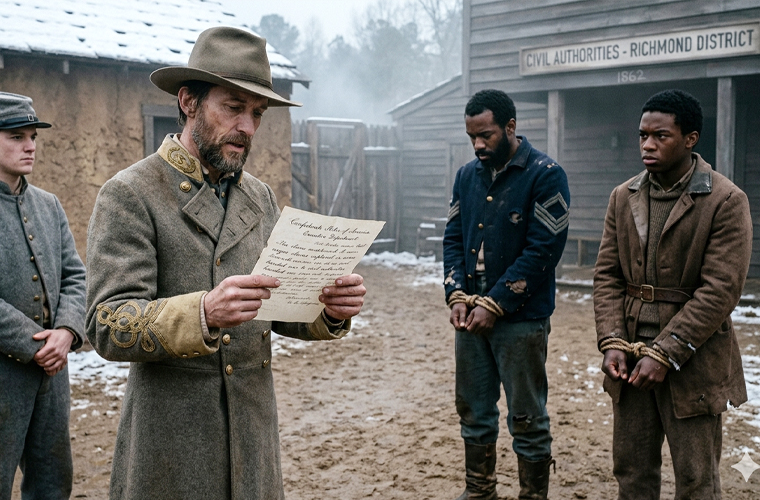
On Christmas Eve 1862, as the American Civil War raged into its second winter, Confederate President Jefferson Davis issued a chilling directive to the Confederate army. He ordered that all Black men—referred to as “negro slaves”—captured while bearing arms should immediately be handed over to the civil authorities of the states from which they originated, “to be dealt with according to the law of said States.”
This policy reflected the Confederacy’s profound outrage and existential fear. The Southern nation had seceded from the United States primarily to preserve the institution of chattel slavery. The idea that enslaved Black men were now being armed by the Union and turned against their former masters struck at the very core of the Confederate cause.
Several months later, on May 1, 1863, the Confederate Congress passed, and Davis signed a joint resolution that refined and formalized this stance. It declared that all captured Black soldiers—whether enslaved or free, “negroes or mulattoes”—would be delivered to the authorities of the state in which they were taken. Their white officers faced even harsher treatment: they would be tried before Confederate military tribunals on charges of “inciting servile insurrection,” a crime punishable by death at the discretion of the court and the president.
These orders were not abstract legalities. They emerged from a war in which the Confederacy viewed the Union’s recruitment and deployment of Black troops as both a military threat and a direct challenge to the racial order the South sought to defend. Enslaved and free Black men in Union blue represented a nightmare scenario for many Confederates: the inversion of the social hierarchy they believed divinely ordained and essential to their civilization.
In practice, captured Black soldiers often faced treatment that ranged from summary execution to re-enslavement. Surrendering or wounded Black troops were frequently denied the protections afforded to white prisoners of war. One of the most notorious examples occurred on April 12, 1864, at Fort Pillow, Tennessee. After Confederate forces overran the Union garrison, many surrendering Black soldiers were massacred in cold blood. The episode shocked the North and became a rallying cry for Union troops, Black and white alike.
Throughout the final two years of the war, the Confederate policy toward Black Union soldiers remained a volatile mix of official directives, battlefield atrocities, and pragmatic inconsistency driven by manpower shortages. Yet the underlying message was unmistakable: the Confederacy refused to recognize Black men as legitimate soldiers. It would punish both them and their officers for daring to take up arms in defense of the Union and their own freedom. This stance ultimately backfired in multiple ways. It hardened Northern resolve, boosted Black recruitment into the Union Army, and helped ensure that when the Confederacy finally collapsed in 1865, the institution it had fought so desperately to preserve would be destroyed with it.