
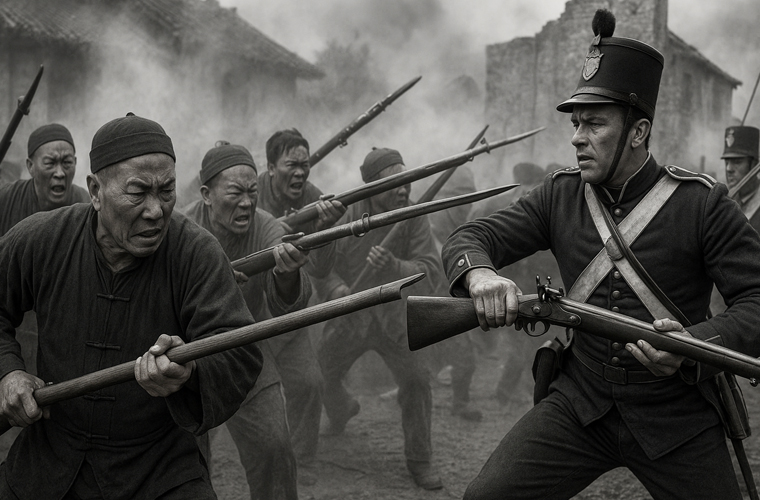
The Opium Wars, a pair of mid-19th-century conflicts between the Qing Dynasty of China and Western powers—primarily Great Britain—marked a pivotal turning point in modern Chinese history. Often referred to as the “Century of Humiliation,” this era began with these wars, which exposed the vulnerabilities of imperial China and paved the way for foreign domination, territorial concessions, and profound social upheaval. Triggered by Britain’s aggressive opium trade, the wars were not just about narcotics but symbolized the clash between a self-sufficient empire and the encroaching forces of Western imperialism. From 1839 to 1860, these battles reshaped Asia’s power dynamics, forcing China to confront its technological and military obsolescence while granting Europeans unprecedented access to its markets and ports.
By the early 1800s, the British East India Company dominated trade with China, exporting vast quantities of tea, silk, and porcelain that created a massive trade imbalance. China, under the Qing Dynasty, demanded payment in silver, draining British coffers. To reverse this, British merchants turned to opium, cultivated in British-controlled India, as a lucrative commodity. What began as a small-scale export exploded into a flood: by the 1830s, millions of Chinese were addicted, leading to widespread social decay, economic drain, and a silver outflow estimated at tens of millions of taels annually.
The Qing government, alarmed by the crisis, banned opium imports in 1799, but enforcement was lax until Commissioner Lin Zexu arrived in Canton (Guangzhou) in 1839. Lin’s bold actions—confiscating and destroying over 20,000 chests of British opium worth millions—ignited the powder keg. British merchants, backed by their government, viewed this as an assault on free trade and property rights, setting the stage for war. This wasn’t merely economic aggression; it reflected Britain’s imperial strategy to pry open China’s “closed” markets, echoing failed diplomatic overtures like Lord Macartney’s 1793 mission, which the Qianlong Emperor dismissed as incompatible with the “Celestial Empire.”
The First Opium War erupted in November 1839 when British naval forces, leveraging steam-powered ships and modern artillery, blockaded Canton and advanced northward. China’s outdated junks and matchlock muskets were no match for the Royal Navy’s firepower. Key battles, such as the capture of the Bogue forts and the island of Chusan, demonstrated Qing military frailty.
The conflict dragged on until 1842, with British forces occupying Nanjing, the dynastic capital. Facing total defeat, the Daoguang Emperor sued for peace. The resulting Treaty of Nanjing, signed on August 29, 1842, was the first of the “unequal treaties” that would define China’s foreign relations for a century. China ceded Hong Kong Island to Britain in perpetuity, opened five treaty ports (Canton, Amoy, Foochow, Ningpo, and Shanghai) to foreign trade, and paid 21 million silver dollars in reparations—effectively reimbursing the destroyed opium. The treaty also granted extraterritoriality, allowing British subjects to be tried in their own courts, further eroding Qing sovereignty.
Tensions simmered for over a decade, exacerbated by ongoing opium smuggling and disputes over trade rights. The spark came in 1856 with the “Arrow Incident,” where Chinese officials boarded a British-registered ship in Canton, leading Britain and France—eager for their share of concessions—to declare war. This Second Opium War, also known as the Arrow War, saw allied forces capture Canton in 1857 and push to Tianjin, humiliating the Qing further.
In 1860, after a brief armistice shattered by the execution of French and British envoys, Anglo-French troops sacked Beijing’s Summer Palace, looting priceless artifacts in an act of cultural vengeance. The Treaty of Tianjin (1858) and the Convention of Beijing (1860) compounded the damage: China legalized the opium trade, opened 11 more ports, allowed foreign missionaries inland, and ceded the Kowloon Peninsula to Britain. The United States and Russia also extracted similar privileges under most-favored-nation clauses.
Key Treaties from the Opium
| Wars | Date | Major Provisions |
|---|---|---|
| Treaty of Nanjing | 1842 | Ceded Hong Kong; opened 5 ports; 21M silver dollars reparations; extraterritoriality for Britons. |
| Treaty of the Bogue (U.S.) | 1844 | Mirrored Nanjing; U.S. access to ports and navigation rights. |
| Treaty of Tianjin | 1858 | Legalized opium; opened 11 ports; inland travel for foreigners; diplomatic missions in Beijing. |
| Convention of Beijing | 1860 | Ceded Kowloon; ratified Tianjin; indemnities to Britain and France. |
The Opium Wars inflicted deep wounds on China. Economically, the opium trade’s legalization entrenched addiction, with imports peaking at 80,000 chests annually by 1880, fueling corruption and social disintegration. Militarily, defeats revealed the Qing’s technological lag, sparking the Self-Strengthening Movement in the 1860s—a futile attempt at modernization amid internal rebellions like the Taiping Uprising, which killed 20–30 million.
The wars ushered in the “unequal treaties” era, inviting exploitation by multiple powers, including Japan in the 1894–95 Sino-Japanese War. This humiliation fueled nationalist fervor, contributing to the 1911 Revolution that ended imperial rule. Today, the Opium Wars resonate in Chinese discourse on sovereignty and trade, often invoked in critiques of Western intervention—echoing parallels to modern opioid crises like America’s fentanyl epidemic.
The Opium Wars were more than colonial skirmishes; they dismantled the illusion of China’s invincibility and initiated a painful reckoning with the world. While Britain profited from open markets, China paid dearly in sovereignty, treasure, and pride. As the Qing Dynasty staggered toward collapse, these conflicts sowed seeds of resilience that would bloom in the 20th century’s revolutionary upheavals. In understanding this history, we see the perils of unchecked imperialism and the enduring scars of economic coercion—a cautionary tale for global relations even now.