
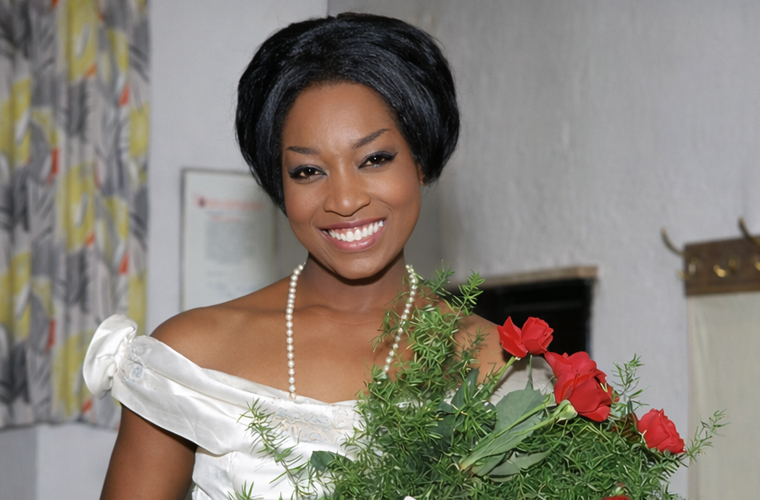
Gloria Davy (March 29, 1931 – November 28, 2012) was a pioneering American-born soprano (later a Swiss citizen through marriage and residence) celebrated for her powerful lirico-spinto voice, dramatic stage presence, and trailblazing contributions as one of the first generation of African American singers to achieve international success in opera during a time of significant racial barriers in the classical music world.
Born in Brooklyn, New York, to parents who immigrated from the Caribbean island of Saint Vincent in the Windward Islands, Davy grew up in modest circumstances—her father worked as a token clerk in the New York City subway system. She showed exceptional musical talent early on, graduating from the prestigious High School of Music and Art in Manhattan. She continued her studies at the Juilliard School, where she earned a degree in vocal performance in 1953 under the guidance of teacher Belle Julie Soudant. She stayed an additional year for postgraduate opera training.
Her talent was quickly recognized: she won the Marian Anderson Award (named for the groundbreaking Black contralto) in both 1951 and 1952 while still in high school and early Juilliard years. In 1953, she won the Music Education League’s vocal competition, leading to her professional concert debut at New York’s Town Hall on June 12, 1953, and a contract with The Little Orchestra Society.
Davy’s early professional work included appearances on Broadway, such as in revivals of Virgil Thomson’s Four Saints in Three Acts (1952) and My Darlin’ Aida (1952). A breakthrough came in 1954 when she replaced Leontyne Price as Bess in the international tour of George Gershwin’s Porgy and Bess, which took her across Europe, the Middle East, Africa, Russia, and Latin America through 1956. During this tour’s stop in Milan, conductor Victor de Sabata encouraged her to prepare Verdi’s *Aida*, though a planned La Scala engagement was canceled due to political issues in Italy.


Her operatic debut as Aida came at the Opéra de Nice in 1957, followed by performances in Bologna and Zagreb. She also sang Aida in concert with the New York Philharmonic at Lewisohn Stadium. These successes paved the way for her historic Metropolitan Opera debut on February 12, 1958, as Aida—the first African American to perform the title role at the Met (and only the fourth Black artist to appear on the Met stage overall, following Marian Anderson, Robert McFerrin, and Mattiwilda Dobbs). She sang 15 performances with the company over four seasons (1958–1961), including roles like Pamina in Mozart’s The Magic Flute, Nedda in Leoncavallo’s Pagliacci, and Leonora in Verdi’s Il trovatore. Critics praised her rich, low tones, clear upper register, and overall vocal command.
In 1959, Davy married Swiss stockbroker Herman Penningsfield (or Penningsfeld) and relocated to Geneva, Switzerland, where she became a Swiss citizen and based much of her later career. The couple had one son, Jean-Marc Penningsfield. She performed widely in Europe, including Aida under Herbert von Karajan at the Vienna State Opera, at London’s Royal Opera, and as a resident artist at the Berlin State Opera (1961–1968), where she took on leading Verdi and Puccini roles. Guest appearances included La Scala (as Donna Anna/Elvira in Don Giovanni, Nedda in Pagliacci, and more), the Théâtre Royal de la Monnaie in Brussels, and houses in Parma, Hamburg, and elsewhere.
Davy excelled in 20th-century repertoire, premiering or performing works by composers like Richard Strauss (Daphne, Capriccio), Benjamin Britten, Paul Hindemith, Hans Werner Henze, and Karlheinz Stockhausen (*Momente*). She also sang in concert settings, including Beethoven’s Symphony No. 9 with the Philadelphia Orchestra at the United Nations.
From the 1970s onward, she shifted toward concert and recital work while occasionally returning to staged roles. She taught voice on the faculty of Indiana University’s Jacobs School of Music from 1984 to 1997, influencing a new generation of singers.
Gloria Davy passed away in Geneva after a long illness on November 28, 2012, at age 81. Her legacy endures as a barrier-breaker who brought emotional vitality, technical skill, and joy to opera and song, helping expand opportunities for African American artists in classical music.