
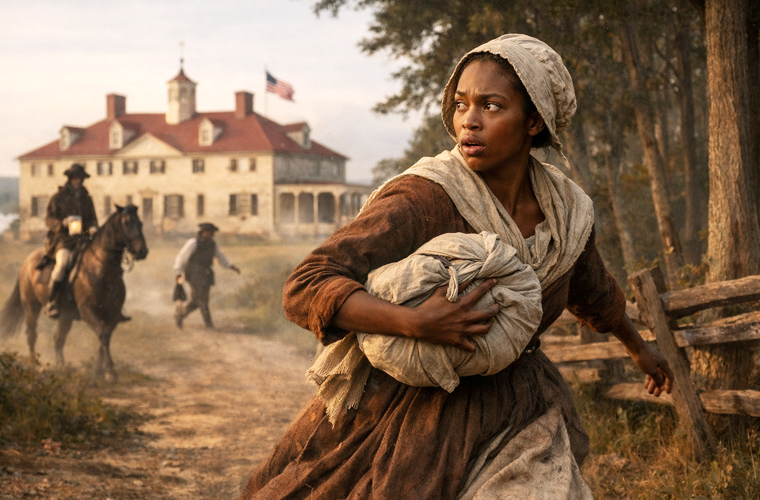
In 1796, a 22-year-old slave woman named Ona Judge fled President George Washington’s household for a life of freedom in New Hampshire. Born around 1774 at Mount Vernon, Ona (often called “Oney”) was the daughter of Betty, an enslaved seamstress, and Andrew Judge, a white English indentured tailor. She grew up on the plantation and, as a child, began training as a housemaid. By her teens, she had become Martha Washington’s personal attendant—skilled with a needle, responsible for dressing her mistress, caring for her wardrobe, and attending to her daily needs.
When George Washington became president, Ona was among the small group of enslaved people selected to accompany the first family. She lived with them first in New York City (the temporary capital) and then in Philadelphia starting in 1790. There, the Washingtons rotated their enslaved household staff in and out of the state every six months to evade Pennsylvania’s gradual abolition law, which could have granted freedom after prolonged residence.
Despite the relative privileges of household service—finer clothes, occasional outings, and proximity to urban life—Ona remained enslaved. She later recalled having no formal education or moral instruction while with the Washingtons. In the spring of 1796, as the family prepared to return to Mount Vernon for the summer, she learned that Martha Washington planned to give her as a wedding gift to one of her granddaughters. Ona decided she would never return to Virginia and resolved to seize her freedom.
On the evening of May 21, 1796, while the Washingtons were eating dinner, Ona slipped out of the President’s House in Philadelphia. She had quietly arranged help from members of the city’s free Black community. They assisted her in boarding a ship—the sloop Nancy, commanded by Captain John Bolles (or Bowles)—bound for Portsmouth, New Hampshire. After a roughly five-day voyage, she stepped ashore in a free state, determined never to be anyone’s property again.
A Fugitive in Freedom
Ona quickly found work as a seamstress and domestic servant in Portsmouth. She lived cautiously, aware that her escape made her a fugitive under the 1793 Fugitive Slave Act. Within months, she was recognized on the street by Elizabeth Langdon, a friend of Martha Washington’s granddaughter. Word reached the president, who discreetly enlisted officials—including Portsmouth customs collector Joseph Whipple—to persuade or recapture her.
Washington’s agents offered her a deal: return voluntarily, and she would be freed upon Martha’s death. Ona refused. In a later interview, she explained her reasoning plainly: she preferred the hardships of freedom to the comforts of slavery, knowing that returning to Virginia meant she would never be liberated.
In 1797, she married Jack Staines, a free Black sailor. They had three children. Jack died in 1803, leaving Ona to raise the family while continuing domestic work and later sharing a household with a free Black family in nearby Greenland, New Hampshire. She faced at least one more serious attempt at recapture in 1799, when Washington sent his nephew, Burwell Bassett Jr., to seize her. Warned in time (possibly by Senator John Langdon or his household), she fled temporarily and evaded capture.
After George Washington died in 1799, the pursuit largely ended, though legally she remained the property of the Custis heirs until her death. She never returned to enslavement.
Later Life and Legacy
In the 1840s, as an elderly woman living in poverty and supported by the county, Ona gave two remarkable interviews to abolitionist newspapers. She described learning to read after her escape, converting to Christianity, and having no regrets despite the struggles of freedom. When asked if she was sorry she left the Washingtons, she replied: “No, I am free, and have, I trust, been made a child of God by the means.”
Ona Judge Staines died on February 25, 1848, in Greenland, New Hampshire, at about age 75, having lived nearly 52 years as a free woman. She outlived her husband and all three of her children.
Her story stands as a powerful reminder of the human desire for liberty, even when it meant risking everything to escape one of the most prominent households in the young United States. Though George and Martha Washington are revered as founders of the nation, Ona Judge’s bold self-emancipation highlights the contradictions of freedom in a republic that still tolerated human bondage. Her courage continues to be remembered in historical accounts, books like Erica Armstrong Dunbar’s Never Caught, and exhibits at sites tied to the Washingtons’ lives.