
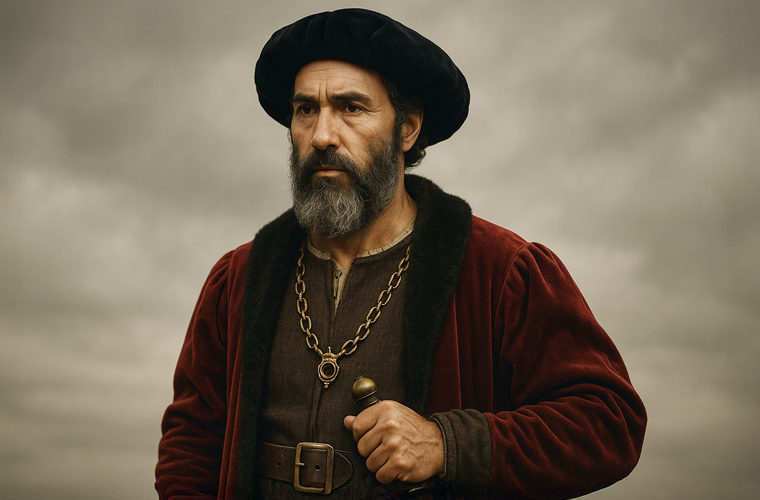
Vasco da Gama, born around 1460 in Sines, Portugal, to a noble family—his father, Estêvão da Gama, a knight and fortress commander, and mother Isabel Sodré, of English descent—was a trailblazing Portuguese explorer whose daring voyages reshaped global trade. Educated in navigation amid Portugal’s seafaring culture, he rose to prominence by 1492, leading a naval raid against French ships that impressed King John II.
Commissioned by King Manuel I, da Gama’s first expedition (1497–1499) departed Lisbon with four ships and 170 men, rounding the Cape of Good Hope—previously charted by Bartolomeu Dias—and reaching Calicut, India, on May 20, 1498, via alliances with Kenyan pilots. This grueling journey, plagued by scurvy and local hostilities, claimed over half his crew but forged Europe’s first direct sea route to the Indies, returning with spices that heralded immense wealth. Knighted and ennobled upon his 1499 arrival in Lisbon, he married Catarina de Ataíde and fathered seven children.
His second voyage (1502–1503), commanding 20 ships, was more forceful, bombarding resistant ports to secure trade forts and pacts, cementing Portuguese dominance in the Indian Ocean. Later, as Viceroy of India in 1524 under King John III, the 64-year-old da Gama arrived in Cochin to quell disputes but succumbed to illness on December 24, dying there. His remains were repatriated to Lisbon’s Jerónimos Monastery in 1538.
Da Gama’s legacy endures as a symbol of the Age of Discovery: his routes flooded Europe with Eastern luxuries, spurred colonial expansion, and advanced tools like the astrolabe and cross-staff. Although his methods drew criticism for their brutality, monuments like Lisbon’s Vasco da Gama Bridge immortalize his pivotal role in connecting the worlds.