
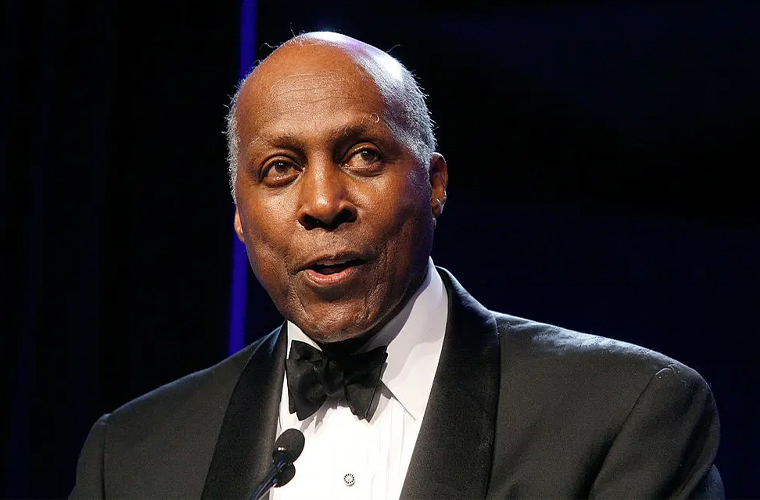
Vernon Eulion Jordan Jr. (August 15, 1935 – March 1, 2021) was a prominent American civil rights leader, attorney, business executive, and presidential advisor. He rose from humble beginnings in segregated Atlanta, Georgia, to become one of the most influential figures in the fight for racial equality, later transitioning into a powerful Washington insider and corporate leader. Born in Atlanta to Vernon E. Jordan Sr. and Mary Belle (Griggs) Jordan, he grew up in the racially segregated South—an honors graduate of David T. Howard High School, Jordan attended DePauw University in Greencastle, Indiana, graduating with a B.A. in 1957. He was the only Black student in his class and later reflected on the challenges and transformative impact of that experience. He earned his J.D. from Howard University School of Law in 1960.
Jordan began his career in Atlanta, joining the law office of civil rights activist Donald L. Hollowell. He played a key role in the legal team that successfully desegregated the University of Georgia in 1961. He personally escorted student Charlayne Hunter (later Hunter-Gault) through a hostile crowd of white protesters to register for classes.
He went on to serve as Georgia field secretary for the NAACP, director of the Voter Education Project for the Southern Regional Council (helping register Black voters across the South), and executive director of the United Negro College Fund (1970). In 1971, he became president and CEO of the National Urban League, a position he held until 1981. Under his leadership, the organization expanded its focus on economic empowerment, jobs, and justice for Black Americans. He launched the influential State of Black America annual report in 1976.


On May 29, 1980, while in Fort Wayne, Indiana, Jordan was shot and seriously wounded by white supremacist Joseph Paul Franklin (who later admitted to the crime). The attack, which became the first story broadcast by the new network CNN, was intended to incite a race war. Jordan survived after a long recovery.
In 1981–1982, he left the Urban League and joined the Washington, D.C., office of the law firm Akin Gump Strauss Hauer & Feld as legal counsel. He joined numerous corporate boards (including American Express, Dow Jones, Xerox, Revlon, and others), using his influence to advocate for minority hiring and advancement in business. From 2000 onward, he served as a senior managing director at Lazard Frères & Co. LLC.
Jordan was a close friend and advisor to President Bill Clinton, whom he had known for years. He chaired Clinton’s 1992–1993 presidential transition team—the first African American to hold such a role—and remained a trusted informal counselor on Cabinet selections, policy, and personal matters. He testified during the Clinton impeachment proceedings related to the Monica Lewinsky scandal. He also advised other presidents, including Lyndon B. Johnson, Jimmy Carter, Ronald Reagan, and George H.W. Bush. In 2004, he assisted John Kerry’s presidential campaign with debate preparation. He served on the 2006 Iraq Study Group.
Jordan married Shirley Yarbrough (who died in 1985); they had one daughter, Vickee. In 1986, he married Ann Dibble Cook, gaining four stepchildren. He had nine grandchildren. He authored the memoir Vernon Can Read! (2001, with Annette Gordon-Reed) and Make It Plain: Standing Up and Speaking Out (2008), a collection of speeches. Jordan received numerous honors, including the NAACP’s Spingarn Medal (2001), the Barnard Medal of Distinction, and over 80 honorary degrees. After his death, Howard University named its law school library in his honor.
Vernon Jordan died at his home in Washington, D.C., on March 1, 2021, at age 85. He is remembered as a bridge-builder who combined grassroots civil rights activism with elite corporate and political influence, opening doors for generations and championing economic and racial justice. His life exemplified strategic leadership, resilience, and a commitment to service.