
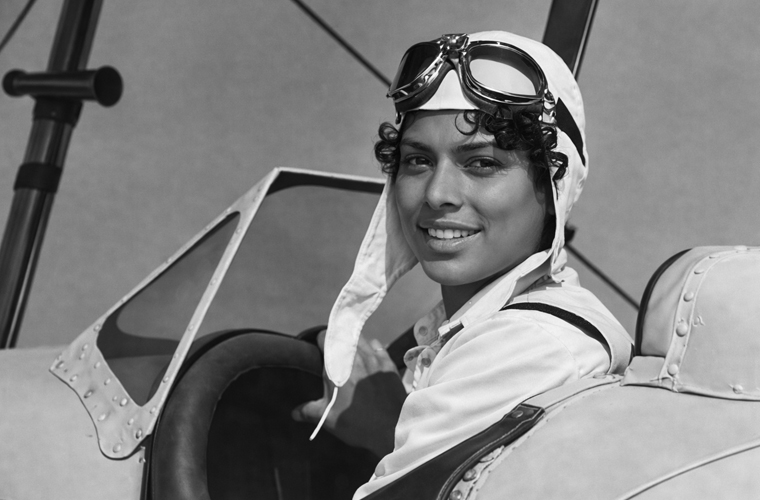
Willa Beatrice Brown (later known as Willa Brown Chappell) was a pioneering American aviator, educator, lobbyist, and civil rights activist who broke multiple racial and gender barriers in aviation during the 1930s and 1940s. She is widely recognized as the first African American woman to earn a pilot’s license in the United States, the first African American officer in the Civil Air Patrol, and the first woman in the U.S. to hold both a pilot’s license and an aircraft mechanic’s license. Her advocacy and training efforts played a direct role in the creation of the Tuskegee Airmen program and contributed to the eventual integration of the U.S. military.
Early Life and Education
Willa Beatrice Brown was born on January 22, 1906, in Glasgow, Kentucky, the second child and only daughter of Eric (or Erice) Brown, an African American man, and Hallie May Carpenter (sometimes described with Native American heritage). The family moved to Indiana seeking better educational opportunities in integrated schools. She graduated from Wiley High School in Terre Haute, Indiana, in 1923. She then attended Indiana State Teachers College (now Indiana State University), earning a bachelor’s degree in business (with a minor in French) in 1927. At age 21, she became one of the youngest high school teachers in the Gary, Indiana, school system, teaching at Roosevelt High School.
In the early 1930s, Brown moved to Chicago, where she worked as a social worker with the Works Progress Administration (WPA). Feeling constrained by limited career opportunities for African Americans, she sought new challenges and was inspired by the pioneering aviator Bessie Coleman. She began taking flying lessons around 1934 at Chicago’s racially segregated Harlem Airport, training under instructors including Cornelius R. Coffey at the Curtiss-Wright Aeronautical University.


Aviation Career and Achievements
While pursuing flight training, Brown earned her master mechanic’s certificate in 1935 and a Master of Business Administration (MBA) from Northwestern University in 1937. On June 22, 1938 (some sources note her private pilot’s license in 1937 or 1938 with certificate #43814), she became the first African American woman to earn a U.S. pilot’s license. She quickly advanced, obtaining a limited commercial pilot’s license in 1939. In 1943, she earned her aircraft mechanic’s license, making her the first woman in the United States to hold both a (commercial) pilot’s license and a mechanic’s license.
Brown emerged as a leader in Chicago’s Black aviation community. She joined the Challenger Air Pilots Association (also called the Aero Challenger Club) and helped co-found the National Airmen’s Association of America (NAAA) in 1937/1939 with Cornelius Coffey. The organization aimed to promote Black interest in aviation and push for inclusion in the U.S. military and federal programs.
In 1938–1940, she and Coffey established the Coffey School of Aeronautics at Harlem Airport (later associated with locations like Oak Lawn), the first Black-owned school. They operated a private flight training academy in the U.S. As director and instructor, Brown trained hundreds of pilots and mechanics—estimates range from around 200 directly linked to Tuskegee pathways to as many as 2,000 students overall. Many of her trainees became cadets or instructors in the famed Tuskegee Airmen program (the 99th Pursuit Squadron and related units at Tuskegee Institute). Her lobbying in Washington, D.C., helped secure African American inclusion in the Civilian Pilot Training Program (CPTP) and influenced the Army Air Corps’ decision to train Black pilots, paving the way for military integration via Executive Order 9981 in 1948.
During World War II, Brown served as a training coordinator for the Civil Aeronautics Administration (CAA) and the War Training Service. In 1941, she joined the Civil Air Patrol (CAP) as a second lieutenant, becoming the first African American officer in the organization and federal coordinator of the Chicago unit. She continued instructing and advocating for equal opportunities in aviation.
Later Career, Politics, and Personal Life
After the war and the closure of the Coffey School, Brown turned to politics. In 1946, she became the first African American woman to run for the U.S. Congress, campaigning as a Republican in Chicago’s 1st District (she ran again in 1948 and 1950 but did not win). She also worked for the federal government in various capacities.
Brown married three times. Her first marriage was to Wilbur J. Hardaway, an African American firefighter, in 1929 (divorced 1931). She and Cornelius Coffey, her former instructor and business partner, married in 1947 (divorced after less than 10 years; sources vary slightly on exact timing). In 1955, she married Reverend J. H. Chappell, becoming Willa Brown Chappell and actively participating in the West Side Community Church in Chicago. She returned to teaching in Chicago public schools (business and aeronautics subjects) from 1962 until her retirement in 1971.
In 1972, the Federal Aviation Administration (FAA) appointed her to its Women’s Advisory Committee on Aviation (sometimes called the Women’s Advisory Board), recognizing her contributions; she was the first African American woman on the board and served until 1974.
Legacy and Death
Willa Beatrice Brown Chappell died on July 18, 1992, at age 86 in Chicago from complications of a stroke. She is buried in Lincoln Cemetery, Chicago, Illinois. Her tombstone notes her pilot certificate since 1937.
Posthumously, she has received numerous honors, including induction into halls of fame (such as the Kentucky Aviation Hall of Fame and others), recognition as one of the 100 Most Influential Women in Aviation and Aerospace, and a Congressional Gold Medal for her CAP service. Historical markers in Glasgow, Kentucky, and elsewhere commemorate her as a trailblazer. She is remembered as the “Maker of Pilots” for her role in training future Tuskegee Airmen and her tireless fight against racial and gender discrimination in aviation and beyond. Her life exemplified determination, advocacy, and the breaking of barriers in a segregated era.
Brown’s story highlights the intersection of aviation, education, and civil rights, inspiring generations in the ongoing pursuit of equality and opportunity in the skies and society.