
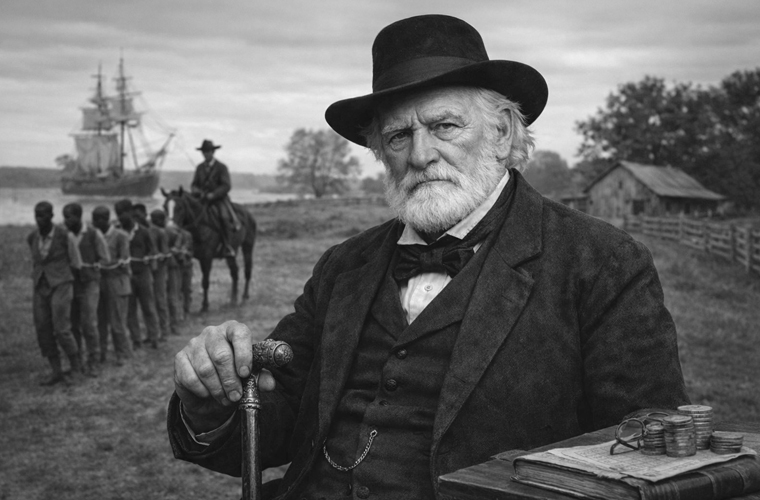
George Kephart (February 7, 1811 – August 26, 1888) was a 19th-century American slave trader, landowner, farmer, and later philanthropist from Maryland. He played a prominent role in the interstate domestic slave trade, particularly in the Chesapeake region, before transitioning to agricultural pursuits and quiet retirement in the post-Civil War era. Born in Frederick County, Maryland (later part of Carroll County), Kephart came from a farming family. He was most likely raised on his parents’ farm, known at the time as Brick Mills (later renamed Trevanion by a subsequent owner). This rural upbringing in the upper Potomac area provided early familiarity with agriculture and the local economy, which relied heavily on enslaved labor. Maryland’s position in the Chesapeake region made it a key sourcing area for the interstate slave trade, as surplus enslaved people from declining tobacco economies were often sold southward to cotton plantations in the Deep South.
Kephart entered the slave trade as an agent for the prominent firm Franklin & Armfield, one of the largest and most organized interstate slave-trading operations in the United States during the 1820s and 1830s. Around 1834, he was one of five full-time agents tasked with collecting enslaved people from throughout the greater Chesapeake region (including Maryland and Virginia) for shipment south, often via Alexandria, Virginia (then part of the District of Columbia), to markets in New Orleans and beyond. His colleagues in this network included figures like Rice C. Ballard and James F. Purvis.
When Franklin & Armfield largely exited the trade in the mid-1830s, Kephart built upon their established networks. In 1837, he took over operations at the firm’s notorious slave jail and pen at 1315 Duke Street in Alexandria. He advertised the business, initially operating as George Kephart & Co., and later maintained involvement through partnerships. He did not immediately purchase the property but occupied and eventually owned it in 1846, using it as a holding facility for enslaved people awaiting sale or transport. Kephart remained connected to the site even after selling the building in 1858–1859; he stayed on as a partner or investor in the early operations of the subsequent firm, Price, Birch & Co. (which included traders like Charles M. Price, John C. Cook, and William H. Birch). The Duke Street complex was a major hub in the domestic slave trade until the Civil War.
Kephart’s sourcing focused on the Chesapeake, where he scouted and purchased enslaved individuals from counties like Frederick and Montgomery in Maryland. Contemporary accounts and later recollections describe him as a significant operator; a 1928 local history called him “probably the largest slavedealer” in his county. He reportedly maintained holding facilities, including underground and brick jails, on his own Maryland farm properties to confine people—sometimes described as “unruly”—before transport. Enslaved individuals held by him faced the trauma of family separations common to the trade, with oral histories (such as that of fugitive Fred Fowler) recalling fear associated with his name in Frederick County.
He expanded alliances with other traders, including Hope Hull Slatter, Bacon Tait, and James H. Birch, while also engaging in related ventures like lumber dealing. Census records from the period list him variably as a “farmer” or “merchant,” reflecting how many involved in the trade presented themselves publicly. By the 1850s, he owned significant numbers of enslaved people himself, both in Alexandria and on his Maryland properties.
Beyond the Alexandria slave pen, Kephart owned farmland in Maryland, including properties in Frederick/Carroll County and later Belmont in Loudoun County, Virginia (purchased around 1851). He listed properties for sale at times, sometimes accepting enslaved people as payment. He also held land and investments that supported his operations. After the Civil War, with the abolition of slavery, these agricultural holdings became central to his identity as a farmer.
Following the Civil War and emancipation, Kephart lived primarily as a farmer. By the 1870s–1880s, he resided in the Baltimore area (including Baltimore County), where he was known for sociable habits and hospitality. In 1867, he donated a half-acre of land in Baltimore County for the establishment of a school for Black children (referred to in records as the Reisterstown School for Colored Children or associated with Methodist Episcopal efforts). This act stood in notable contrast to his earlier career profiting from the enslavement and sale of Black people.
Kephart never married and had no children. He suffered multiple strokes in his later years; after a paralytic stroke on August 21, 1888, he fell into a coma and died on August 26, 1888, at age 77, while living with his sister. His obituary portrayed him simply as a prosperous farmer and bachelor of sociable tastes, with no reference to his decades-long involvement in the slave trade. He was buried in Reisterstown Cemetery.
Kephart exemplified the “respectable” face of the domestic slave trade in the antebellum Upper South—often presenting as a farmer or merchant while profiting from the forced migration of hundreds (or thousands) of enslaved people. His story highlights the scale of the interstate trade, which treated human beings as commodities to supply labor for expanding cotton economies. The Duke Street site he operated later became a museum focused on this history (Freedom House).
Posthumous accounts varied: some contemporaries or descendants’ recollections emphasized his “kind heart” toward those he held temporarily (a common rationalization of the era, tied to their economic value), while survivor testimonies underscored the fear and disruption he caused. Modern scholarship, drawing from census data, advertisements in the Alexandria Gazette, business correspondence, and local histories, situates him as a key transitional figure between the Franklin & Armfield era and later traders.
His later philanthropy and omission of his trading past in obituaries reflect the broader societal shift after emancipation, where many former participants in slavery sought to reframe their legacies around agriculture, landownership, and selective acts of charity. Kephart’s life thus embodies the complexities and contradictions of 19th-century American history regarding race, economy, and memory.