
A Grim Chapter in Florida’s History
On July 19, 1935, in the midst of the Great Depression, a 30-year-old Black tenant farmer named Rubin Stacy (sometimes spelled Stacey) was lynched in Broward County, Florida, near Fort Lauderdale. His death stands as a stark example of racial terror violence in the Jim Crow South, where accusations against Black men—often fabricated or exaggerated—could lead to extrajudicial murder with impunity. Stacy’s case drew national attention largely because of haunting photographs of the lynching that were later used in anti-lynching campaigns.
Rubin Stacy was an illiterate farm worker, married, and the father of a young child. He lived and labored in the rural areas around Fort Lauderdale during a time of economic hardship and entrenched segregation. On or around July 16 or 17, 1935, Stacy approached the home of a white woman named Marion Jones. According to contemporary accounts, including court records and newspaper reports, he knocked on her door seeking a drink of water or food—common for transient workers during the Depression.
What happened next became the basis for the accusation against him. Mrs. Jones reportedly allowed him inside while she fetched water, but then claimed that Stacy approached her with a penknife and attempted to assault her. She screamed, causing him to flee. Stacy denied the allegation. He was soon spotted hiding in bushes near a highway and was arrested by deputies from the Broward County Sheriff’s Office under Sheriff Walter Clark.
Stacy was initially held in the Broward County Jail. Authorities planned to transfer him to Dade County Jail (in Miami) for safekeeping, likely due to fears of mob violence—a common concern in such cases. On July 19, while being transported by deputies, a group of white men (described as a mob, some masked) intercepted the vehicle. They overpowered the law enforcement officers, seized Stacy from custody, and took him to a location near Davie Boulevard and SW 31st Avenue (close to where the alleged incident occurred).
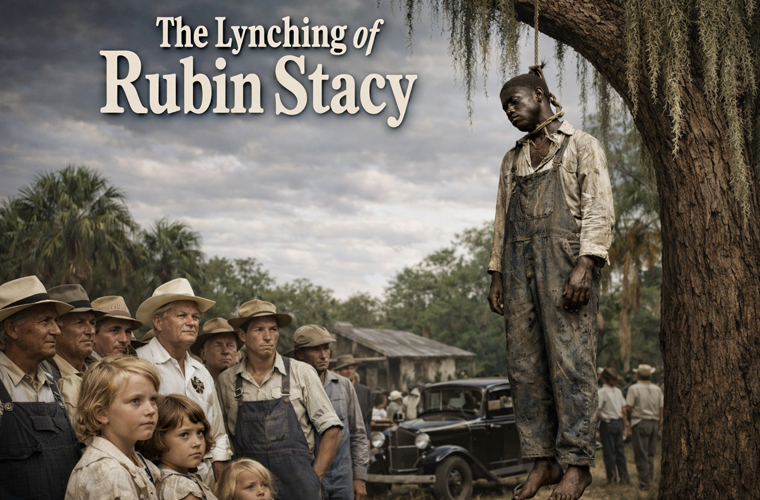
There, the mob hanged Stacy from a tree and shot him. The lynching occurred in broad daylight, and a crowd gathered at the scene, including onlookers of various ages. Photographs taken at the site show Stacy’s body suspended from the tree, surrounded by white spectators—including several young girls standing nearby, some appearing curious or smiling in the images. These pictures, later described as “murder pornography,” captured the casual spectacle that often accompanied Southern lynchings.
The body of Rubin Stacy hangs from a tree after being lynched, surrounded by onlookers, including young girls, Fort Lauderdale, Florida, July 19, 1935.
An inquest followed, but it exonerated local law enforcement of any collusion with the mob. No one was ever prosecuted for Stacy’s murder—a pattern repeated in thousands of lynchings across the United States. Between 1882 and 1968, documented records (primarily from the NAACP and Tuskegee Institute) show thousands of lynchings, with Florida recording 282 known cases, the vast majority targeting Black individuals.
Stacy’s lynching occurred amid renewed efforts to pass federal anti-lynching legislation. The National Association for the Advancement of Colored People (NAACP) seized on the photographs from the scene to galvanize support for the Costigan-Wagner Anti-Lynching Bill, one of several such measures introduced in Congress during the 1930s. The bill aimed to make lynching a federal crime and hold local officials accountable for failing to prevent or prosecute such acts. Although the NAACP distributed flyers featuring the Stacy images, the legislation ultimately failed, repeatedly blocked by Southern senators through filibusters.
The case faded from national headlines but remained etched in local memory. In recent decades, efforts to acknowledge this history have grown. In 2020 and 2022, Fort Lauderdale and Broward County commemorated Stacy through proclamations, a documentary screening, and a street renaming. A portion of Davie Boulevard was officially designated as Rubin Stacy Memorial Boulevard, near the site of his lynching. Community leaders, historians, and descendants (including family members who have shared oral histories) have worked to ensure his story is remembered as part of a broader reckoning with racial terror in America.
Rubin Stacy’s death was not an isolated tragedy but part of a systemic pattern of violence designed to enforce racial hierarchy. His name now stands as a memorial to the victims of lynching and a reminder of the long struggle for justice that continues today.