
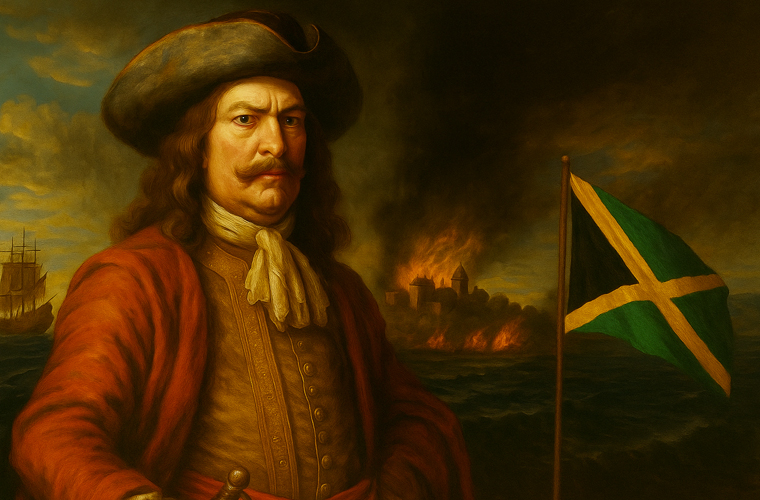
Sir Henry Morgan (c. 1635 – August 25, 1688) was a Welsh privateer, plantation owner, and later Lieutenant Governor of Jamaica who gained notoriety for his exploits in the Caribbean during the 17th century. Born in Monmouthshire, Wales, Morgan went to the West Indies in the 1650s, where he began his career at sea. In 1662, he received his first command as a privateer captain, attacking Santiago de Cuba. Morgan’s rise to prominence began in the 1660s when he joined privateering expeditions against Spanish colonies, earning a reputation for his ruthless tactics and military prowess.
Morgan’s successful raids on Puerto Principe (Cuba) and Portobelo (Panama) in 1667 earned him respect and further commissions. His most famous expedition was the attack on Panama City in 1671, which resulted in the city’s destruction and a significant haul of treasure. Despite the brutality of his attacks, Morgan’s actions were sanctioned by the English crown, and in 1674, he was knighted by King Charles II for his services.
Morgan amassed considerable wealth throughout his career, purchasing three large sugar plantations in Jamaica. However, his involvement in the slave trade was a significant and controversial aspect of his life. Morgan brought 700 planters and their slaves to Jamaica in 1664, greatly expanding the slave-dependent plantation economy of the island. By the time of his death, he owned 131 enslaved Africans on his estates, including 64 men, 67 women, and 33 children, valued at £1,923.
As Lieutenant Governor of Jamaica, Morgan led three campaigns against Jamaican Maroons, communities of escaped slaves led by Juan de Serras. While he failed to capture de Serras, his actions aimed to suppress slave rebellions and maintain the plantation system. Morgan also invested in private ships, which were often involved in the slave trade, and collaborated with other colonial officials to facilitate the trade of enslaved people.
Despite his controversial legacy, Morgan remained a prominent figure in popular culture long after his death. He is memorialized on the labels of Captain Morgan’s Spiced Rum, and his life has been dramatized in various novels, including John Steinbeck’s “A Cup of Gold” and Josephine Tey’s “The Privateer”. Sir Henry Morgan died on August 25, 1688, possibly due to tuberculosis or liver cirrhosis, leaving behind a complex legacy as both a celebrated privateer and a key figure in the expansion of slavery in the Caribbean.