
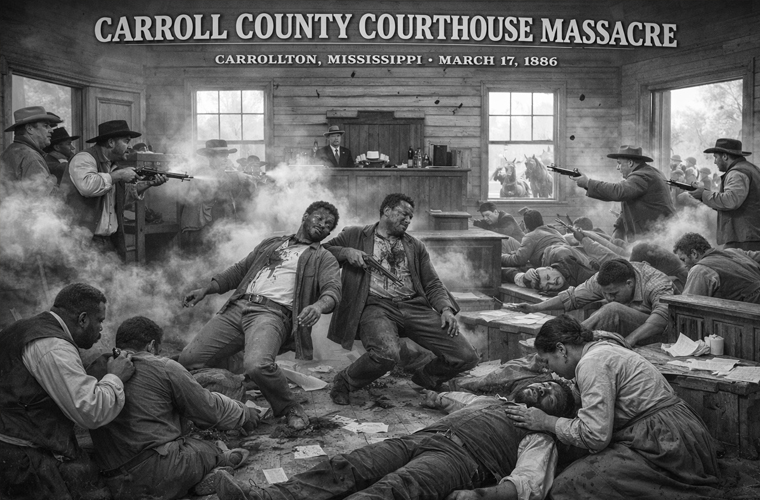
The Carroll County Courthouse Massacre of March 17, 1886, stands as one of the most brutal and unpunished acts of racial violence in post-Reconstruction America. Occurring in Carrollton, the county seat of Carroll County, Mississippi, the event saw a white mob storm the local courthouse and open fire on Black residents who had gathered for a trial, resulting in the deaths of at least 23 Black people.
The incident stemmed from an altercation earlier that year. In January or February 1886, two Black brothers, Ed Brown and Charley Brown (sometimes described as half-Black and half-American Indian in contemporary accounts), were delivering a barrel of molasses to a saloon in Carrollton. The barrel accidentally broke or spilled, splashing molasses onto the clothing of a white man named Robert Moore. Moore reacted angrily, and the situation escalated into a confrontation with local white attorney James Monroe Liddell (also known as Jim Liddell). Liddell allegedly assaulted the brothers during the altercation.
Determined to seek justice through the legal system—a bold and rare step for Black individuals in the Jim Crow South—the Brown brothers filed charges against Liddell for the assault. The mere act of Black men attempting to hold a white man accountable outraged many white residents in the deeply segregated and racially tense county. Rumors and threats circulated widely in the lead-up to the trial.
On March 17, 1886, the day the case was scheduled to be heard, a large group of armed white men—estimates range from 50 to over 100—rode into Carrollton on horseback. They stormed the courthouse, bursting into the courtroom or onto the grounds where Black residents, including the Brown brothers and their supporters, had assembled as witnesses, observers, or family members. The mob opened indiscriminate fire on the Black attendees. In the chaos, 23 Black people were killed immediately, including both Ed and Charley Brown. Some sources note that additional victims may have died later from their wounds, though the confirmed death toll is most often cited as 23. Remarkably, no white individuals in the courthouse—neither mob members nor bystanders—were injured by gunfire.
The massacre drew national attention and outrage, particularly in Black communities and among civil rights advocates. In Washington, D.C., prominent Black leaders and politicians met with President Grover Cleveland to urge federal intervention. Legislation was introduced in Congress calling for a formal investigation into the killings. However, these efforts were rebuffed; the federal government took no meaningful action.
Locally, authorities in Mississippi refused to pursue justice. No members of the mob were ever arrested, charged, or tried for the murders. Mississippi Governor Robert Lowry publicly defended the violence, blaming the victims by stating that “the riot was provoked and perpetrated by the outrage and conduct of the Negroes.” This stance reflected the prevailing racial attitudes of the era, where both law and extralegal terror upheld white supremacy.
Physical evidence of the atrocity lingered for over a century. Bullet holes—reportedly as many as 135 in the courtroom walls, benches, and surrounding areas—remained visible in the Carroll County Courthouse until the building underwent renovations in the 1990s.
The Carroll County Courthouse Massacre remains a stark example of the violent backlash against Black attempts at legal equality during the post-Reconstruction period. It highlights how the withdrawal of federal protections after 1877 enabled unchecked racial terror in the South, contributing to a climate where lynchings and mass killings went unpunished. To this day, the event is often described as a “cold case,” with no perpetrators ever held accountable, underscoring the enduring legacy of impunity in America’s racial violence.