
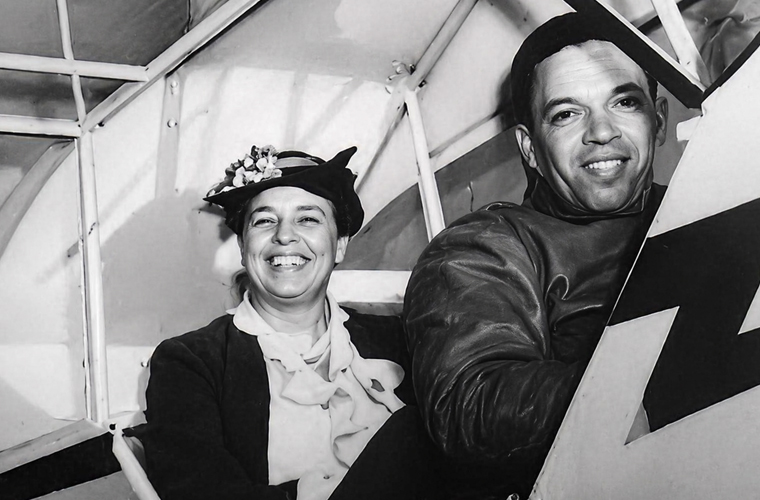
Charles Alfred “Chief” Anderson Sr. (February 9, 1907 – April 13, 1996) was a pioneering American aviator widely known as the “Father of Black Aviation.” He served as the chief flight instructor for the Tuskegee Airmen program during World War II, training hundreds of African American pilots and breaking racial barriers in aviation.
Born in Bryn Mawr, Pennsylvania (a Philadelphia suburb), to Iverson and Janie Anderson, Charles was an only child fascinated by airplanes from a young age. As a boy, he once ran away from home, hoping to find barnstorming pilots. Racial segregation denied him formal flight training, so he attended ground school, studied mechanics, and absorbed knowledge by hanging around airports.
At age 22, he borrowed $2,500 from friends and family to buy a used Velie Monocoupe. He largely taught himself to fly by taxiing, taking off, and landing, gaining cross-country experience through a deal with pilot Russell Thaw. In August 1929, he earned his private pilot’s license (No. 7638). Facing ongoing barriers, he trained under German-American aviator Ernest H. Buehl (“The Flying Dutchman”), becoming in February 1932 the first African American to earn an air transport pilot’s license from the Civil Aeronautics Administration—the equivalent of an advanced commercial rating.


Pre-WWII Achievements and Record Flights
In 1933, Anderson partnered with Dr. Albert E. Forsythe, a Black physician and pilot. Together, they completed the first transcontinental round-trip flight by Black pilots, flying from Atlantic City, New Jersey, to Los Angeles, California, and back in a Fairchild 24 (named The Pride of Atlantic City), using road maps for navigation with minimal instruments.
In 1934, they flew a goodwill Pan American tour in a Lambert Monocoupe christened The Spirit of Booker T. Washington, island-hopping through the Caribbean (including the first land-plane landing in the Bahamas) to Trinidad and the northeastern tip of South America. These high-profile flights promoted Black aviation, garnered international attention, and challenged stereotypes. Anderson also flew other “firsts” for Black pilots to Canada and various U.S. destinations.
On June 24, 1932, he married his childhood sweetheart, Gertrude Elizabeth Nelson of Ardmore, Pennsylvania. They had two sons: Charles Alfred Anderson Jr. and another (sometimes referenced in connection with the family legacy). Gertrude preceded him in death in 1995.
Tuskegee Airmen and WWII Role
In 1940, Tuskegee Institute recruited Anderson as chief civilian flight instructor for its Civilian Pilot Training Program (CPTP). He developed the curriculum, taught advanced courses, and earned the lifelong nickname “Chief” from students and colleagues due to his experience (he had logged thousands of hours by then). He recruited additional Black instructors and became ground commander and chief instructor for the 99th Pursuit Squadron, the first all-Black fighter squadron, which joined the 332nd Fighter Group (“Red Tails”).
A pivotal moment came on April 11, 1941, when First Lady Eleanor Roosevelt visited Tuskegee. Skeptical about Black pilots’ abilities (“colored people couldn’t fly”), she insisted on flying with Anderson in a Piper Cub. After a 40-minute flight, she declared, “Well, I see you can fly, all right!” This “Flight That Changed History” helped convince the Roosevelt administration to expand the Tuskegee pilot training program. Anderson also flew Vice President Henry Wallace.
Under his leadership (with other instructors), the program trained nearly 1,000 pilots, bombardiers, navigators, and support personnel from 1940 to 1946. The roughly 450 Tuskegee Airmen who saw combat flew 1,378 missions, destroyed 260 enemy aircraft, and earned over 150 Distinguished Flying Crosses. Anderson trained notables, including General Benjamin O. Davis Jr. and General Daniel “Chappie” James Jr.
Post-WWII Career and Legacy
After the war, Anderson stayed in Tuskegee, continuing instruction at Moton Field under the G.I. Bill for Black and white students, plus Army/Air Force ROTC cadets and civilians. He ran an aircraft sales and maintenance business in the Southeast and Southwest. In 1967, he co-founded Negro Airmen International (NAI), the oldest African American pilot organization, and for over 20 years directed its Summer Flight Academy for youth aged 16–19. He continued instructing until age 82 in 1989 and had logged over 52,000 hours of flight time by his death.
He advocated tirelessly for integrating African Americans into aviation and promoting aeronautical education in Black communities. In 1993 (at age 86), he recreated his 1934 Caribbean flight as a birthday gift to himself.
Anderson died peacefully at home in Tuskegee, Alabama, on April 13, 1996, after a battle with cancer. He was buried at Greenwood Cemetery in Tuskegee. His granddaughter, Christina L. Anderson, founded the C. Alfred “Chief” Anderson Legacy Foundation in 2012 to preserve his and the Tuskegee Airmen’s legacy.
Awards and Honors
- Enshrined in the National Aviation Hall of Fame (2013).
- U.S. Postal Service stamp in the Distinguished Americans series (unveiled 2014 at Tuskegee Airmen National Historic Site).
- Alabama Aviation Hall of Fame (1991).
- Brewer Trophy (1985).
- Honorary Doctorate of Science from Tuskegee University (1988).
- Inductee, International Order of the Gathering of Eagles (1990), among many others.
Chief Anderson’s life exemplified perseverance in the face of racism through self-reliance, skill, and mentorship. He not only flew record-setting missions but also directly enabled the Tuskegee Airmen’s success and inspired generations of pilots. His story remains central to African American aviation history and broader narratives of breaking barriers in the U.S. military and skies.