
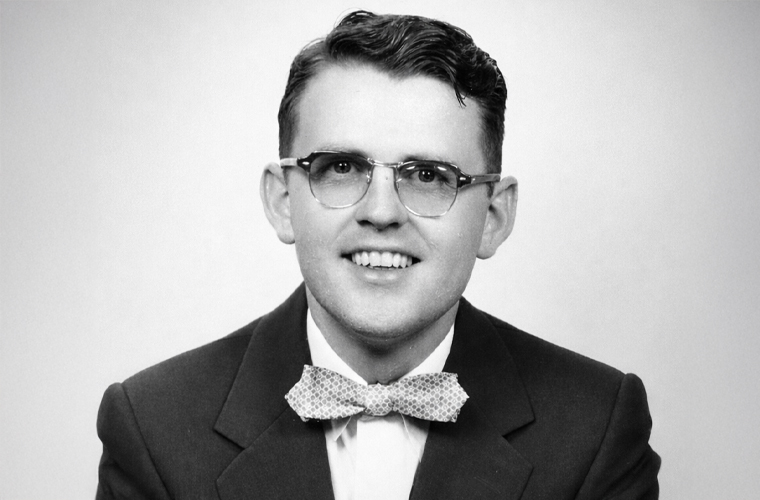
Unitarian Universalist Minister and Civil Rights Martyr
James Joseph Reeb was an American clergyman whose life and brutal death at the age of 38 became a defining turning point in the American Civil Rights Movement. Born in Wichita, Kansas, in 1927, his service in the U.S. Army shaped Reeb’s early life at the end of World War II and a profound calling to the ministry. He graduated from St. Olaf College before attending Princeton Theological Seminary, where he was ordained as a Presbyterian minister in 1953. However, his evolving theology and deep-seated commitment to social justice eventually led him to the Unitarian Universalist faith, a tradition he felt more closely aligned with his desire to combat systemic inequality through direct action.
By 1964, Reeb had moved his wife, Marie, and their four young children to the Dorchester neighborhood of Boston. Unlike many professionals of his era who opted for the suburbs, Reeb intentionally chose to live in the inner city to be in solidarity with the community he served. As the community relations director for the American Friends Service Committee, he dedicated himself to fair housing advocacy and to improving living conditions for Black citizens displaced by urban renewal projects.
The trajectory of Reeb’s life changed forever on March 8, 1965. Following the “Bloody Sunday” attacks at the Edmund Pettus Bridge in Selma, Alabama, Dr. Martin Luther King Jr. issued a nationwide plea for clergy of all faiths to join him for a second march. Reeb responded immediately, flying to Alabama that same evening. On March 9, after participating in the “Turnaround Tuesday” march, Reeb and two fellow ministers were leaving an integrated cafe when they were ambushed by a group of white supremacists. Reeb was struck in the head with a heavy wooden club, suffering a catastrophic brain injury. Because local Selma hospitals refused to treat him due to the racial nature of the conflict, he had to be transported to Birmingham. He died two days later on March 11, 1965.
The death of a white, Northern clergyman sparked a level of national outrage that previous murders of Black activists had often failed to generate in the mainstream media. This public outcry provided President Lyndon B. Johnson with the political leverage needed to push for federal intervention. In a historic televised address to Congress just days after Reeb’s death, Johnson invoked the sacrifice of “that good man” to demand the passage of the Voting Rights Act, famously concluding his speech with the movement’s anthem, “And we shall overcome.”
Though an all-white jury acquitted his attackers in December 1965, Reeb’s legacy remained intact as a “witness to the truth.” His martyrdom bridged the gap between the local struggle in the South and the conscience of the entire nation, proving that the fight for civil rights was a moral imperative that transcended race and geography.