
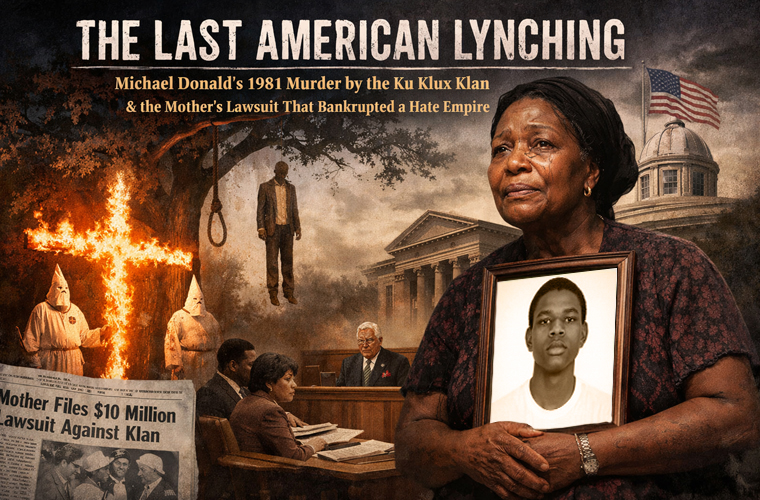
On the night of March 21, 1981, in Mobile, Alabama, 19-year-old Michael Donald—a young Black man with no criminal record or involvement in drugs—became the victim of one of the final recorded lynchings in United States history. Beaten, strangled, slashed across the throat three times, and hanged from a tree, his death was not the result of random street violence but a calculated act of racial terror orchestrated by members of the United Klans of America (UKA), one of the most violent factions of the Ku Klux Klan. What began as a brutal retaliation for a mistrial in an unrelated case evolved into a landmark civil rights victory when Donald’s mother, Beulah Mae Donald, refused to accept the initial police cover-up and launched a legal battle that ultimately dismantled the organization responsible.
The Spark: A Mistrial and a Klan Call for Revenge
The chain of events leading to Michael Donald’s murder traced back to Birmingham, Alabama, where Josephus Anderson, a Black man, stood trial for the 1979 armed robbery and murder of white police officer Albert Eugene Ballard. Due to intense pretrial publicity, the case was moved to Mobile. Anderson’s second trial ended in a mistrial on March 20, 1981, when a mixed-race jury deadlocked and could not reach a verdict on any of the four counts. Local media reported the outcome that evening.
That same night, members of UKA Unit 900 gathered in Mobile. Bennie Jack Hays—the second-highest-ranking official in the Alabama Klan and father of one of the eventual killers—voiced the group’s fury: “If a black man can get away with killing a white man, we ought to be able to get away with killing a black man.” His son, 26-year-old Henry Francis Hays (Exalted Cyclops of the local unit), and 17-year-old James “Tiger” Knowles took the statement as a directive. Armed with a gun and a rope borrowed from Frank Cox (Hays’s brother-in-law), they drove through a predominantly Black neighborhood searching for a target. Michael Donald was walking home after buying cigarettes for his sister at a nearby gas station. The Klansmen lured him over by asking for directions, then forced him into their car at gunpoint. They drove him to a secluded wooded area near Mobile Bay.


The Brutal Killing
Donald fought back. He knocked away Henry Hays’s gun and fled into the woods. The two men pursued him, beating him severely with a tree limb. Hays then looped the rope around Donald’s neck and strangled him while Knowles continued the assault. Once Donald stopped moving, Hays slit his throat three times “to make sure he was dead.” The pair returned to Mobile and hung the body from a tree on Herndon Avenue—directly across the street from Henry Hays’s own home. It remained there until it was discovered the next morning. To celebrate, two other UKA members burned a cross on the lawn of the Mobile County courthouse that same night.
A Botched Investigation and a Mother’s Unyielding Demand for Truth
Local police initially dismissed the murder as drug-related violence. They arrested three suspects based on a tip from a man who later admitted to perjury, claiming the killing stemmed from a botched deal. Autopsies and tests confirmed no drugs in Michael Donald’s system, and his family—particularly his mother, Beulah Mae—insisted he had no involvement in such activity. Beulah Mae Donald, a 60-year-old single mother of seven who had worked in hotels and raised her children alone after a divorce, refused to let the case die. She contacted civil rights leader Rev. Jesse Jackson, who helped organize protest marches in Mobile demanding answers. The initial suspects were released, and the FBI nearly closed its file. It was Assistant U.S. Attorney Thomas Figures, working with FBI agent James Bodman, who insisted on reopening the investigation. Beulah’s brother, state senator and attorney Michael Figures, also applied pressure. After more than two years of advocacy, the breakthrough came in 1983.
Criminal Convictions and the First Execution in Decades
Henry Hays and James Knowles were charged with murder. Knowles later pleaded guilty to federal civil rights violations, testifying that the killing was intended “to show Klan strength in Alabama.” He received a life sentence but avoided the death penalty by cooperating. Henry Hays was convicted of capital murder; though the jury recommended life, the judge imposed death. Benjamin Franklin Cox Jr., the truck driver who supplied the rope and pistol, was initially shielded by the statute of limitations but was later convicted as an accomplice and sentenced to life. Bennie Jack Hays was indicted for inciting the murder, but died before a retrial.
Henry Hays became the first white man executed in Alabama for killing a Black person since 1913. On June 6, 1997, he died in the electric chair known as “Yellow Mama.” Two days earlier, he privately confessed to a minister and renounced his racist views. His brother, Stanley Donald, witnessed the execution. James Knowles was paroled after 25 years in 2006 and entered witness protection. Cox was paroled in 2000.
Beulah Mae Donald’s Civil Suit: Holding the Klan Accountable
Even after the criminal convictions, Beulah Mae Donald wanted more. She sought to expose the UKA’s institutional responsibility. In 1984, with the help of her attorney Michael Figures and Southern Poverty Law Center founder Morris Dees, she filed a wrongful death lawsuit in federal court against the United Klans of America and its members. The suit argued that the killers acted as agents of the organization under an “agency theory” of liability.
Beulah refused a $1 million settlement offer, insisting on a full trial so the world would understand “how and why they did it.” On February 12, 1987, an all-white jury deliberated for just four hours before awarding her $7 million in damages—the largest civil verdict against a hate group at the time. The UKA, unable to pay, filed for bankruptcy. The organization surrendered its national headquarters in Tuscaloosa (sold for just $51,875), and individual members faced wage garnishments and property seizures. The judgment bankrupted the UKA, effectively ending its operations in Alabama and setting a precedent for using civil lawsuits to combat hate groups.
Beulah Mae Donald lived to see the verdict but died of natural causes on September 17, 1988, at age 67. In her final years, she received national honors, including being named one of Ms. magazine’s Women of the Year. She once told a Klansman during the proceedings, “I do forgive you. From the day I found out who you all were, I asked God to take care of y’all, and he has.”
Legacy: A Street Renamed, a Precedent Set
Michael Donald’s murder is widely recognized as one of the last lynchings in America. In 2006, the city of Mobile renamed Herndon Avenue “Michael Donald Avenue” in his honor. Author Ravi Howard later fictionalized the community’s trauma in the novel Like Trees, Walking. The case inspired documentaries, including CNN’s The People v. The Klan, and remains a cornerstone example of how persistent activism and innovative legal strategy can confront systemic racism.
Beulah Mae Donald’s victory proved that justice could extend beyond individual convictions to dismantle entire organizations built on hate. As her attorney, Michael Figures reflected, she was “the rock on which all of this was ultimately built.” Her courage transformed personal grief into a lasting blow against white supremacist terror, ensuring that Michael Donald’s death was not in vain but a catalyst for accountability that echoes in civil rights law to this day.