
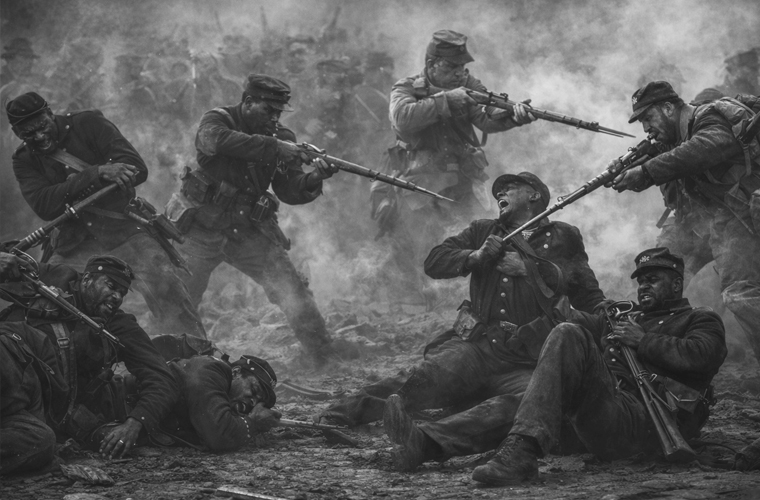
A Dark Chapter in the American Civil War
On April 12, 1864, along the banks of the Mississippi River in Lauderdale County, Tennessee, one of the most infamous atrocities of the American Civil War unfolded at Fort Pillow. Confederate forces under the command of Major General Nathan Bedford Forrest overran a small Union garrison, only to unleash a wave of violence that claimed the lives of hundreds of surrendering soldiers—predominantly African American troops. What began as a tactical assault devolved into what many historians describe as a deliberate massacre, fueled by racial animus and the brutal realities of a war increasingly divided along lines of emancipation and equality. The event shocked the nation, becoming a rallying cry for Union forces and a stain on the Confederacy’s legacy that endures to this day.
The Fort Pillow Massacre cannot be understood without the broader context of the Civil War’s evolving stakes. By 1864, President Abraham Lincoln’s Emancipation Proclamation had transformed the conflict into a fight for abolition, prompting the enlistment of nearly 180,000 African American men into the United States Colored Troops (USCT). This development enraged Confederate leaders, who viewed Black soldiers not as legitimate combatants but as escaped slaves or insurrectionists. In May 1863, the Confederate Congress passed a law declaring that captured Black Union soldiers would be turned over to state authorities for re-enslavement or execution, while their white officers faced trial for inciting servile insurrection.
Fort Pillow itself was a modest earthwork fortification constructed in early 1862 by Confederate Brigadier General Gideon J. Pillow—after whom it was named—overlooking a strategic bend in the Mississippi River, about 40 miles north of Memphis. Designed to impede Union naval advances, it featured three lines of entrenchments, rifle pits, and several artillery pieces. After the Confederate loss at Memphis in June 1862, the fort fell into Union hands with little resistance and was garrisoned lightly, serving more as a supply depot and lookout post than a major defensive stronghold.
Enter Nathan Bedford Forrest, a self-taught tactician and former slave trader whose cavalry raids terrorized Union supply lines in the Western Theater. In March 1864, Forrest launched a daring expedition into West Tennessee and Kentucky with 1,500–2,500 mounted troops, divided into divisions under Brigadier Generals James R. Chalmers and Abe Buford. His objectives were pragmatic: capture Union prisoners, seize supplies, and disrupt fortifications to relieve pressure on Confederate forces elsewhere. Skirmishes along the way built momentum, culminating in the decision to strike Fort Pillow on April 11.
The Union garrison numbered around 585–605 men, a mix of roughly 262 Black soldiers from the 6th U.S. Regiment Colored Heavy Artillery and the Memphis Battery Light Artillery, and 295 white troops from the 13th Tennessee Cavalry under Major William F. Bradford. Commanded initially by Major Lionel F. Booth, a veteran of earlier engagements, the defenders were outnumbered but positioned advantageously atop bluffs, supported by the ironclad gunboat USS New Era on the river below.
The Assault on Fort Pillow
Dawn broke on April 12 with Confederate scouts probing the fort’s perimeter. By mid-morning, Forrest had enveloped the position, with Chalmers’s men seizing nearby buildings and cutting off escape routes. A Confederate sharpshooter mortally wounded Booth early in the engagement, thrusting Bradford into command. Union artillery and rifle fire initially repelled probes, but the Confederates maintained relentless pressure, their dismounted cavalry using the terrain’s cover to close in.
Around 11:00 a.m., Forrest dispatched a courier under a flag of truce demanding unconditional surrender. He promised to treat prisoners humanely “as prisoners of war,” but Bradford, wary of Forrest’s reputation and hoping for reinforcements from the New Era or nearby garrisons, requested a one-hour truce. Forrest, ever aggressive, granted only 20 minutes before resuming fire. As the deadline expired, waves of Confederate infantry—many on foot after exhausting their horses—scaled the steep bluffs and breached the outer works. The Union line crumbled under the onslaught; defenders fled toward the riverbank, expecting the gunboat’s cannons to provide covering fire. Tragically, the New Era’s commander hesitated, fearing friendly fire, and held back.
By noon, the fort was in Confederate hands. Scattered pockets of resistance dissolved into chaos as Union soldiers, many discarding their arms, sought shelter along the water’s edge or attempted to swim across the Mississippi.
The Massacre Unfolds
What followed has been etched into history as the Fort Pillow Massacre. Eyewitness accounts from Union survivors paint a harrowing picture: As white and Black troops alike threw down their weapons and raised white flags or handkerchiefs in surrender, Confederate soldiers—shouting “No quarter!” and “Kill the damned Black sons of bitches!”—opened fire indiscriminately. Bayonets and clubbed muskets finished off the wounded. Some victims were herded to the river’s edge and shot at point-blank range; others drowned while fleeing into the current, weighed down by equipment or wounds.
The racial dimension was stark. Approximately 70% of the Black Union soldiers—around 200 men—were killed, compared to just 20% of their white counterparts. One survivor, USCT private Armstead Burgess, later recounted being spared only after capture, then forced into labor before rejoining Union ranks. A chilling Confederate corroboration came in a letter from Sergeant Achilles V. Clark: “We shot them like dogs… the slaughter was awful.” Women and children present in the fort had been evacuated beforehand, sparing them the horror, but the garrison’s surgeon and other noncombatants witnessed the brutality.
Confederate apologists, including Forrest, claimed the killings stemmed from the fog of battle: fleeing troops who retained their arms posed a threat, and the refusal to surrender justified harsh measures. However, federal investigations, including a 1864 congressional inquiry, debunked these defenses, concluding that the violence targeted disarmed prisoners in a premeditated act of racial vengeance.
Aftermath and Investigations
The toll was devastating. Confederate losses were light—14 killed and 86 wounded—reflecting the assault’s one-sided nature. Union casualties numbered 221–297 dead (including drownings), with 130 wounded and only 226 captured (58 Black and 168 white). Of those taken prisoner, some faced summary execution in the following days. Forrest’s forces looted the fort’s supplies but abandoned the site shortly after, gaining little strategic ground.
News of the massacre spread rapidly, igniting outrage in the North. On April 17, General Ulysses S. Grant demanded that Confederate authorities treat Black prisoners equally or face reprisals against captured Confederates. Richmond’s Secretary of War James Seddon rebuffed the ultimatum, insisting on the May 1863 policy. President Lincoln, who had authorized retaliatory executions in 1863, refrained from immediate action to avoid escalating prisoner abuses further. The event echoed in later battles, such as the Crater in July 1864, where similar fates befell Black troops.
A joint congressional committee’s report in 1864 branded the incident a “massacre,” based on survivor testimonies and forensic evidence. Southern accounts, including Forrest’s memoirs, portrayed it as a legitimate combat victory, but modern historians like Albert Castel and Richard Fuchs affirm the massacre’s occurrence, attributing it to deep-seated racism rather than explicit orders from Forrest.
Legacy and Remembrance
The Fort Pillow Massacre reverberated through the war’s final year, galvanizing Black recruits with the defiant slogan “Remember Fort Pillow!” It underscored the perilous stakes for USCT soldiers, who fought not just for Union victory but for recognition as equals in arms—and in death. The event contributed to the Union’s hardening resolve, influencing policies on prisoner exchanges and bolstering support for emancipation.
In the postwar era, Fort Pillow faded from some narratives, overshadowed by larger battles like Gettysburg or Appomattox. Yet its shadow loomed in literature—Mark Twain alluded to it in Life on the Mississippi—and popular culture, appearing in novels like Frank Yerby’s The Foxes of Harrow and documentaries such as The Forgotten Battle of Fort Pillow. Forrest, who later founded the Ku Klux Klan, denied wrongdoing until he died in 1877, complicating his legacy as a military genius tainted by atrocity.
Today, Fort Pillow State Historic Park preserves the site, designated a National Historic Landmark in 1974. Annual commemorations on April 12 include wreath-layings and readings of the fallen’s names, while the remains of 109 USCT soldiers rest in Memphis National Cemetery, relocated there in 1867. Efforts by park rangers and historians continue to educate visitors, countering historical erasure and honoring the valor of those who perished. The massacre serves as a grim reminder of war’s racial undercurrents, urging reflection on America’s unfinished reckoning with its past.