
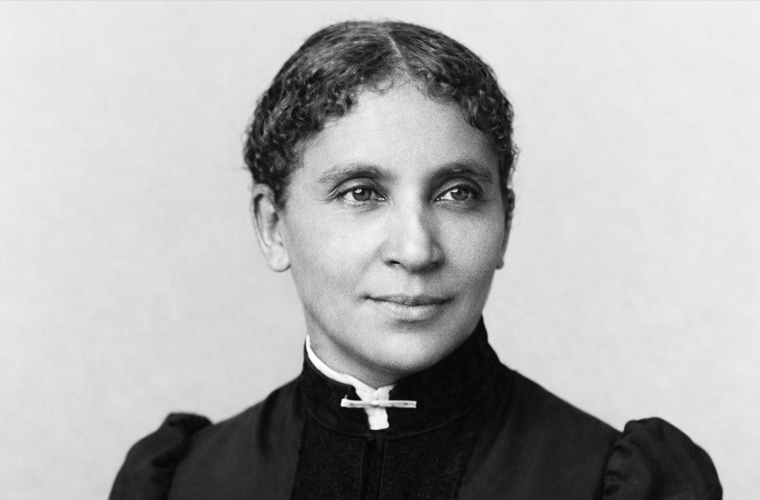
Charlotte Louise Bridges Forten Grimké (née Forten; August 17, 1837 – July 23, 1914) was a prominent African American abolitionist, poet, educator, and civil rights activist. She is best remembered for her detailed diaries chronicling life as a free Black woman in the antebellum North, her pioneering teaching work with freedpeople during the Civil War era (including as one of the first Northern Black teachers in the South), and her lifelong commitment to education, racial equality, and women’s rights.
Born in Philadelphia, Pennsylvania, into a wealthy and influential free Black family, Charlotte was the daughter of Robert Bridges Forten (a mathematician, public speaker, and businessman) and Mary Virginia Wood Forten. Her mother died when Charlotte was just three years old. Her grandfather, James Forten Sr., was a successful sailmaker who amassed significant wealth and used it to support the abolitionist movement, the Underground Railroad, and The Liberator. The Forten family hosted leading abolitionists (both Black and white) and maintained close ties with figures like William Lloyd Garrison and John Greenleaf Whittier. Her grandmother, Charlotte Vandine Forten, and aunts (including Sarah, Harriet, and Margaretta) were founding members of the Philadelphia Female Anti-Slavery Society.
This environment immersed Charlotte in activism, intellectual pursuits, and a commitment to social justice from a young age. Philadelphia’s segregated public schools prompted her father to arrange private tutoring and later send her north for better educational opportunities.
Education and Early Career in Salem, Massachusetts
At age 16 (around 1853–1854), Charlotte moved to Salem, Massachusetts—a progressive community with integrated schools—to continue her studies. She boarded with family friends, including abolitionist Charles Lenox Remond, and attended Higginson Grammar School as the only Black student among about 200. She later enrolled in the Salem Normal School (now Salem State University), graduating in 1856 as its first known African American graduate.
She began teaching at the all-white Epes Grammar School in Salem, becoming one of the first Black teachers hired to instruct white students in the public schools there. During this period, she joined the Salem Female Anti-Slavery Society, engaged in fundraising and coalition-building, and started writing poetry and keeping her famous journals (begun in 1854). Her poems appeared in antislavery publications like The Liberator. She described her Salem school days as among the happiest of her life. Health issues, including recurring “lung fever” (pneumonia or tuberculosis), forced her to return to Philadelphia temporarily, but she remained deeply involved in abolitionist circles.
Civil War Era and Teaching Freedpeople
A fervent abolitionist, Charlotte closely followed the Civil War. In 1862, she volunteered for the Port Royal Experiment on the Sea Islands off South Carolina (particularly St. Helena Island), where Union forces had occupied plantations abandoned by Confederate owners, leaving thousands of formerly enslaved people. She taught at the Penn School (one of the first schools for freed African Americans) and other sites, often at Brick Baptist Church, becoming the first Black teacher in Beaufort County.
Her experiences are vividly captured in her two-part essay “Life on the Sea Islands” (published in The Atlantic Monthly in May and June 1864), which brought national attention to the freedpeople’s efforts and the educational mission. She met Harriet Tubman there and expressed deep fulfillment in her work, writing of gathering her scholars and aiding “a long-abused race.” She taught for about two years before health problems, compounded by the deaths of her friend Colonel Robert Gould Shaw (of the 54th Massachusetts Regiment) and her father (who served in the Union Army), led her to return north.
Post-War Work, Writings, and Activism
After the war, Charlotte worked as secretary of the Boston branch of the Freedmen’s Union Commission (recruiting and training teachers), taught at an all-Black school, and served as a clerk in the U.S. Treasury Department in Washington, D.C. (starting around 1873). She continued writing poetry and essays. Her five volumes of diaries (spanning 1854–1864 and 1885–1892, with some gaps) provide rare, eloquent insights into the life of an educated, cultured free Black woman during this transformative era. They were published posthumously (first edited edition in 1953; comprehensive edition in 1988 as The Journals of Charlotte Forten Grimké) and remain key primary sources.
Marriage and Later Life in Washington, D.C.
In 1878, at age 41, she married Francis James Grimké (13 years her junior), a Presbyterian minister, former slave, and nephew of the famous white abolitionist Grimké sisters (Sarah and Angelina). The couple settled in Washington, D.C., where he pastored the Fifteenth Street Presbyterian Church for decades. They had one daughter who died in infancy. Charlotte continued her literary and activist work, publishing poems (e.g., about Frederick Douglass and the Corcoran Art Gallery) and residing for a time in the Dupont Circle area. She co-founded the Colored Women’s League (1892) with figures like Ida B. Wells and Mary Church Terrell, and helped establish the National Association of Colored Women (1896), focusing on education, health, social services, and political activism. She supported women’s suffrage and remained active in civil rights until late in life. The couple’s home in D.C. is on the National Register of Historic Places.
Death and Legacy
Charlotte Forten Grimké died on July 23, 1914, in Washington, D.C., at age 76 (some sources note complications from a cerebral embolism or long-term invalidity). She is buried in National Harmony Memorial Park Cemetery in Hyattsville, Maryland. Her husband outlived her by over two decades and never remarried. Her legacy endures as a trailblazer in education, literature, and activism. Salem State University honors her with a legacy room and events; a statue and park in Salem commemorate her; and her writings continue to illuminate Black women’s experiences in 19th-century America. She exemplified dedication to equality, self-reliance through education and work, and the power of the pen in the fight for justice. Her life bridged the abolitionist era and the early civil rights movement, influencing later generations through her documented insights and unwavering commitment to upliftment.