
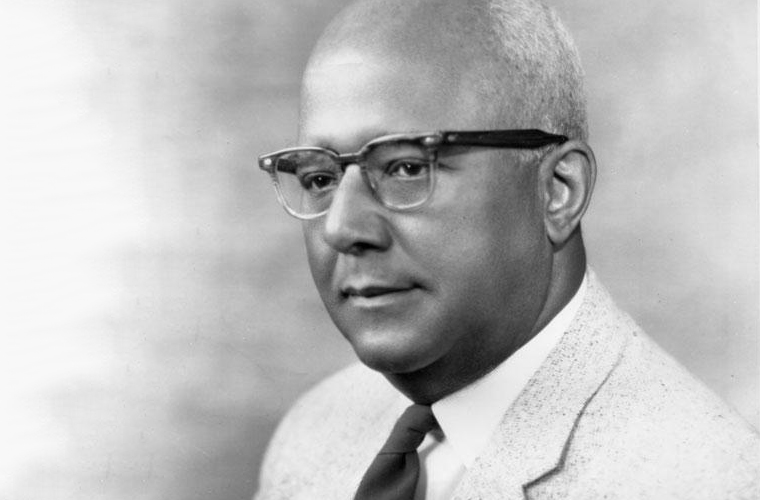
Historian and anthropologist, William Leo Hansberry began his college education at Atlanta University, but (at the urging of W.E.B. DuBois) he transferred to Harvard in 1917. Based on his reading of classical texts and his study of archeological evidence, Hansberry became convinced as an undergraduate that sophisticated civilizations had existed in Africa–especially in Ethiopia–for centuries prior to the rise of the Greeks and Romans in Europe. He pursued that premise for the rest of his life.
A circular letter announcing his desire to develop courses in African civilization landed him a temporary job at Howard University in Washington D.C., following his graduation from Harvard in 1921. There he quickly built his new program into one of the most popular undergraduate majors on the campus, and he hosted international conferences to stimulate the study of ancient and medieval African societies. By the mid-1920s, however, he ran afoul not only of the wider white academic community, which was extremely skeptical of Hansberry’s ambitious claims but also of senior colleagues at Howard, who believed he was giving the university a bad name by teaching assertions for which there was little or no compelling evidence. The Howard board settled the dispute by retaining the popular African program while relegating Hansberry himself to a secondary position without tenure.
Through the 1930s, Hansberry continued to pursue evidence of early African civilization while studying again at Harvard (M.A. 1932), at the University of Chicago’s Oriental Institute, at Oxford, in Europe, and in Africa. Not until after WWII did Howard finally promote him to associate professor with tenure, and during the 1950s he lectured and traveled widely throughout Africa. Hansberry became a mentor to many African American and African students, including Nnamdi Azikiwe, the first president of post-colonial Nigeria. That nation named one of its academic centers in Hansberry’s honor in 1963. In 1964, Hansberry received the first Haile Selassie Prize. Though he never published the magnum opus his admirers had hoped for, much of his research was posthumously edited by Joseph E. Harris and printed in two volumes by Howard University Press: Pillars in Ethiopian History (1974), and Africa and Africans as Seen by Classical Writers (1977).