
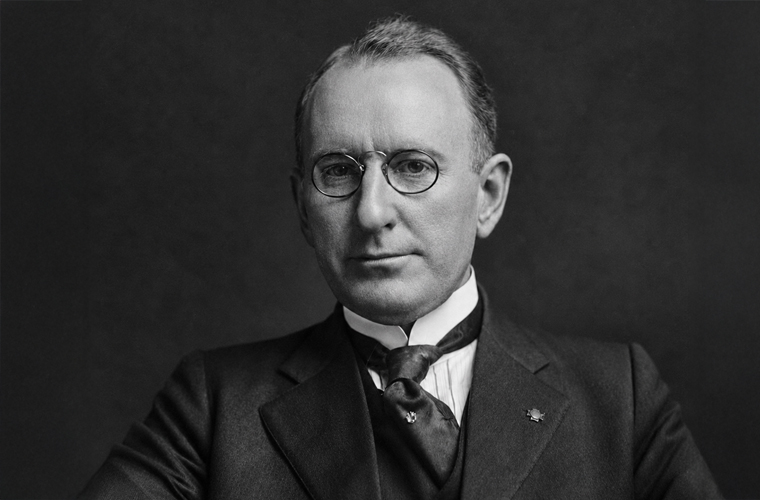
William Joseph Simmons (May 7, 1880 – May 18, 1945) was an American Methodist preacher, teacher, and fraternal organizer best known as the founder and first Imperial Wizard of the second Ku Klux Klan (KKK), which he revived in 1915.
He led the organization from its ceremonial founding on Stone Mountain, Georgia, until internal power struggles led to his ouster in 1922–1923 by Hiram Wesley Evans. Under Simmons, the Klan transformed from a small, regional group into a nationwide fraternal order emphasizing “100% Americanism,” white Protestant supremacy, nativism, and opposition to immigration, Catholicism, and Judaism. At its peak in the mid-1920s (after his departure), the organization claimed millions of members and significant political influence before declining amid scandals.
Early Life
Simmons was born in Harpersville, Alabama (Shelby County), to Calvin Henry Simmons, a physician, and Lavonia Simmons (née Davis). His father had reportedly been involved with the original post-Civil War Klan. As a young man, Simmons aspired to study medicine at Johns Hopkins University but could not afford it. Instead, he enlisted in the Alabama Volunteers during the Spanish-American War, serving briefly before receiving an honorable discharge.
After the war, he worked as a circuit-riding Methodist preacher in Alabama and Florida but was suspended by the church in 1912 for inefficiency. He became deeply involved in fraternal organizations, joining groups such as the Woodmen of the World (where he earned the title “Colonel”). He was known by nicknames such as “Joe,” “Doc,” and “Colonel.” These experiences in promotion and ritualistic fraternalism heavily influenced his later approach to rebuilding the Klan as a structured, membership-driven secret society.
Revival of the Ku Klux Klan (1915)
In 1915, while recovering from injuries sustained in a car accident, Simmons was inspired by D.W. Griffith’s film The Birth of a Nation (based on Thomas Dixon Jr.’s The Clansman), which glorified the original Reconstruction-era Klan. He also drew from the atmosphere surrounding the Leo Frank trial and lynching in Atlanta, which fueled anti-Semitic sentiments.
Simmons obtained a copy of the original Klan’s “Prescript” and drafted his own prospectus for a new organization. On Thanksgiving evening, November 25, 1915, he led a small group of about 15 men—including friends and two surviving members of the original Klan—up Stone Mountain near Atlanta. They built an altar, burned a large cross (an innovation drawn from the film, not a tradition of the first Klan), and took oaths to the “Invisible Empire.” Simmons proclaimed himself Imperial Wizard of the Knights of the Ku Klux Klan.
The new Klan adopted white hooded robes and masks (popularized by the film), elaborate rituals, and a hierarchical structure with titles like Kleagle (recruiter), Cyclops, and Wizard. It positioned itself initially as a patriotic, Protestant fraternal order promoting morality, anti-immigration views, and “pure Americanism” amid rapid social changes, including waves of Catholic and Jewish immigrants from Southern and Eastern Europe.
Growth was modest at first—only a few thousand members in the initial years—largely confined to Georgia and nearby areas.
Leadership and Expansion (1915–1922)
Simmons served as a professor of Southern history at the short-lived Lanier University in Atlanta while leading the Klan. Significant expansion began around 1920 when he hired the Southern Publicity Association, run by Edward Young Clarke and Elizabeth Tyler, to professionalize recruitment. They deployed “Kleagles” (salesmen) on commission, rapidly growing membership to around 100,000 by late 1921.
The organization spread to the Midwest and other regions, capitalizing on nativist, anti-Catholic, and racial anxieties. Simmons emphasized the Klan’s “fraternal” and Christian aspects, framing it as a defender of traditional Protestant values. He authored pamphlets and books such as The Ku Klux Klan (1917), ABC of the Invisible Empire (1920), and later works like The Klan Unmasked (1923) and America’s Menace (1926).
In 1921, the New York World published exposés on Klan violence and activities, prompting a U.S. House Committee on Rules investigation. Simmons testified, portraying the Klan as a benign fraternal group and distancing it from violent acts. The hearings produced no immediate legal repercussions and, counterintuitively, boosted publicity and recruitment.
Ouster and Later Activities
Internal tensions grew over finances, control, and Simmons’ leadership style. Hiram Wesley Evans, a Dallas dentist who had risen quickly in the Texas Klan, along with others, challenged Simmons and Clarke for perceived incompetence and profiteering. At a 1922 Klonvocation in Atlanta, Simmons was elevated to “Emperor for Life” (a largely ceremonial role), while Evans became Imperial Wizard. Real power shifted to Evans, leading to a power struggle.
Simmons eventually accepted a financial settlement (reportedly around $146,000) and relinquished his copyrights and influence in the main Klan. In the mid-1920s, he and his associate, Roy Elonzo Davis, attempted to launch a rival group, the Knights of the Flaming Sword, but it failed to gain significant traction compared to the Evans-led Klan.
The second Klan peaked in the mid-1920s with estimates of 3–5 million members at one point but declined sharply due to scandals (such as the D.C. Stephenson rape and murder case in Indiana), internal corruption, and shifting public opinion.
Death and Legacy
Simmons lived his later years in Atlanta. He died there on May 18, 1945, at age 65. His legacy is that of the architect of the second Klan, which brought the organization into the 20th century as a mass movement with political clout (influencing elections in states like Indiana, Oregon, and others) but also widespread violence, intimidation, and bigotry. Simmons’ innovations—such as the burning cross ritual and modern marketing—shaped the Klan’s image for decades. While he presented the group as a defender of American Protestant values, historians view it as a vehicle for white supremacy, nativism, and reaction against modernity and demographic change.
The second Klan’s influence waned by the late 1920s–1930s, though the organization persisted in various forms. Simmons’ role highlights the interplay of fraternal culture, media (notably Birth of a Nation), and social anxieties in early 20th-century America.
Note: This article draws from historical sources and aims for factual accuracy. The Ku Klux Klan’s activities involved documented violence, racism, and terrorism, which Simmons publicly disavowed in testimony while leading an organization that practiced them. For deeper reading, consult primary sources like congressional hearings or scholarly works on the era.