
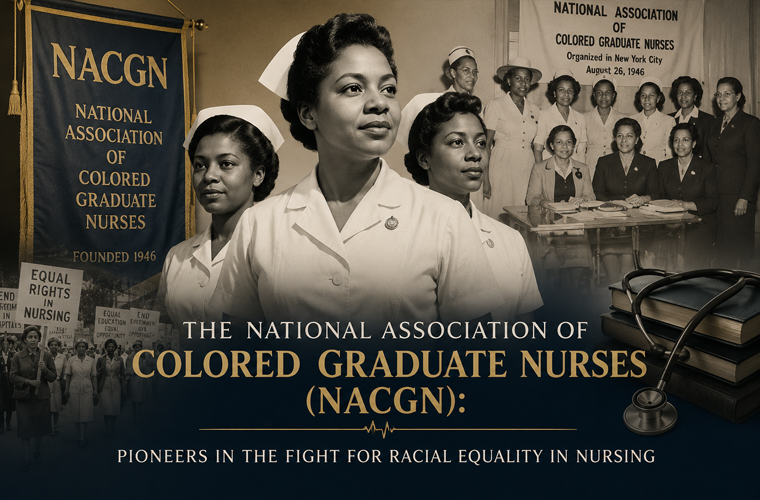
Pioneers in the Fight for Racial Equality in Nursing
The National Association of Colored Graduate Nurses (NACGN) was a groundbreaking professional organization founded in 1908 by African American nurses in the United States. It emerged during an era of deep racial segregation in healthcare and nursing education, serving as a vital platform for Black nurses to advance professional standards, combat discrimination, and create opportunities where mainstream organizations like the American Nurses Association (ANA) largely excluded them.
At the turn of the 20th century, nursing was a rapidly professionalizing field, but racial barriers severely limited opportunities for Black women. Most nursing schools refused Black applicants, public employers and hospitals practiced segregation, and many state nurses’ associations barred Black members. This effectively excluded qualified Black nurses from full participation in the American Nurses Association (formed in 1911 from earlier groups), which required state-level membership.
Black nurses faced limited access to training, employment, and military service. Hospitals often maintained stark disparities in care for Black patients, and professional advancement was hindered by systemic racism. In response, visionary leaders decided to organize independently.
Founding and Early Years
On August 25, 1908, 52 Black graduate nurses convened in New York City at St. Mark’s Methodist Episcopal Church. The meeting was organized by Martha Minerva Franklin, a nurse from Connecticut who had surveyed Black nurses nationwide about their challenges. Franklin was unanimously elected as the organization’s first president.
Key co-founders and early leaders included:
- Mary Eliza Mahoney — The first African American licensed professional nurse in the U.S. (graduated in 1879), who served as a co-founder and lifelong advocate.
- Adah Belle Samuels Thoms, who became president in 1916 and served as the first treasurer.
The NACGN adopted the motto “Not for ourselves, but for humanity” and set three primary goals:
- To advance the standards and best interests of trained nurses.
- To break down discrimination in the nursing profession.
- To develop leadership within the ranks of Black nurses.
The first annual convention was held in Boston in 1909. Early growth was modest—125 members by 1912 and about 500 by 1920—but the organization expanded through state chapters (such as the North Carolina Association of Colored Graduate Nurses) and built alliances, including with the National Medical Association.
Leadership and Key Achievements
The NACGN’s success relied on dedicated leaders who combined professional excellence with activism:
- Adah Belle Samuels Thoms (President from 1916): Established the first national job registry for Black nurses and advocated successfully for their inclusion in the U.S. Army Nurse Corps during World War I, especially amid the 1918 flu pandemic. Eighteen Black nurses were eventually appointed.
- Carrie E. Bullock (President 1927–1930): Enhanced communication by founding and editing The National News Bulletin.
- Estelle Massey Osborne (President 1934–1939): The first Black nurse to earn a master’s degree in nursing. She prioritized hiring a paid executive secretary and pushed for broader integration.
- Mabel K. Staupers (Executive Secretary from 1934): Arguably the most influential leader in the organization’s later years. She orchestrated major campaigns for military integration and was a tireless lobbyist.
By the 1940s, the NACGN had grown significantly, with nearly 11,000 graduate nurses and students connected through its headquarters by 1944 and over 200 affiliated groups.
World War II and Major Victories
The NACGN’s efforts peaked during World War II. Initially, the U.S. military imposed quotas and restrictions on Black nurses despite urgent needs. Staupers and the organization launched letter-writing campaigns, met with Eleanor Roosevelt and other officials, and secured support from Congresswoman Frances P. Bolton.
Key outcomes included:
- The Bolton Act (Nurse Training Act of 1943), which included an anti-discrimination amendment and funded the U.S. Cadet Nurse Corps. This enabled thousands of Black (and Indigenous) nurses to train.
- Increased recruitment into the Army Nurse Corps (reaching about 400 Black nurses by war’s end) and acceptance into the Navy Nurse Corps.
- Broader acceptance in nursing education and state associations.
These wartime gains accelerated integration in the broader profession.
Merger with the American Nurses Association (1951)
By the late 1940s, as more nursing schools and state associations opened to Black members amid the growing Civil Rights Movement, the NACGN’s original mission of separate advocacy became less necessary. In 1949, members voted to merge with the ANA. The organization officially dissolved in 1951, with its functions absorbed into the ANA.
The ANA continued the Mary Mahoney Award (created by the NACGN in 1936) to honor contributions to intergroup relations.
Legacy and Impact
The NACGN transformed American nursing by:
- Providing professional support, education, and employment assistance when none existed.
- Forcing the integration of the military nursing corps.
- Advancing civil rights in healthcare decades before broader societal changes.
- Developing generations of Black nursing leaders who influenced academia, policy, and clinical practice.
Its dissolution marked a victory rather than defeat—the successful fulfillment of its core goals. Today, the NACGN is remembered as a cornerstone of equity in nursing. Organizations like the National Black Nurses Association continue this legacy of advocacy. The courage of NACGN members—facing exclusion, quotas, and segregation—improved not only opportunities for Black nurses but the entire profession’s commitment to care without prejudice. Their story underscores how targeted, persistent collective action can dismantle systemic barriers.