
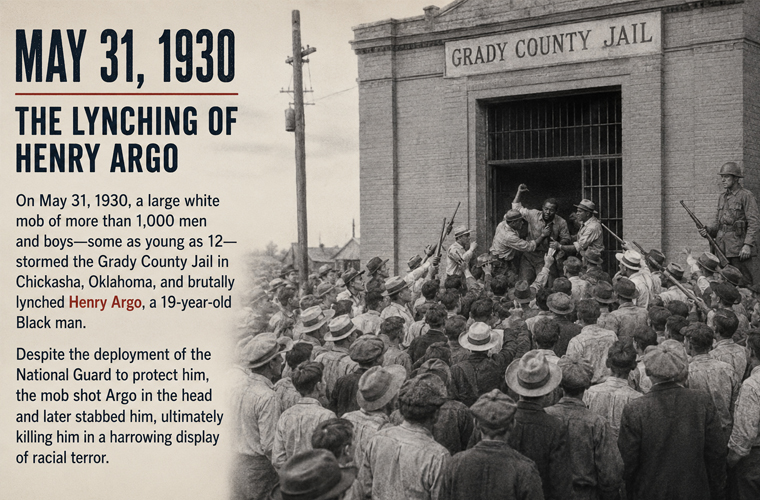
On May 31, 1930, a large white mob of more than 1,000 men and boys—some as young as 12—stormed the Grady County Jail in Chickasha, Oklahoma, and brutally lynched Henry Argo, a 19-year-old Black man. Despite the deployment of the National Guard to protect him, the mob shot Argo in the head and later stabbed him, ultimately killing him in a harrowing display of racial terror.
The Accusation and Broader Context
Henry Argo had been arrested and jailed after being accused of sexual impropriety or assault against a white woman. In the Jim Crow South and during the lynching era, such accusations against Black men were frequently fueled by racial animus rather than credible evidence. African Americans were often subjected to indiscriminate suspicion and false accusations following any reported crime involving a white victim, particularly when the alleged offense involved perceived contact between a Black man and a white woman.
Nearly 25% of all documented racial terror lynchings involved allegations of “assault” or “sexual assault” by Black men against white women. Even minor or innocuous interactions—such as delivering a letter, entering a room where white women were present, or any behavior that could be interpreted as seeking contact—could provoke lethal violence. Accusations against Black individuals were rarely investigated with any rigor, and mere rumors were often sufficient to incite mobs. In Argo’s case, the mob was led by George Skinner, a white man who claimed Argo had assaulted his wife.
The Mob’s Assault on the Jail
The violence unfolded over two days. On the night of May 30, after Argo’s arrest, a white mob gathered and launched an initial attempt to break into the jail using sledgehammers and battering rams. In response, authorities called in the National Guard to safeguard the prisoner. However, the Guard’s protection proved tragically ineffective.
Undeterred, the mob returned with even greater force on May 31. They repeatedly shot at the Guardsmen and attempted to set the jail on fire dozens of times. When the National Guard deployed tear gas to disperse the crowd, the tactic backfired. The fumes were so overpowering that they reportedly drove away some of the very Guardsmen sworn to protect Argo. The mob, apparently less affected by the gas, seized the opportunity to breach the jail. Once inside, a member of the mob shot Henry Argo in the head at close range.
The Killing
Miraculously, Argo survived the initial gunshot wound. Rather than immediately transferring him to a hospital for treatment, authorities kept him inside the damaged jail. Soon afterward, with the belief that Argo had been fatally wounded, the jail began allowing visitors to view “the ruins of the hectic night’s battle.” George Skinner, the mob leader and accuser, was among those granted access. Upon discovering that Argo was still alive, Skinner stabbed him. Argo was finally rushed to a hospital but died shortly thereafter from his injuries.
Aftermath and Impunity
Following the lynching, Skinner and three other men were arrested. However, they were promptly released without bond, reflecting the widespread lack of accountability that characterized most racial terror lynchings. This event was emblematic of a broader pattern during the peak of racial terror lynchings in the United States. Lynch mobs routinely seized victims from jails, prisons, courtrooms, or directly from law enforcement custody. Police officers and other officials, though armed and responsible for protecting those in their care, rarely used force to resist white mobs targeting Black people—and in some cases, were complicit or active participants.
Historical Significance
Henry Argo was one of at least 75 documented victims of racial terror lynching in Oklahoma between 1877 and 1950. Nationally, he was among more than 6,500 Black victims of racial terror lynching documented by the Equal Justice Initiative (EJI) between 1865 and 1950. These acts of extrajudicial violence were not isolated crimes but instruments of racial control designed to enforce white supremacy and intimidate entire Black communities.
The lynching of Henry Argo stands as a stark example of how the justice system often failed Black Americans during this era, allowing mobs to override due process with impunity while state and local authorities frequently stood by—or actively facilitated—the violence.