
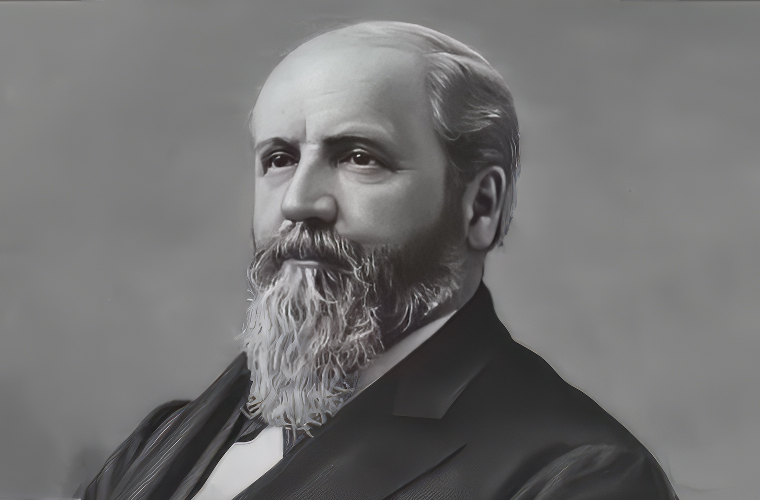
Clinton Bowen Fisk (December 8, 1828 – July 9, 1890) was a multifaceted American figure—a Civil War general, Reconstruction-era administrator, educator, and pioneering politician—who left an indelible mark on post-war Southern education and the temperance movement. As the Prohibition Party’s presidential candidate in 1888, he championed social reform with unyielding conviction, famously declaring to a political rival, “Vote for it and die, then, and I will write on your tombstone, ‘Blessed are the dead that die in the Lord.'” His legacy endures through institutions like Fisk University and his advocacy for equality and sobriety.
Early Life and Education
Born in the rural hamlet of York (near Griggsville) in Livingston County, New York, Fisk was the fifth son of Benjamin Bigford Fisk, a blacksmith, and Lydia Aldrich Powell, a devout Methodist. The family, embodying the era’s westward expansion, relocated to Coldwater, Michigan, when Clinton was an infant. Raised on a modest farm amid the hardships of frontier life, young Fisk balanced chores with a thirst for learning. He attended the preliminary course at Albion Seminary before becoming one of the inaugural students at Michigan Central College (now Hillsdale College) upon its opening in 1844. Though his formal education was brief, it instilled a lifelong commitment to self-improvement and moral discipline.
Pre-War Career
Fisk’s early adulthood blended entrepreneurship with financial ups and downs. In Coldwater, he worked as a merchant, miller, and banker, building a reputation for integrity. The Panic of 1857, however, wiped out much of his wealth, prompting a bold move in 1859 to St. Louis, Missouri. There, he thrived in the insurance industry, rising to become a respected businessman and community leader. His Methodist upbringing fueled an early aversion to alcohol, laying the groundwork for his future activism.
Military Service
When the Civil War erupted in 1861, Fisk enlisted as a private in the Union Army, driven by abolitionist fervor. His rapid ascent was remarkable: Appointed colonel of the 33rd Missouri Volunteer Infantry on September 5, 1862, he earned a brigadier general’s commission just seven weeks later on November 24. Fisk commanded a brigade under Major General George Armstrong Custer and led operations in Missouri and Arkansas, including the District of Southeast Missouri and the Department of North Missouri. His forces quelled Confederate guerrilla raids and protected Union supply lines. By war’s end in 1865, he received a brevet promotion to major general for gallant service.
Reconstruction and Educational Legacy
Fisk’s post-war contributions proved transformative. In 1865, Major General Oliver Otis Howard appointed him assistant commissioner of the Freedmen’s Bureau for Kentucky and Tennessee. Amid the chaos of emancipation, Fisk focused on relief, labor rights, and—crucially—education for freed African Americans and poor whites alike. Partnering with the American Missionary Association, he established the South’s first free public schools, serving over 200,000 students by 1870. In Nashville, he repurposed abandoned Union barracks into the Fisk School, personally endowing it with $30,000 (a fortune at the time). Renamed Fisk University in 1867, the historically Black institution stands today as a testament to his vision for racial uplift and accessible learning.
Returning to New York in 1866 after the Bureau’s mandate expired, Fisk rebuilt his banking career. In 1874, President Ulysses S. Grant named him to the Board of Indian Commissioners, where he advocated for Native American welfare.
Political Involvement
A staunch prohibitionist, Fisk viewed alcohol as a scourge rivaling slavery. He helped found the Prohibition Party in 1869 and ran unsuccessfully for New Jersey governor in 1886. His crowning political moment came in 1888, when the party nominated him for president by acclamation on June 6 in Indianapolis. Campaigning on temperance, women’s suffrage, and anti-corruption, Fisk garnered 249,506 votes nationwide (2.2% of the total), with his strongest showing in New Jersey (8.55%). Critics accused him of spoiling the race for Democrat Grover Cleveland, aiding Republican Benjamin Harrison’s victory, but Fisk saw it as a moral stand.
Death and Legacy
Fisk’s health, battered by wartime rigors and ceaseless advocacy, succumbed to influenza on July 9, 1890, in New York City at age 61. He was buried in Coldwater, Michigan, his hometown. His influence rippled far: Clinton B. Fisk Avenue in Staten Island’s Westerleigh (formerly Prohibition Park) honors him, as does his 2001 induction into the Hillsdale County Veterans’ Hall of Fame. Fisk University continues to educate generations, embodying its belief in education as the great equalizer. In an era of division, Clinton B. Fisk bridged battlefields and ballot boxes, proving one man’s resolve could forge paths to justice and reform.