
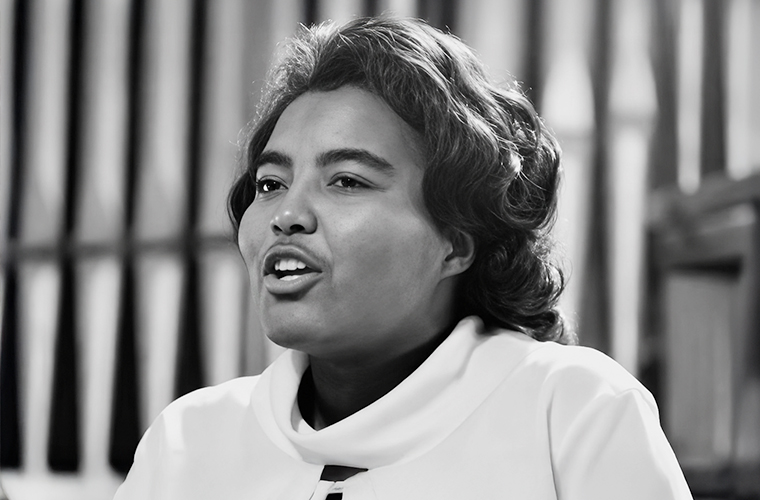
Prathia Laura Ann Hall Wynn (January 1, 1940 – August 12, 2002) was an influential American civil rights activist, womanist theologian, ethicist, preacher, and educator. She played a pivotal role in the Civil Rights Movement as one of the first women field organizers for the Student Nonviolent Coordinating Committee (SNCC) and is widely credited with inspiring Martin Luther King Jr.’s iconic “I Have a Dream” refrain.
Early Life and Education
Born in Philadelphia, Pennsylvania, to Rev. Berkeley L. Hall and Ruby Hall (née Johnson), Prathia was the second of four children. Her father, a Baptist minister and advocate for racial justice, founded Mount Sharon Baptist Church in Philadelphia in 1938 and viewed her as his spiritual successor. He instilled in her a deep faith and commitment to social justice. Her family had Southern roots in Virginia. At age five, during a 1945 train trip to visit grandparents in Virginia, she experienced the harsh reality of Jim Crow segregation when her family was forced to move to a segregated car after crossing the Mason-Dixon line. This early encounter with dehumanizing discrimination shaped her resolve.
Hall attended the Philadelphia High School for Girls, graduating in 1958. She then enrolled at Temple University, earning a B.A. in Political Science in 1962. While at Temple, she became active in the Fellowship House, an ecumenical group focused on peace, interracial relations, and nonviolence. By her junior year, she participated in sit-ins and protests on Maryland’s Eastern Shore. In November 1961, she was arrested during a sit-in at a segregated drive-in in Annapolis, Maryland, and held without bail for two weeks.
Civil Rights Activism
After graduating from Temple, Hall joined SNCC and worked with Charles Sherrod in Southwest Georgia during the Albany Movement. She became one of the first female field organizers (and the first in Southwest Georgia), focusing on voter registration in “Terrible Terrell” County, known for extreme violence against activists. She canvassed door-to-door, taught in Freedom Schools to prepare Black residents for voter registration tests, and participated in mass meetings.
On September 6, 1962, nightriders fired into the “freedom house” where she and other activists (including Jack Chatfield and Christopher Allen) were staying in Dawson, Georgia; Hall was wounded. She endured multiple arrests and threats, including time in the notorious Sasser jail.
A defining moment came on September 9, 1962, at a prayer vigil for the burned Mount Olive Baptist Church in Terrell County, attended by Martin Luther King Jr. and James Bevel. Hall led the prayer, spontaneously repeating the rhythmic phrase “I Have a Dream.” Bevel and others credit this as the direct inspiration for King’s use of the phrase in subsequent sermons, culminating in his 1963 March on Washington speech. Hall later confirmed that King sought her permission to use it.
Hall also worked in Selma, Alabama, following the brutal beating of Bernard Lafayette. She witnessed and spoke powerfully about the violence of Bloody Sunday (March 7, 1965) on the Edmund Pettus Bridge. Deeply affected, she experienced a theological crisis but continued her work until resigning from SNCC in 1966 as the organization shifted away from nonviolence. Her oratory and preaching were legendary; colleagues like Judy Richardson described the emotional power of her words, and King reportedly said he preferred not to follow her as a speaker.
Later Life, Ministry, and Academia
In the mid-1960s, Hall married Ralph Wynn; they lived in Roosevelt, New York. The couple had a daughter who tragically died young after suffering a stroke at age 23. Hall faced personal grief and chronic pain from earlier injuries.
She pursued theological education at Princeton Theological Seminary, earning a Master of Divinity (1982), Master of Theology (1984), and Ph.D. in History and Ecumenics (1997, magna cum laude). Her dissertation focused on the religious and social consciousness of African American Baptist women. She was ordained as a Baptist minister—one of the first women in the American Baptist Churches USA—and served as pastor of her father’s Mount Sharon Baptist Church in Philadelphia starting in 1978, commuting from Princeton.
Academically, she joined the faculty at United Theological Seminary in Dayton, Ohio, where she became dean of African American studies and director of the Harriet Miller Women’s Center. She was a visiting scholar at the Interdenominational Theological Center in Atlanta and later held the Martin Luther King Jr. Chair in Social Ethics at Boston University School of Theology (from around 2000). Her scholarship centered on womanist theology, ethics, freedom faith (the belief that God desires freedom and equips people to pursue it), and African American church history. Ebony magazine recognized her preaching prowess, naming her among the most powerful preachers in the 1970s and #1 on its 1997 list of “Top 15 Greatest Black Women Preachers.”
Legacy and Death
Prathia Hall Wynn embodied the integration of faith, activism, and scholarship. Her concept of “freedom faith” and her trailblazing role as a woman in ministry and civil rights continue to inspire. She remained active until her death from cancer on August 12, 2002, in Boston, Massachusetts, at age 62. She is remembered through biographies like Courtney Pace’s Freedom Faith: The Womanist Vision of Prathia Hall, oral histories, and tributes highlighting her presence, moral clarity, and eloquence. Her life exemplified the power of combining religion and politics in the pursuit of justice.
Notable Quote: “We who believe in freedom cannot rest until it comes.” — Prathia Hall Wynn.