
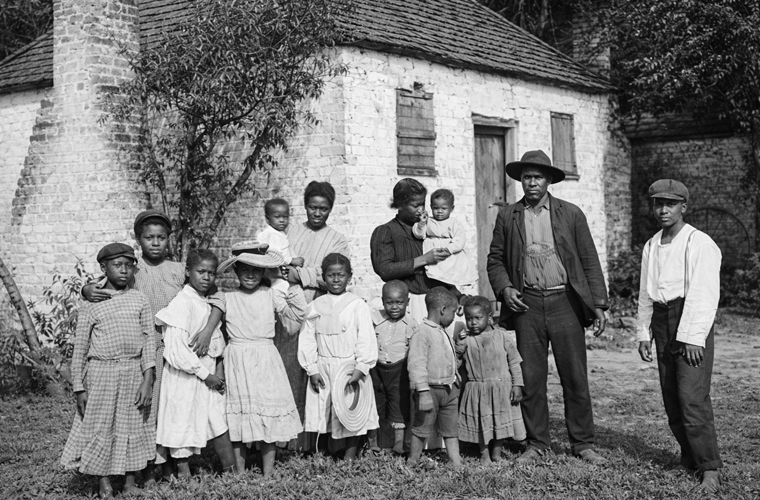
The term slave quarters (also known as slave cabins) refers to the rudimentary housing provided for enslaved African and African American people on plantations, farms, and sometimes urban properties across the Southern United States during the era of chattel slavery, spanning from the early 17th century until emancipation in 1865 following the Civil War.
These dwellings formed an essential yet grim component of the plantation landscape, where millions of enslaved individuals—nearly 4 million by 1860—lived under constant surveillance and control. The design and placement of slave quarters deliberately reinforced the power dynamics of slavery: they were typically positioned on the periphery of the plantation, often in rows, parallel lines (known as “double rows”), clusters resembling small villages, or scattered near fields for easy oversight by overseers. This layout kept enslaved people visible and accessible for dawn-to-dusk labor while distancing them from the enslaver’s grand “Big House,” symbolizing their subordinate status. Construction and features varied by the planter’s wealth, the region, the era, local materials, and the crop grown (such as cotton, tobacco, rice, indigo, or sugar). Most were modest and cheaply built to minimize costs:
- Common materials included logs (often notched without nails), rough-sawn wood frames, or clapboards, with gaps sealed by mud chinking (a mixture of clay, sand, moss, or other fillers) for basic weatherproofing.
- Floors were usually packed dirt, though some had wooden puncheons (rough planks).
- Roofs featured wood shingles or rough boards.
- Chimneys were frequently made of clay, sticks, or mud-daubed wood (sometimes movable), with a central fireplace serving for both heating and cooking.
- Windows were rare, small, unglazed (often just holes or shutters), and minimal to reduce light, ventilation, and potential escape routes.
- Size typically ranged from about 8×10 to 16×16 feet (roughly 80–250 square feet), often one or two rooms, sometimes with a loft for extra sleeping or storage space.
Many housed entire families—often four to six people or more—in cramped conditions, with multiple families sharing proximity in clustered arrangements. Field workers generally occupied the simplest log cabins. At the same time, house servants or skilled artisans (like blacksmiths or cooks) might receive slightly better accommodations near the main house, occasionally with brick, stone foundations, or stucco walls on wealthier estates. In rare cases, such as at Boone Hall in South Carolina or parts of Evergreen Plantation in Louisiana, brick cabins were built for durability.
Living conditions were harsh and dehumanizing. Sanitation was poor, with limited access to clean water, privies (outhouses), or waste management, leading to widespread diseases like dysentery, cholera, malaria, tuberculosis, and respiratory issues. Overcrowding exacerbated health problems, malnutrition from inadequate rations (typically cornmeal, pork, and fish), and exposure to weather through leaky roofs or drafty walls. Enslaved people were often required to maintain or repair their own quarters after grueling fieldwork, further eroding any sense of personal space or rest.


Despite these oppressive circumstances, enslaved communities transformed these spaces into vital centers of resilience and culture. From sundown to sunup—when personal freedom was marginally greater—they cultivated small provision gardens behind cabins to supplement diets with vegetables, raised chickens or pigs, preserved food in subfloor pits, crafted handmade items like quilts, pottery (including colonoware), musical instruments (drums, fiddles from gourds), and personal effects. These quarters became hubs for family life, storytelling, spiritual practices, music, and social bonds that fostered community and subtle resistance against total dehumanization. Former enslaved people later described sweeping dirt floors clean and white with sage brooms, creating order amid hardship. Today, few original slave quarters survive—likely fewer than 300 intact examples—due to decay, demolition, or repurposing after emancipation (some continued as sharecropper housing into the 20th century). Notable preserved sites offer powerful, tangible connections to this history:
- Evergreen Plantation (Louisiana) preserves 22 original slave cabins in a double-row “village,” a rare, unchanged example listed as a National Historic Landmark.
- Boone Hall Plantation (South Carolina) maintains brick slave cabins along “Slave Street,” with interpretations of Gullah culture.
- Whitney Plantation (Louisiana) centers its museum entirely on the experiences of the enslaved, featuring preserved cabins, memorials (like the Field of Angels and Wall of Honor), and sculptures.
- McLeod Plantation Historic Site (South Carolina) includes “Transition Row” cabins occupied by descendants into the 1980s.
- Other sites like Arlington House (Virginia), Owens-Thomas House (Georgia), and various National Register-listed cabins provide insights through archaeology and restored structures.
These preserved quarters and related historic sites serve as stark reminders of slavery’s brutality, the forced labor that built much of the antebellum South’s wealth, and the profound resilience of those who endured it. By visiting and interpreting these spaces through the lens of the enslaved—rather than solely the enslavers—they foster a more honest reckoning with America’s complex history, honoring the humanity, suffering, and contributions of millions while confronting the enduring legacies of racial inequality and injustice.