
California’s 1943 Race Registration Statute and the Fight for Interracial Marriage Rights in America
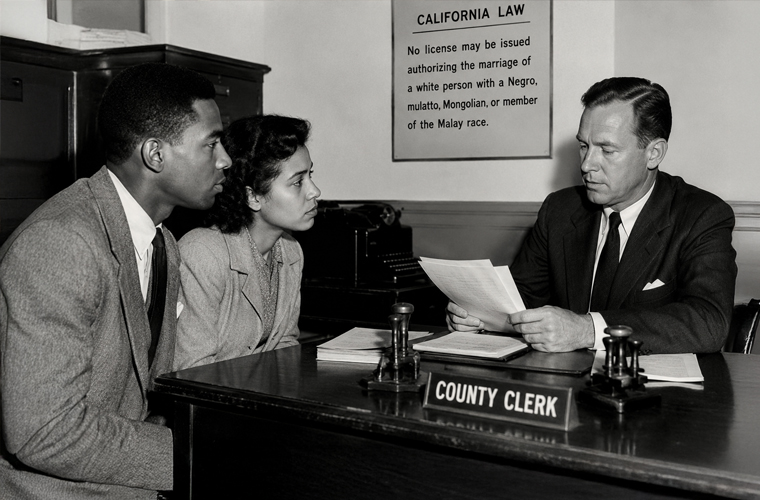
On May 5, 1943, a new law took effect in California mandating that every marriage license issued in the state must record the race of both parties. Passed unanimously by the state’s all-white, all-male legislature, the measure was explicitly designed to strengthen enforcement of California’s longstanding prohibition on interracial marriage. At the time, California law stated: “no license may be issued authorizing the marriage of a white person with a Negro, mulatto, Mongolian, or member of the Malay race.” Violations carried severe penalties: interracial couples who married in defiance of the ban, as well as any county clerk who issued a license to such a couple, could face fines of up to $10,000 or imprisonment for up to ten years.
Laws banning interracial marriage—commonly known as anti-miscegenation laws—have deep roots in American history, stretching back to the colonial period and predating the founding of the United States. Both Northern and Southern colonies enacted such restrictions early on. By the outbreak of the Civil War in 1861, 28 states had laws prohibiting interracial marriage, and seven more states added bans before the war ended in 1865.
While many Northern states repealed their anti-miscegenation statutes either before or shortly after the Civil War, Southern and Western states often moved in the opposite direction. The emancipation of millions of enslaved Black Americans triggered intense anxiety among white populations about the erosion of racial hierarchy. In the South, where the vast majority of newly freed Black people lived, many white leaders viewed the end of slavery as the first step toward “social equality” and interracial intimacy. Western states, fearing a potential influx of Black migrants after the war, similarly used marriage bans as a tool to preserve the existing racial order.
California’s own history with these laws began at statehood. In 1850, the very first year California entered the Union, the legislature declared that “all marriages of whites with negroes or mulattoes are declared to be null and void.” Over subsequent decades, lawmakers expanded the prohibition in response to growing Asian immigration, adding bans on marriages between white people and those classified as “Mongolian” or “Malay.” These policies enjoyed broad support within California’s white community and were vigorously enforced by state officials.
The legal foundation of these restrictions in California finally began to crumble in the mid-20th century. On October 1, 1948, the California Supreme Court, in the landmark case Perez v. Sharp, struck down both the 1943 race-registration law and the state’s older ban on interracial marriage. The decision was a significant victory for civil rights, coming nearly two decades before the U.S. Supreme Court addressed the issue nationally.
On June 12, 1967, the U.S. Supreme Court delivered its unanimous ruling in Loving v. Virginia, declaring all remaining state bans on interracial marriage unconstitutional. The decision invalidated anti-miscegenation laws still in force in 16 states and explicitly overturned the Court’s earlier 1883 precedent in Pace v. Alabama, which had upheld such restrictions. As a result, laws that had persisted for more than eighty years after the Civil War were finally rendered unenforceable nationwide.
Nevertheless, formal legal change did not immediately erase social or political opposition. In a striking example of lingering resistance, Alabama remained the last state to repeal its anti-miscegenation provision. In 2000—more than thirty years after the Loving decision—Alabama voters approved a ballot measure removing the outdated ban from the state constitution.
This history illustrates how marriage laws served as powerful instruments for maintaining racial boundaries in the United States, long after the abolition of slavery, and how the struggle to dismantle them formed an important chapter in the broader civil rights movement.