
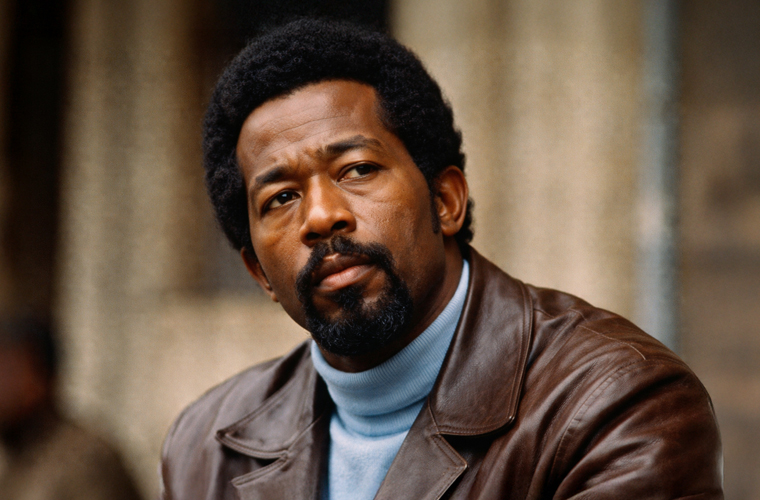
Leroy Eldridge Cleaver was born on August 31, 1935, in Wabbaseka, Arkansas, to Leroy Cleaver, a nightclub entertainer and waiter, and Thelma Hattie Robinson Cleaver, an elementary school teacher. His early childhood unfolded in a household marked by domestic violence, with his father frequently beating his mother—an experience that left a deep impression on him. In 1943, the family first relocated to Phoenix, Arizona, following his father’s job on a railroad dining car, and then to the Watts neighborhood of Los Angeles in 1946 amid the broader Great Migration of African Americans to the West Coast.
In Los Angeles, Cleaver’s adolescence descended into repeated legal trouble. He engaged in petty crimes such as bicycle theft, vandalism, and marijuana possession, leading to stints in juvenile detention centers and reform schools. At age 18, a felony drug conviction sent him to Soledad State Prison. Released in 1957, he was soon convicted the following year of assault with intent to commit murder and rape—crimes he later described in his writings as acts of rebellion against white society and its laws, though he eventually renounced such justifications. This conviction resulted in nearly a decade of incarceration, primarily at San Quentin and Folsom prisons, where he spent much of his 20s and early 30s.

Prison became a turning point for intellectual and ideological growth. Largely self-educated, Cleaver immersed himself in wide reading, including works by Thomas Paine, Voltaire, Karl Marx, Richard Wright, and the teachings of Malcolm X and the Nation of Islam. He began writing essays and letters reflecting on race, racism in America, masculinity, sexuality, and revolutionary politics. Some of these pieces were published in Ramparts magazine starting in 1966, attracting national attention and helping secure his parole on December 12, 1966.
Shortly after his release, Cleaver joined the newly formed Black Panther Party in Oakland, founded by Huey Newton and Bobby Seale. He quickly rose to prominence as the party’s Minister of Information, becoming one of its most charismatic and outspoken leaders. He advocated armed self-defense against police brutality, revolutionary socialism, and Black internationalism. In late 1967, he married Kathleen Neal, a fellow activist who played a key role in the party’s operations.
In 1968, Cleaver published Soul on Ice, a collection of his prison writings that combined raw autobiography, political analysis, and searing critiques of American racism. The book became a bestseller, selling millions of copies and establishing him as a major voice of Black Power and radical dissent. That same year, he ran for U.S. president on the Peace and Freedom Party ticket while still on parole. However, in April 1968, he was involved in a shootout with Oakland police that left one Panther dead (Bobby Hutton) and Cleaver and two officers wounded. Facing potential reimprisonment and fearing for his life, he jumped bail in November 1968 and fled into exile, first to Cuba, then Algeria (where he established an International Section of the Black Panther Party), and later France. While abroad, he visited countries such as North Korea, North Vietnam, the Soviet Union, and China, deepening his engagement with global revolutionary movements.
During exile, tensions grew between Cleaver and Huey Newton over the direction of the Black Panther Party—Cleaver pushing for international guerrilla warfare and armed struggle, while Newton emphasized community service programs. This rift culminated in Cleaver’s expulsion from the party in 1971, after which he formed his own short-lived Revolutionary People’s Communication Network.
After seven years abroad, Cleaver returned to the United States in 1975 to face the lingering charges from the 1968 shootout. The attempted murder charges were eventually dropped, and he received probation. Upon his return, he underwent a dramatic ideological transformation. He renounced his earlier revolutionary stance, declared himself a born-again Christian (detailed in his 1978 memoir Soul on Fire), briefly associated with groups tied to the Unification Church, and later joined The Church of Jesus Christ of Latter-day Saints (Mormons). Politically, he embraced conservatism, supported Ronald Reagan, ran unsuccessfully for a Republican Senate nomination in California, praised American democracy, adopted pro-Zionist views, and criticized communism based on his experiences in socialist countries.
In his later years, Cleaver pursued various ventures with limited success, including designing men’s fashion (notably controversial codpiece pants), stonemasonry, a recycling business, and environmental concerns. He struggled with substance abuse, including crack cocaine addiction in the 1980s and 1990s, which led to further legal troubles and health issues, including prostate cancer and insulin dependency.
Cleaver died on May 1, 1998, at age 62 in Pomona Valley Hospital Medical Center in Pomona, California, from a heart attack. At the time, he worked as a lecturer and diversity consultant at the University of La Verne. His life traced an extraordinary arc—from impoverished Southern roots and criminal youth, through radical fame as a Black Panther leader and influential writer, to international exile and, finally, a conservative reinvention—embodying many of the contradictions and upheavals of 20th-century American racial and political history.