
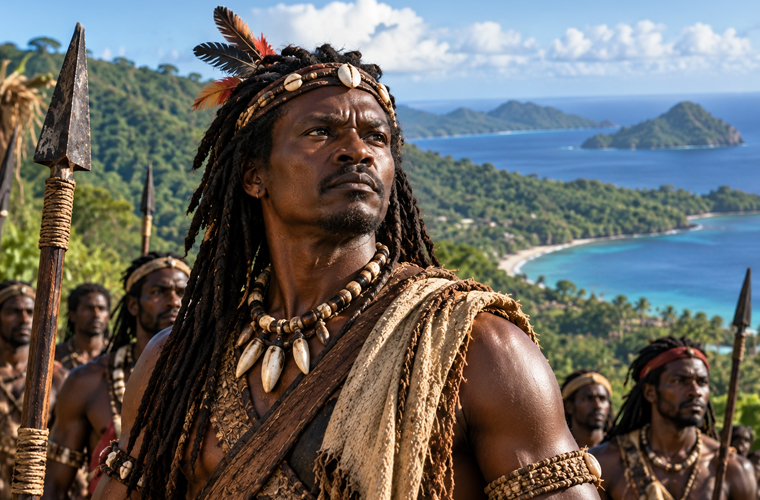
Chief Joseph Chatoyer (also known as Satuye or Satuyé) was the paramount chief of the Garifuna (Black Carib) people of Saint Vincent in the late 18th century. He led armed resistance against British colonial expansion and remains a national hero of Saint Vincent and the Grenadines and a lasting symbol of Indigenous and Afro-Caribbean defiance.
Background and the Garifuna People
The Garifuna (or Garinagu) of Saint Vincent—known to them as Yurumein—emerged from the intermixing of Indigenous Kalinago (Island Carib) peoples and Africans, including survivors of shipwrecked slave ships and escapees from plantations. By the mid-18th century, they controlled much of the island’s rugged interior and windward coasts, maintaining a distinct culture, language, and political organization despite growing European pressure.
Joseph Chatoyer first appears clearly in historical records around 1768 as chief of the Grand Sable district. He rose to the position of Paramount Chief (sometimes described as “King” or “Chief of Chiefs”) and headed the Garifuna war council. Fluent in French as well as Garifuna, he combined military leadership with diplomatic skill and is said to have held spiritual as well as political authority. Exact details of his birth and early life remain sparse; estimates place his birth in the mid-18th century.
The First Carib War and Treaty of 1773
British claims to Saint Vincent intensified after the 1763 Treaty of Paris transferred the island from French to British control. Colonial surveyors and settlers pressed into Garifuna lands. In 1772, Chatoyer led a major uprising—the First Carib War—that forced the British to negotiate. In 1773, the two sides signed a treaty that recognized Garifuna territory on the windward side of the island. This was a rare concession: one of the first formal agreements the British made with a non-white Indigenous population in the Caribbean. Chatoyer headed the Garifuna delegation. The British, however, repeatedly violated the treaty’s spirit and letter in the years that followed.
Alliances and the Second Carib War
Chatoyer skillfully navigated the rivalry between Britain and France. During the American Revolutionary War period (late 1770s), he coordinated joint French–Garifuna operations against the British. After the French returned Saint Vincent to Britain in 1783, tensions continued to rise. By early 1795, with Britain distracted by the wider wars of the French Revolution and with French revolutionary agents active in the region, Chatoyer and fellow chief Duvalle (often described as his brother or close ally) launched the Second Carib War. They divided the island: Chatoyer operated primarily on the leeward side while Duvalle took the windward. French supporters, including forces linked to Guadeloupe, joined the uprising. The combined forces advanced toward the capital, Kingstown, establishing a stronghold on Dorsetshire Hill.
Death at Dorsetshire Hill
On the night of 14–15 March 1795, British forces under General Ralph Abercromby (with local militia) launched a surprise attack on Dorsetshire Hill. In the fighting, Chatoyer was killed. Contemporary British accounts credit Major Alexander Leith of the militia with killing him in close combat; some later Vincentian oral traditions question the exact circumstances and suggest his body was recovered by his followers.
Chatoyer’s death was a severe blow. French allies largely withdrew, and although Duvalle continued the struggle until 1796, the tide turned decisively against the Garifuna. Survivors were eventually rounded up, held on the barren island of Baliceaux, and deported in 1797 to Roatán (off the coast of present-day Honduras). From there, the Garifuna people spread along the Caribbean coast of Central America.
Legacy
More than two centuries later, Chatoyer’s standing was formally restored. On 14 March 2002, the government of Saint Vincent and the Grenadines declared him the nation’s first National Hero. March 14 is observed as National Heroes Day, with commemorations at the obelisk on Dorsetshire Hill marking the place associated with his death.
He is also honored among Garifuna communities in Belize, Honduras, Guatemala, Nicaragua, and the diaspora. His story inspired one of the earliest known plays by an African-American playwright: William Brown’s The Drama of King Shotaway (performed in New York in 1823), which dramatized the Carib resistance.
Chatoyer remains a powerful emblem of resistance to colonial dispossession, the defense of land and sovereignty, and the enduring identity of the Garifuna people. His leadership helped force European powers to treat the Garifuna as a political entity rather than a mere obstacle to settlement—an achievement that still resonates in Caribbean and Central American historical memory.