
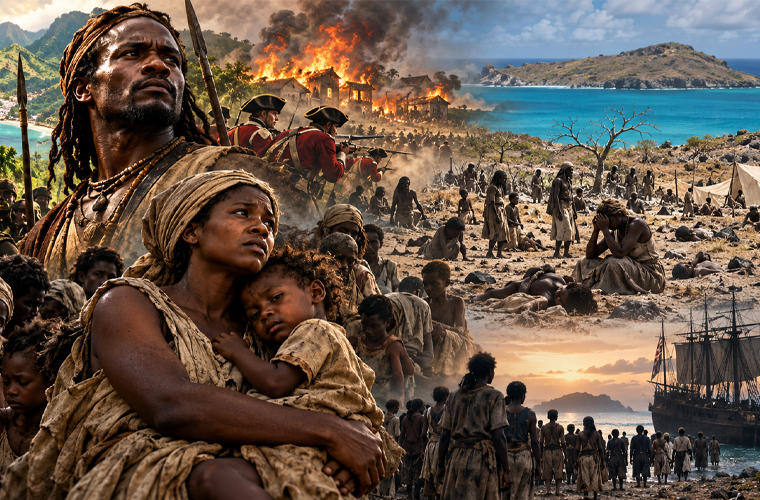
The Forgotten Island Where a Nation Was Left to Die
Off the coast of St. Vincent, in the turquoise waters of the Grenadines, sits a small, dry island called Baliceaux. Today it’s quiet, home to little more than wind, scrub and the odd passing yacht. But beneath its stony soil lie the bones of more than two thousand men, women and children. Their story is one of the darkest chapters in Caribbean history, and one of the least known.
The Garifuna, whom British colonists called the “Black Caribs,” emerged on St. Vincent in the 1600s. Africans who survived shipwrecks or escaped slavery found refuge among the island’s Indigenous Carib people. Over generations, the two peoples married and merged, forming a new nation with its own language, culture, and fierce sense of freedom. They called their homeland Yurumein, and for more than a century they held on to it while European empires carved up the Caribbean around them, keeping their land free of plantations and their people free of chains.
That freedom had a price. The British wanted the fertile land of St. Vincent’s windward coast for sugar. Tension built for decades, and in 1795 it exploded into war. Led by Paramount Chief Joseph Chatoyer and backed by the French, the Garifuna fought to keep their land. For a time, they pushed the British back. Then, in a night battle at Dorsetshire Hill, Chatoyer was killed. The French eventually abandoned their allies, and the British turned to a scorched-earth campaign, burning crops and destroying villages to starve the Garifuna into surrender.
Between July 1796 and February 1797, the British rounded up 4,776 people and shipped them to Baliceaux. Most were Garifuna, and most were women and children: 2,003 women and 1,693 children, alongside 1,080 men. Many arrived already starving. The island had no fresh water, and even the British army doctor stationed there admitted it was a poor place to hold so many people. Within weeks, a deadly fever, most likely yellow fever, tore through the camp. Victims fell ill and died within days. Weakened by hunger, exposure and thirst, the prisoners had little strength to fight it. By the time the British were ready to move them, about 2,445 people had died on Baliceaux.
Their graves were never marked. The island is, in effect, one vast unmarked cemetery. Historians and Garifuna communities alike describe what happened there as ethnic cleansing, and many call it genocide. The British had no intention of letting the survivors return home. On March 11, 1797, the 2,248 who remained were forced onto ships bound for Roatán, an island about 1,700 miles off the coast of Honduras. Among them were two of Chatoyer’s children and his brother, Du Vallée. The voyage claimed another 222 lives. On April 12, 1797, just 2,026 people stepped ashore at Roatán, the remnant of a nation torn from its homeland.
The story doesn’t end in exile. From Roatán, the Garifuna moved to the Central American mainland and spread along the Caribbean coast. Today every Garifuna community in Honduras, Belize, Guatemala, and Nicaragua traces its roots to those 2,026 survivors. With large communities in cities like New York and Los Angeles, the Garifuna now number in the hundreds of thousands, and they still speak their language and keep the traditions their ancestors carried across the sea. In 2001, UNESCO proclaimed Garifuna language, dance and music a Masterpiece of the Oral and Intangible Heritage of Humanity.
On St. Vincent, Joseph Chatoyer is honoured as the country’s first National Hero, remembered every year on March 14, National Heroes Day. Garifuna descendants still make the pilgrimage back to Baliceaux to stand on the island where their ancestors suffered, and to remember them. Baliceaux isn’t found in most history books. Yet it stands as a reminder of what colonial greed cost the people who stood in its way, and of how a people who were meant to vanish instead endured. The sea remembers, and so do the Garifuna.