
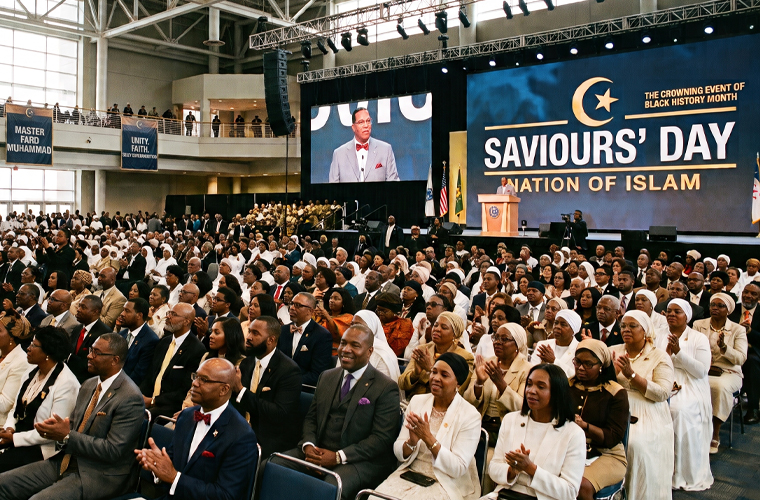
The Nation of Islam’s Annual Commemoration of Divine Intervention and Black Resurrection
Saviours’ Day (often styled as Saviour’s Day in earlier references) is the premier annual holiday and convention of the Nation of Islam (NOI). It commemorates the birth of Master Wallace Fard Muhammad (W.D. Fard), the founder of the NOI, who was born on February 26, 1877, in Mecca, Arabia, according to NOI teachings.
Origins and Theological Significance
Master Fard Muhammad appeared in the United States on July 4, 1930, in Detroit, Michigan. NOI doctrine holds that he is the long-awaited Messiah of the Christians and the Mahdi of the Muslims—the “God in Person” who came to deliver Black people in America from 400 years of bondage, fulfilling biblical prophecies such as Genesis 15:13.
He taught and raised the Honorable Elijah Muhammad (born October 7, 1897), who led the NOI for over 40 years. Elijah Muhammad established the annual Saviour’s Day celebration to honor Fard’s birth and expound on the divine wisdom received from him. The day serves as a powerful reminder of self-determination, moral reform, economic independence, and spiritual resurrection for Black Americans, whom the NOI refers to as the “lost-found Nation of Islam in the wilderness of North America.”
Evolution Under Leadership
After Elijah Muhammad died in 1975, his son, Warith Deen Mohammed, led much of the community toward Sunni Islam and initially renamed the observance “Survival Day” or “Ethnic Survival Day,” de-emphasizing the divine attributes ascribed to Fard. Louis Farrakhan, who re-established the NOI in 1977, revived the traditional Saviours’ Day in 1981 in Chicago. In 1983, Minister Farrakhan changed the spelling to the plural Saviours’ Day. This was not merely grammatical; it symbolized that while Master Fard Muhammad is the supreme Saviour, Elijah Muhammad and the believers themselves are “little saviours” tasked with the work of uplifting and resurrecting their people.
Under Farrakhan’s leadership, the event grew into a major multi-day convention featuring:
- Keynote addresses (historically delivered by Minister Farrakhan)
- Workshops and seminars on health, education, economics, family, and community development
- Health screenings
- Fashion shows, entertainment, and cultural activities
- The Salaam Expo bazaar
- Youth programs
- Since 2010, Dianetics auditor graduations in partnership with the Church of Scientology
The gathering often draws thousands of attendees, prominent guests from politics, sports, entertainment, and international figures. It has been held in various cities, including Chicago (its frequent home), Detroit, Los Angeles, Atlanta, and even internationally in Accra, Ghana, in 1994.
Saviours’ Day in Practice and Recent Years
The convention is typically held around late February, aligning with Black History Month and serving as its “crowning event” for many participants. It blends spiritual renewal, organizational strategy, family celebration, and calls to action for community improvement. For example, the 2026 theme emphasized practical community building: “We Must Make Our Community a Decent Place to Live.” Recent gatherings have continued to highlight generational transition, with figures like Student Minister Ishmael Muhammad delivering key addresses.
Broader Impact
Saviours’ Day is more than a birthday celebration. It functions as the NOI’s annual state-of-the-nation address, a family reunion, a recruitment and motivational platform, and a visible demonstration of Black self-reliance and discipline. The event underscores core NOI principles: knowledge of self, separation from dependency, moral uprightness, and the belief that God has intervened directly in the affairs of Black people in America.
For members and supporters, it reinforces hope and purpose rooted in the appearance of Master Fard Muhammad and the lifelong mission of Elijah Muhammad and Louis Farrakhan. Critics and external observers often note its role in promoting NOI ideology, which blends elements of Islam, Black nationalism, and unique eschatological teachings.
Whether viewed through a religious, cultural, or historical lens, Saviours’ Day remains one of the most enduring and vibrant traditions in Black American religious and activist life—a time for reflection on the past, recommitment in the present, and vision for a liberated future.