
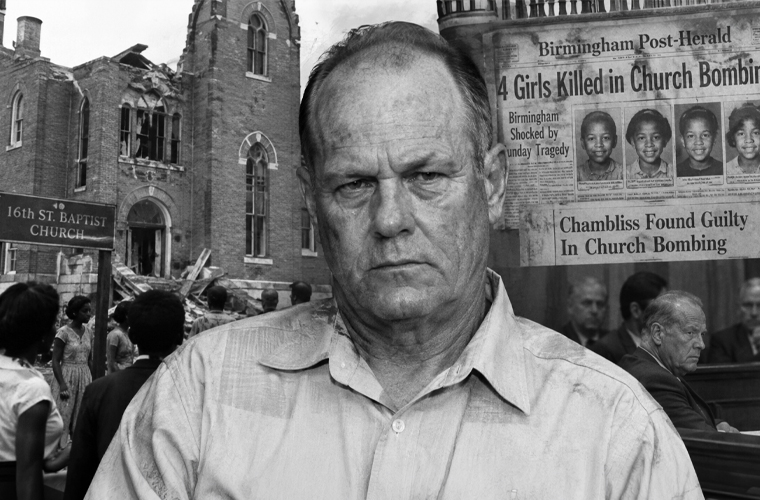
Robert Edward Chambliss (January 14, 1904 – October 29, 1985), known as “Dynamite Bob,” was an American white supremacist, longtime Ku Klux Klan member, and explosives user convicted in 1977 of first-degree murder for his role in the September 15, 1963, bombing of Birmingham, Alabama’s 16th Street Baptist Church. The attack killed four African American girls and injured more than 20 others; it became one of the most notorious acts of racial terrorism during the Civil Rights era.
Early Life and Background
Chambliss was born in Pratt City (then a working-class suburb of Birmingham) in Jefferson County, Alabama, to John Darnell Chambliss (1881–1956) and Artie Mae Tomlin (1883–1936). He grew up in modest circumstances typical of industrial Alabama families of the period. He worked a variety of blue-collar jobs, including quarryman, miner, auto mechanic, employee at the City of Birmingham’s auto repair shop in the 1940s, and later truck driver for an auto parts company.
He joined the Ku Klux Klan around 1924 at age 20 and remained active for decades. He was associated with the United Klans of America and helped form or participate in the militant Eastview Klavern 13 (sometimes called Eastview 13), a breakaway group frustrated with what members saw as insufficient resistance to desegregation. He earned the nickname “Dynamite Bob” for his reputation for handling explosives in racially motivated attacks.
Chambliss was married to Flora (sometimes referred to as “Tee”). He lived for a time at addresses such as 2505 32nd Avenue North in Birmingham. Major accounts mention no children of his own. Still, he was uncle (by marriage) to Elizabeth Ann Hollifield Cobbs (later known as Petric Smith), whose testimony proved pivotal in his prosecution.
Klan Activities and Violence
Chambliss was linked to multiple acts of racial intimidation and violence in Birmingham from the 1940s onward. He was suspected of firebombing homes of African American families, particularly in areas experiencing demographic change or challenges to segregation. Birmingham was known as “Bombingham” in this period due to a wave of such attacks (dozens in the decade leading up to 1963). He was also involved in threats and confrontations related to housing integration and civil rights activism.
In the early 1960s, amid intensifying civil rights protests led by figures such as Fred Shuttlesworth and Martin Luther King Jr., and the push for school desegregation, Chambliss and associates escalated their activities. He purchased dynamite in the period before the church bombing.
The 16th Street Baptist Church Bombing
On Sunday morning, September 15, 1963, a bomb made of dynamite (accounts commonly cite around 15–19 sticks, sometimes with a timing device) exploded outside the basement of the 16th Street Baptist Church, a key gathering place for the civil rights movement in Birmingham. Four girls died: Carol Denise McNair (age 11), Addie Mae Collins (14), Carole Robertson (14), and Cynthia Wesley (14). They had been in a basement restroom area preparing for Youth Day services. More than 20 others were injured.
The bombing shocked the nation, galvanized support for civil rights legislation (contributing momentum toward the Civil Rights Act of 1964), and highlighted the violent resistance to desegregation in the Deep South. The FBI identified Chambliss, along with Bobby Frank Cherry, Thomas Edwin Blanton Jr., and Herman Frank Cash, as primary suspects. A May 13, 1965, memo to FBI Director J. Edgar Hoover named the four.
Immediately after the bombing, Chambliss faced charges related to illegal possession of dynamite (he had purchased a case around that time and claimed it was for legitimate purposes such as blowing stumps). He received a relatively light penalty. No murder charges were brought at the time.
Investigation, Trial, and Conviction
The FBI investigated extensively and accumulated evidence, including informant information and statements, but the case was closed in 1968 without charges under orders from Hoover. Key materials were not shared with state prosecutors. Alabama Attorney General Bill Baxley reopened the investigation in the early 1970s after gaining access to FBI files. Crucial testimony came from Chambliss’s niece, Elizabeth Cobbs (Petric Smith). She recounted statements by Chambliss before the bombing (including boasts about having enough dynamite “to flatten half of Birmingham” and cryptic remarks about waiting “till after Sunday morning”) and other incriminating comments. Additional witnesses testified about his possession of dynamite, associations, and behavior.
In 1977, Chambliss was indicted and tried specifically for the murder of Denise McNair (prosecutors focused on one charge). An all-white jury convicted him of first-degree murder. He was sentenced to life imprisonment. Alabama did not have a death penalty applicable to the 1963 crime at the time of trial. He was held at the St. Clair Correctional Facility (near Springville) in isolation for much of his sentence and later transferred due to health issues.
Chambliss maintained his innocence throughout, claiming at sentencing and afterward that he had not bombed the church. He rejected opportunities that might have reduced his sentence in exchange for testimony against others and hoped for a pardon (including from figures associated with segregationist politics). He died of heart-related problems on October 29, 1985, at Lloyd Noland Hospital and Health Center in the Birmingham area at age 81, still proclaiming innocence. He was buried at Elmwood Cemetery alongside his wife Flora. Later prosecutions secured convictions of Thomas Blanton (2001) and Bobby Frank Cherry (2002). Herman Cash died without being tried. Chambliss was the first of the group to be successfully prosecuted for the murders.
Legacy and Context
Chambliss is remembered primarily as a central figure in one of the most infamous domestic terrorist acts of the civil rights era. His case illustrated both the depth of violent white supremacist resistance in Birmingham and the long delays in achieving accountability due to investigative, political, and evidentiary obstacles. Prison correspondence and archival materials later deposited at the Birmingham Public Library show him continuing to deny involvement and portray himself as a victim, with no expressed remorse in the available records.
Primary sources for details on Chambliss include contemporary news coverage, court records from the 1977 trial and appeals, FBI materials later released or referenced in state proceedings, family accounts (notably Petric Smith’s memoir Long Time Coming), and local historical compilations. Accounts of his exact technical role in assembling or placing the bomb rely on circumstantial evidence, witness statements, and associations rather than a confession.