
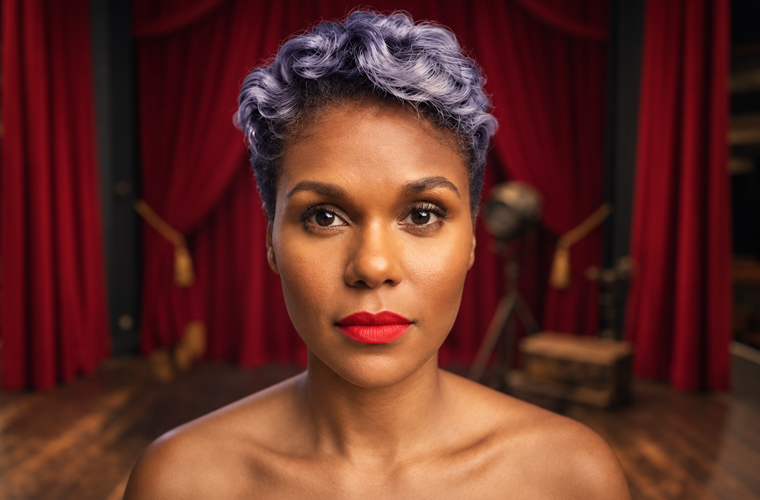
Joyce Bryant (born Ione Emily Bryant; October 14, 1927 – November 20, 2022) was an American singer, dancer, actress, and civil rights activist. She rose to prominence in the late 1940s and early 1950s as a glamorous nightclub and theater performer known for her powerful voice, striking silver hair, and form-fitting mermaid dresses. Nicknamed the “Bronze Blond Bombshell,” “the Black Marilyn Monroe,” “the Belter,” and “the Voice You’ll Always Remember,” she was one of the first dark-skinned African American women celebrated as a sex symbol in mainstream media.
Early Life
Bryant was born in Oakland, California, the third of eight children, and raised in San Francisco in a strict Seventh-day Adventist household. Her father, Whitfield W. Bryant, worked as a chef for the Southern Pacific Railroad; her mother, Dorothy Constance Withers, was a devout Adventist. The family’s religious environment clashed with her emerging talent. At age 14, she eloped in a brief marriage that was quickly annulled; she never remarried. She began performing as a teenager. While visiting cousins in Los Angeles, she joined a club singalong on a dare, performing “On Top of Old Smoky.” The audience response led to a paid engagement (reported as $125 a week for two weeks). She soon worked with groups such as the Lorenzo Flennoy Trio and built a following on the West Coast and beyond.
Rise to Stardom
By the late 1940s and early 1950s, Bryant was headlining major nightclubs. Her signature look—silver-dyed or painted hair (initially using radiator paint for a dramatic effect when sharing a bill with Josephine Baker) and extremely tight, backless silver mermaid gowns designed by Zelda Wynn Valdes—made her unforgettable. The dresses were so form-fitting that she sometimes had to be carried on and off stage. She recorded for Okeh Records beginning around 1952. Notable sides included “A Shoulder to Weep On,” “After You’ve Gone,” “Farewell to Love,” “Runnin’ Wild,” and especially “Love for Sale” and “Drunk with Love.” The latter two were banned from radio play by censors for their suggestive lyrics, which only heightened her notoriety.
Bryant broke racial barriers in segregated venues. In December 1952, she became the first Black entertainer to perform at the Hotel Algiers’ Aladdin Room in Miami Beach, despite Ku Klux Klan death threats and the burning of her effigy. She headlined the Copacabana in New York in 1953 (covered in a multi-page Life magazine feature) and was among the first Black performers at the Casino Royal in Washington, D.C. Time magazine ranked her among the top female nightclub headliners of the day. Ebony named her one of the five most beautiful Black women in the world. She earned substantial sums—reports place her annual income in the six figures at her peak—and appeared in films, though some of her scenes were cut.
Departure from Show Business and Later Career
At the height of her success in 1955, with major contracts still on the table, Bryant walked away from entertainment. Factors included industry exploitation, racism and colorism, physical and emotional strain (including hair and scalp damage from bleaching, management pressure involving substances after a tonsillectomy, and a reported assault), and a return to her religious roots. She enrolled at Oakwood University (a historically Black Seventh-day Adventist college in Huntsville, Alabama), engaged in missionary work, and became active in civil rights efforts, organizing fundraisers for communities in need.
In the 1960s, she reinvented herself as a classical vocalist. After intensive training with Frederick Wilkerson of Howard University, she performed with the New York City Opera and toured with European companies (Italian, French, and Viennese). In later decades, she returned to jazz and popular song, performed on cruise ships and in clubs (including New York venues such as the Rainbow Grill), and worked as a vocal coach. Her students included Phyllis Hyman, Raquel Welch, Jennifer Holliday, and others.
Death and Legacy
Bryant died on November 20, 2022, in Los Angeles at age 95 from complications of Alzheimer’s disease. She was cared for by her niece Robyn LaBeaud. Though her peak commercial fame was relatively brief and she was somewhat overlooked for decades, Bryant is remembered as a trailblazer who combined glamorous stage presence with vocal power, challenged v in entertainment venues, and later pursued spiritual and classical paths. A documentary, Joyce Bryant: The Lost Diva, has further highlighted her story. Her recordings and the images of her silver-haired, sequined performances remain striking documents of mid-century American nightclub culture and the complexities of being a Black female star in that era.