
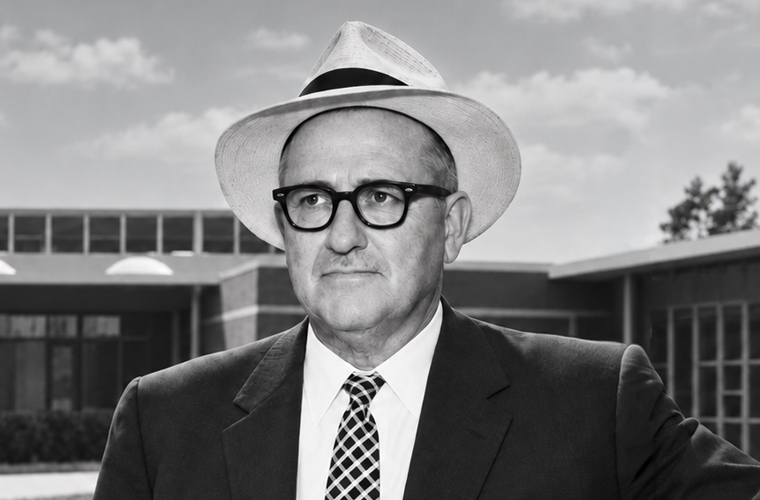
Virgil Tracy Blossom (October 31, 1906 – January 15, 1965) was an American educator and school administrator best known as superintendent of the Little Rock (Arkansas) public schools during the 1957 Little Rock Central High School desegregation crisis. Born in Brookfield, Missouri, to George N. Blossom (who ran a construction business and served as local tax collector) and Fannie M. Blossom (a homemaker), he had one sister. Tall and broad-shouldered with a booming voice, he excelled in athletics and forensics (debate/public speaking) in public schools, graduating from Brookfield High School in 1924.
Financial constraints delayed college. He worked as a clerk in the Missouri state legislature in Jefferson City before receiving an athletic scholarship to Missouri Valley College in Marshall, Missouri, in 1926. He majored in education, played football and baseball, and graduated in 1930. He later earned a Master of Science in education from the University of Arkansas in 1939 and took additional courses at Northwestern University. In fall 1930, Blossom began as athletic director and social sciences teacher at Fayetteville High School in Arkansas. He married Clarrene Tribble (daughter of the Fayetteville mayor) on August 2, 1934; they had two daughters, Bettie Sue (born 1938) and Gail (born 1940).
After a stint as athletic director at Okmulgee High School in Oklahoma (1935–1938), he returned to Fayetteville as high school principal in 1938. In 1942, at age 36, he became superintendent of Fayetteville Public Schools. There he oversaw major improvements, including a new high school, elementary school upgrades (totaling about $2 million), a $200,000 athletic field and community recreation area, and annexation of nearby districts lacking high schools. Fayetteville had no high school for Black students, so he arranged for them to attend segregated schools in Fort Smith. His progressive reputation led Fayetteville to celebrate “Virgil Blossom Day” in May 1953 as he departed.
He was active in the Methodist Church, Lions Club, Freemasons, Consistory, Knights Templar, and the local chamber of commerce. Hired as superintendent of Little Rock public schools in February 1953 (effective that summer), Blossom continued school reforms and was named Greater Little Rock’s Man of the Year in 1955.
The 1954 Supreme Court decision in Brown v. Board of Education upended his agenda. Blossom believed the ruling should have been delayed given Southern segregationist sentiment but began planning compliance. He hoped his gradual-integration approach (the “Blossom Plan”) would model Southern desegregation. He consulted Black and white groups. An early idea of starting with elementary students was abandoned due to white parental opposition (including fears of interracial relationships). The May 1955 plan, adopted by the board, called for phased integration beginning at Central High School in fall 1957, then junior highs, then elementaries (with flexible timelines), plus transfer options for minority students.
Only Central High was integrated in 1957. Of eligible Black students, Blossom ultimately accepted a small number; nine (the Little Rock Nine) entered after screenings and withdrawals. Hall High remained all-white and Horace Mann all-Black. Governor Orval Faubus used the National Guard to block the students; President Dwight D. Eisenhower later federalized the Guard and sent the 101st Airborne to enforce integration. Blossom received death threats and faced intense pressure.
Historians have criticized his leadership as ineffectual and paternalistic: he limited Black input, treated Black students unfairly in some views, sought to minimize and delay desegregation while protecting wealthier whites, and was overwhelmed by the chaos. He blamed extremists on both sides and felt abandoned by Faubus (who had initially seemed supportive). In 1958, Faubus closed Little Rock’s public schools for the “Lost Year.” Most of the school board resigned; in one of its last acts, it terminated Blossom’s contract. He spent the following period writing about the events—a series of Saturday Evening Post articles (“The Untold Story of Little Rock”) that became the basis of his 1959 memoir It Has Happened Here.
After a brief period in New York, Blossom became superintendent of the North East Independent School District (NEISD) in San Antonio, Texas, in July 1959. He oversaw rapid growth (enrollment rose from roughly 4,500 to over 20,000) and is credited with establishing a culture of excellence, particularly in athletics. The district later named its major athletic complex Blossom Athletic Center in his honor. Sources describe NEISD under his leadership as never having been segregated. Blossom died of a heart attack on January 15, 1965, at age 58 in San Antonio. He is buried at Sunset Memorial Park there. Blossom was regarded as an effective, progressive administrator in Fayetteville and San Antonio, but his handling of the Little Rock crisis remains the most scrutinized and criticized aspect of his career. His papers related to the crisis are held at the University of Arkansas Special Collections.