
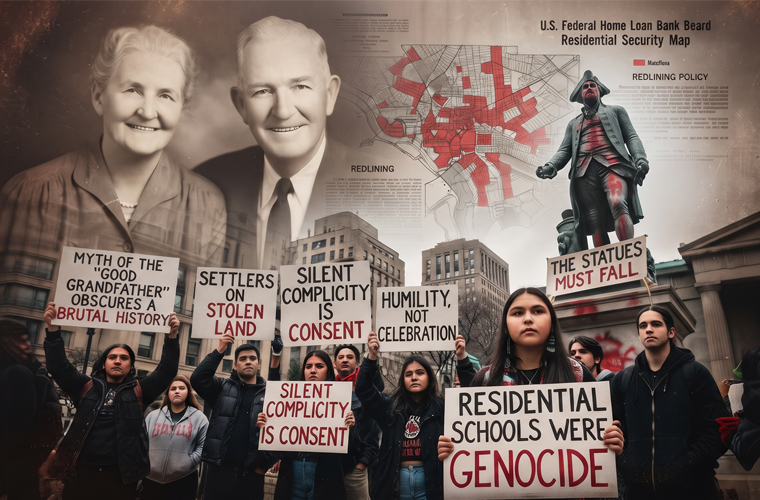
The myth of the “good grandfather” obscures a brutal history that demands humility, not celebration.
When white Europeans, Americans, and Canadians speak of their grandparents, there is often a warmth in their voices—a nostalgia for simpler times, for hardworking ancestors who “built something.” They speak of sacrifice, of struggle, of overcoming adversity. They tell stories of coming to new lands with nothing and making something of themselves. But these stories carry a silence. A gaping hole where truth should be.
Those same grandparents—and their grandparents before them—were not merely hardworking pioneers. They were, in many cases, participants in and beneficiaries of systems of unspeakable violence. They were settlers on stolen land. They were citizens of nations that systematically dehumanized, dispossessed, and murdered millions of people across the globe. They were the voting public that supported apartheid, that celebrated colonial conquest, that looked away from genocide. This is not about guilt by association. This is about truth. And the truth is that celebrating these ancestors without acknowledging their crimes is not heritage—it is propaganda.
The Disease of Benevolent Colonialism
The most insidious myth in the Anglosphere is that colonialism was, on balance, a force for good. This “benevolent colonialism” narrative—promoted by revisionist historians and embraced by governments—claims that European empires brought civilization, infrastructure, and the rule of law to benighted peoples.
The facts tell a different story.
In New Zealand, successive governments have invested considerable public resources into promoting a sanitized national identity built on the myth of “benevolent colonialism“—a narrative that legitimizes the settler state while obscuring the systematic dispossession of Māori land and culture. The numbers are stark. In 1860, Māori held about 80% of the North Island. By 2000, they held as little as 4%. This was not voluntary. It was confiscation, warfare, and legalized theft.
In Australia, the truth is even more brutal. The Tasmanian Aboriginal people were virtually exterminated within seventy years of British settlement—a genocide so complete that it is now often forgotten even in Britain. Between 1804 and 1830, the “Black War” raged as settlers kidnapped, raped, and murdered Aboriginal people who had done nothing but resist the theft of their lands. Lieutenant Governor George Arthur organized a “Black Line” of several thousand settlers to drive the remaining Aboriginal people from their homeland. Survivors were relocated to Flinders Island, where their numbers dwindled further.
Across mainland Australia, over 98% of First Peoples were wiped out in less than 300 years. There have been over 500 documented massacres. The “Stolen Generations”—children forcibly removed from their families from the 1800s through the 1970s—were a direct continuation of this policy of elimination. And this was not unique to Australia or New Zealand. From the smallpox epidemics that decimated Indigenous populations to the residential school systems of Canada, from the scorched earth policies of colonial Africa to the human zoos of Europe, the pattern is consistent: wherever Europeans went, destruction followed.
The Architecture of Racial Domination
The grandparents being celebrated today did not merely witness these horrors. They built them.
Redlining was not an accident. It was federal policy. In the 1930s, the Federal Home Loan Bank Board drew maps that explicitly designated Black neighborhoods as “hazardous” for investment, codifying segregation into the American landscape for generations. The appraisers’ comments on these maps referred to “subversive racial elements” and justified denying mortgages to people based solely on the color of their skin. The Civil Rights Act of 1968 technically ended the policy, but the philosophy—that capital should flow to white spaces and away from Black ones—persists to this day.
Apartheid was not merely a South African phenomenon. It was a system of white supremacy that the Western world tolerated, and in many cases, actively supported, for decades. The Afrikaner National Party came to power in 1948 on an explicitly apartheid platform. They implemented laws prohibiting interracial sex, requiring population registration by race, and forcibly removing 3.5 million people from their homes into artificial “homelands.” The United States, Britain, and other Western powers maintained diplomatic and economic ties with this regime for decades, treating it as a Cold War ally rather than a moral abomination.
Colonialism in Africa was never about civilization. It was about extraction. Walter Rodney argued that European pressure “distorted African economic growth and led to the underdevelopment of the continent.” The British ran their empire “on the cheap,” doing deals with indigenous elites to sustain control at minimal cost while turning a blind eye to coercion and exploitation. The economic consequences are still visible today. In 1750, Indians had a similar standard of living to people in Britain. Now, average Indian incomes are barely a tenth of British levels.
Hiroshima and Nagasaki remain the only uses of nuclear weapons in warfare, killing an estimated 78,000 people instantly in Hiroshima and at least 40,000 in Nagasaki. These were civilians. The bombings were not necessary for victory. They were a demonstration of power—a message sent to the world about who held the ultimate weapon.
The American Indian Genocide
The grandparents who settled this continent did not find an empty land. They found civilizations, nations, and peoples with their own histories, cultures, and ways of life. And they destroyed them.
The Trail of Tears was not a natural disaster. It was policy. Between 1831 and 1838, the United States government forcibly removed tens of thousands of Indigenous people from their ancestral lands in the Southeast to make room for white settlers. The Cherokee, Creek, Choctaw, Chickasaw, and Seminole Nations were driven from their homes at gunpoint. Approximately 4,000 to 8,000 Cherokee died along the way—from exposure, disease, and starvation—during the forced march of over 1,700 kilometers. They called it Nunna daul Isunyi: “the trail where we cried.” White Americans watched them pass and shed tears of compassion, then went back to their lives.
Little Bighorn was not a massacre of innocent whites. It was a battle in a war of conquest. When gold was discovered in the Black Hills—land sacred to the Lakota and guaranteed to them by treaty—the United States government sent the military to remove the Sioux and Cheyenne who refused to sell. Sitting Bull and Crazy Horse led their people in defense of their homeland. They won that battle. They destroyed Custer’s 7th Cavalry. The response of the United States was not to negotiate. It was to send more soldiers, more guns, more violence. Sitting Bull was eventually forced to flee to Canada, and when he returned and surrendered, he was assassinated by Indian police acting on behalf of the U.S. government.
Wounded Knee was not a battle. It was a massacre. On December 29, 1890, U.S. soldiers opened fire on a camp of Lakota men, women, and children at Wounded Knee Creek in South Dakota. The soldiers had come to disarm them. The Lakota had been practicing the Ghost Dance, a religious ceremony that settlers misunderstood as a prelude to war. The troops killed nearly three hundred people—most of them unarmed, many of them women and children. It was the final act of a decades-long genocide.
But Wounded Knee was not the beginning. It was the end. The Indian boarding schools were another instrument of that same genocide. For over 150 years, from 1819 to 1969, the United States government forcibly removed Native American children from their families and placed them in boarding schools designed to “civilize” them—to destroy their languages, their religions, their cultures. At least 973 children died in these institutions, buried in marked and unmarked graves at 65 schools across the country. The actual number is certainly higher. Many children were sent home to die after becoming sick. Others were sexually abused. The government appropriated over $23 billion (in inflation-adjusted dollars) to fund this system of cultural destruction.
White grandparents sent their children to public schools and watched them come home every day. Native grandparents buried their children in unmarked graves.
The Silent Complicity of Ordinary Life
But the most damning indictment of these grandparents is not what they did. It is what they did not do.
While Black Americans were being lynched, bombed, and terrorized during Jim Crow and the struggle for civil rights, white grandparents went to work. They went to church on Sunday. They raised their children. They had backyard barbecues and watched television and planned summer vacations. They lived their lives as if nothing was happening—because for them, nothing was.
This is the quiet horror of white complicity. The violence of segregation was not hidden. It was on the news. It was in the newspapers. Emmett Till’s mutilated body was published in Jet magazine for the world to see. The images of fire hoses and police dogs turned on peaceful Black protesters in Birmingham were broadcast into living rooms across America. The murders of Medgar Evers, of the four little girls in the Birmingham church bombing, of Goodman, Chaney, and Schwerner—these were not secrets.
White grandparents knew. They saw. And they did nothing. They continued to collect their paychecks from jobs that were reserved for whites only. They continued to buy homes in neighborhoods where Black families were barred from living, building generational wealth on foundations of exclusion. They continued to send their children to segregated schools that received more resources than Black schools, then passed those advantages on to their children and grandchildren. They reaped the benefits of a system they knew was unjust. They cashed the checks that white supremacy wrote. And then they went to church and sang hymns about love and justice.
Some of them actively opposed civil rights. They joined White Citizens’ Councils. They signed petitions against integration. They harassed Black families who dared to move into their neighborhoods. They voted for politicians who promised to maintain “law and order”—code for keeping Black people in their place. But even those who did nothing were complicit. Silence in the face of injustice is not neutrality. It is consent. It is a choice to preserve one’s own comfort at the expense of others’ humanity.
The Police: Architects of Terror
And then there were the grandparents who wore badges.
The police were not neutral arbiters of justice during Jim Crow. They were the enforcers of white supremacy. They were the architects of racial terror. In the South, police officers were often members of the Ku Klux Klan. They participated in lynchings. They looked the other way when mobs gathered outside courthouses. They arrested Black men on trumped-up charges and handed them over to white vigilantes. They beat, brutalized, and murdered Black people with impunity, knowing that no jury of their peers would ever convict them.
During the civil rights movement, police were the primary instruments of state repression. In Birmingham, Bull Connor’s police force turned fire hoses and attack dogs on children. In Selma, state troopers beat marchers on the Edmund Pettus Bridge with billy clubs, fracturing skulls and sending dozens to the hospital. In Philadelphia, Mississippi, police conspired with the Klan to murder three civil rights workers and bury their bodies in an earthen dam.
In the North, it was no better. Police in Chicago, Detroit, and Los Angeles routinely terrorized Black communities. They conducted illegal searches, planted evidence, and used excessive force as a matter of routine. The Chicago Police Department, under the direction of Mayor Richard J. Daley, was notorious for its brutality. During the 1968 Democratic National Convention, police attacked anti-war protesters and journalists in what a federal commission later called a “police riot.”
And these police officers went home to their families. They kissed their wives. They played with their children. They went to church on Sunday. They were respected members of their communities—white communities that were comfortable, that were invested in maintaining the racial order. Their grandchildren now speak of them with pride. “My grandfather was a cop.” They display his badge and his photograph. They tell stories of his service. They never mention the Black men he beat. The families he terrorized. The justice he denied. The system he upheld.
The War on Drugs: A War on Black and Brown People
The grandparents of today’s white Americans did not just enforce segregation. They built the machinery of mass incarceration that continues to destroy Black and brown communities to this day.
The War on Drugs was never about drugs. It was about control. When white communities struggled with addiction, the response was treatment, rehabilitation, compassion. When the same drugs appeared in Black and brown neighborhoods, the response was police, prisons, and punishment. This was not accidental. It was policy. The Reagan administration’s escalation of the drug war in the 1980s explicitly targeted communities of color. Mandatory minimum sentences, three-strikes laws, and the militarization of police forces all disproportionately affected Black and Latino Americans. The result is a system of mass incarceration that holds over two million people behind bars, with Black Americans incarcerated at more than five times the rate of white Americans.
And while the grandparents’ generation was waging this war on Black and brown neighborhoods, they were ignoring the addiction crisis in their own homes. White opioid addiction was treated as a public health crisis. Black addiction was treated as a criminal justice problem. The disparity persists to this day. In 2020, overdose death rates among Black Americans exceeded those of white Americans for the first time since 1999—yet Black patients continue to have far less access to lifesaving medications like buprenorphine. The message was clear: white pain deserves healing. Black pain deserves handcuffs.
The Juries That Destroyed Families
And then there were the grandparents who sat on juries.
The right to a trial by a jury of one’s peers is a cornerstone of American democracy. But for Black Americans, the jury has never been a source of justice. It has been an instrument of oppression. All-white juries convicted Black defendants on flimsy evidence while acquitting white defendants of heinous crimes. All-white juries sent Black men to prison for decades for crimes that whites committed with impunity. All-white juries looked at Black families and saw not human beings but threats to be neutralized.
These juries did not just send individuals to prison. They destroyed families. They took fathers and mothers away from children. They left communities without parents, without role models, without hope. They imposed sentences of 25 years, 40 years, life—for nonviolent offenses, for minor infractions, for being in the wrong place at the wrong time. And then they went home to their own families and slept soundly.
The grandparents who sat on these juries knew what they were doing. They knew the system was rigged. They knew the evidence was thin. They knew the consequences would be devastating. But they did it anyway. Because the alternative—treating Black defendants as human beings deserving of fairness—would have required them to confront their own racism, their own complicity, their own investment in the racial order. They chose comfort over justice. They chose order over humanity. And they called it civic duty.
The Hate That Lives in the Home
Perhaps the most poisonous legacy of these grandparents is not the violence they committed in public. It is the hatred they cultivated in private.
White grandparents passed down their racism to their children and grandchildren. They told jokes that dehumanized Black people. They used racial slurs over dinner tables. They warned their children against dating outside their race. They taught their grandchildren to fear Black men. They created a culture of white supremacy that lived not in laws or institutions but in living rooms, kitchens, and bedrooms across America. This was not incidental. It was intentional. The racial hierarchy required constant maintenance. It required that each generation be taught to see Black people as inferior, as dangerous, as less than human. It required that hatred be normalized, that bigotry be made ordinary, that white supremacy be passed down like a family heirloom.
And when their children and grandchildren acted on that hatred—when they told racist jokes at school, when they discriminated against Black coworkers, when they called the police on Black neighbors, when they joined white nationalist movements—the grandparents looked the other way. They turned a blind eye to the hate that came out of their own homes. They pretended that their family was different, that their loved ones were “good people.” But the hate did not come from nowhere. It came from them. It came from the dinner table. It came from the living room. It came from the lessons they taught and the silences they kept.
The Lynching Celebrations
And then there were the lynchings.
Between 1877 and 1950, more than 4,000 Black Americans were lynched in the United States. These were not clandestine murders in the dead of night. They were public spectacles. They were community events. They were, in the words of historian Terry Anne Scott, “a form of racialized recreation in which crowd involvement was integral to the mode and methods of the violence”. White grandparents brought their children to watch Black men and women be tortured and killed. They packed picnic lunches. They bought postcards with photographs of the mutilated bodies. They cheered as human beings were burned alive, castrated, dismembered. They took pieces of the bodies home as souvenirs.
And many of these lynchings happened on Sunday afternoons. After church. After the family had gathered to worship a God of love and justice. They sang hymns and said prayers and then went to watch a Black man die.
The lynching of Sam Hose in Newman, Georgia, in 1899 was one of the most notorious. Hose, a Black laborer, was accused of killing his white employer. A mob of over 2,000 white people gathered to watch him be burned alive. His fingers and ears were cut off and passed through the crowd. His genitals were severed. He was doused in kerosene and set on fire. The crowd cheered. These were not the acts of a few deranged individuals. They were the acts of a community. They were the acts of grandparents. They were the acts of churchgoers. They were the acts of people who considered themselves good, decent, Christian folk.
Lynching was not just violence. It was a ritual of white supremacy. It was a way of teaching the next generation what it meant to be white. It was a way of reinforcing the racial order. It was a way of saying: this is what happens to Black people who step out of line. This is what we will do to you. The grandparents who participated in lynchings—and the thousands more who knew about them and did nothing—were not outliers. They were the mainstream. They were the churchgoing, law-abiding, family-loving white people that their grandchildren now celebrate.
The Statues Must Fall
The question, then, is not why some people want to tear down statues of colonial figures. The question is why anyone would want to erect them in the first place.
Why does Wellington, New Zealand, still have streets and buildings named after men who orchestrated land confiscations? Why does Australia still honor the architects of the Black Line? Why do Canadian cities bear the names of John A. Macdonald, who oversaw the residential school system that tore Indigenous children from their families and buried them in unmarked graves? These are not neutral historical figures. They are not “men of their time.” They were architects of systems that caused mass death and suffering. They enriched themselves and their nations through the dispossession and destruction of others.
The protesters who defaced statues of Egerton Ryerson and Sir John A. Macdonald in Canada understood something that polite society prefers to forget: memorials are moral statements. To honor a person with a statue, a street name, or a building is to declare that person worthy of respect. It is to say: this is what we value. This is who we aspire to be. We cannot claim to value Indigenous lives while honoring those who destroyed them. We cannot claim to have learned from history while preserving monuments to the architects of genocide.
The Humility That Is Required
What is needed is not guilt. Guilt is a dead-end emotion that centers the feelings of the perpetrator while doing nothing to change the world.
What is needed is humility. Humility means acknowledging that the prosperity of white settler nations—the land, the wealth, the systems of governance, the very structures of daily life—was built on foundations soaked in blood. It means recognizing that “our grandparents” were not heroes but participants in something monstrous. Humility means refusing to center our own family stories when discussing colonial history. It means listening to Indigenous voices rather than speaking over them. It means understanding that the trauma of colonialism is not “in the past”—it is ongoing, in the form of intergenerational poverty, cultural erasure, and continuing state violence.
And humility means, at the very least, not demanding that the world celebrate our ancestors. It means tearing down the statues, renaming the streets, and refusing to pretend that the men who committed these crimes deserve our reverence. The grandparents who are the subject of this article’s title—the ones whose memories are invoked at family gatherings, the ones whose photographs hang in living rooms—they were not innocents. They were, in ways large and small, participants in systems of domination. Some directly committed violence. Others voted for it, funded it, or simply looked away.
They went to church while Black churches were bombed. They celebrated Christmas while Black families mourned children killed by police. They built careers while Black men and women were denied the same opportunities. They lived their lives in comfort while others lived in terror.
They watched Native children die on the Trail of Tears. They cheered as the Lakota were massacred at Wounded Knee. They sent their children to schools where Native children were buried. They ignored the addiction in their own homes while waging war on Black and brown neighborhoods. They sat on juries that destroyed Black families. They passed down hatred to their children and grandchildren. They attended lynchings after church and called it justice.
- We cannot change what they did. But we can change what we do with their memory.
- We can stop celebrating. We can start acknowledging. We can, finally, be humble.
- The time for ancestor worship is over. The time for truth is now.