
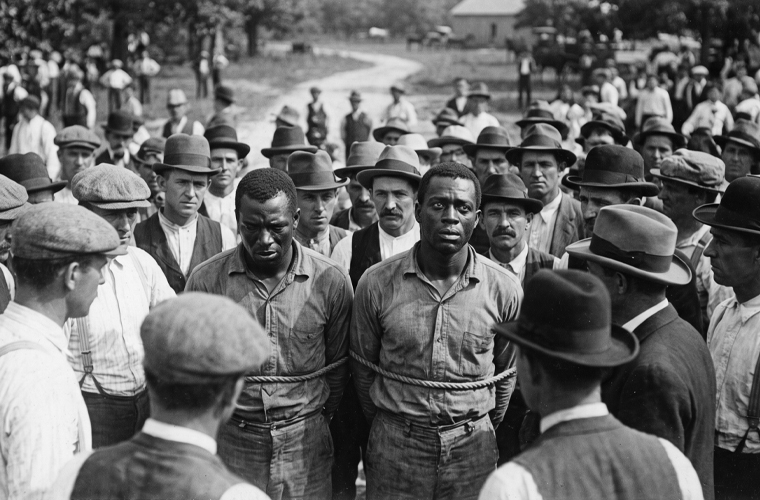
The killings occurred after local judge Charles H. Brand declined offers of protection from state troops, despite knowing for weeks that mob violence was likely. Tom Allen had been accused of sexual impropriety involving a white woman. Because of credible threats against his life, he had been held for safety in Atlanta. Earlier in June, state troops escorted him to Monroe for trial under orders from the governor. Judge Brand openly resented the military presence, postponed the proceedings, and sent Allen back to Atlanta. When Allen was returned to Monroe for trial on June 27, Brand again refused state protection. As a result, Allen was accompanied only by two officers on the train.
Anticipating the lack of serious security, the mob stopped the train, overpowered the two officers, and seized Allen. They tied him to a telegraph pole and shot him in full view of train passengers and hundreds of spectators. The mob then marched about six miles to the county jail in Monroe. There, they encountered no resistance from jail staff as they removed Joe Watts, another Black man being held inside. Some accounts described Watts as an alleged accomplice of Allen; others reported he had simply been arrested for “acting suspiciously” near a white man’s home without any formal charges. The mob hanged Watts from a tree and shot him multiple times.
Both men had insisted on their innocence, and contemporary newspaper reports noted a lack of evidence against them. This incident reflected a broader pattern during the era of racial terror lynchings. Law enforcement and judicial officials frequently failed to protect Black people in their custody, even when threats were well-known. Many were complicit through inaction or outright refusal to provide security, effectively enabling mob violence.
Judge Brand’s decisions played a direct role. He had rejected state troop protection that had successfully safeguarded Allen just weeks earlier. Three months prior, in his hometown of Lawrenceville in neighboring Gwinnett County, Brand had similarly refused troops for Charles Hale, another Black man who was subsequently taken by a mob and lynched. Despite these failures to uphold his duty to protect those in the justice system, Brand continued serving as a judge until 1917. That year, he was elected to the U.S. House of Representatives for Georgia’s 8th Congressional District and served seven consecutive terms.
Tom Allen and Joe Watts were two of at least nine documented victims of racial terror lynchings in Walton County between 1865 and 1950. Across the South and the rest of the country, the Equal Justice Initiative has documented more than 6,500 such racial terror lynchings in that same period.