
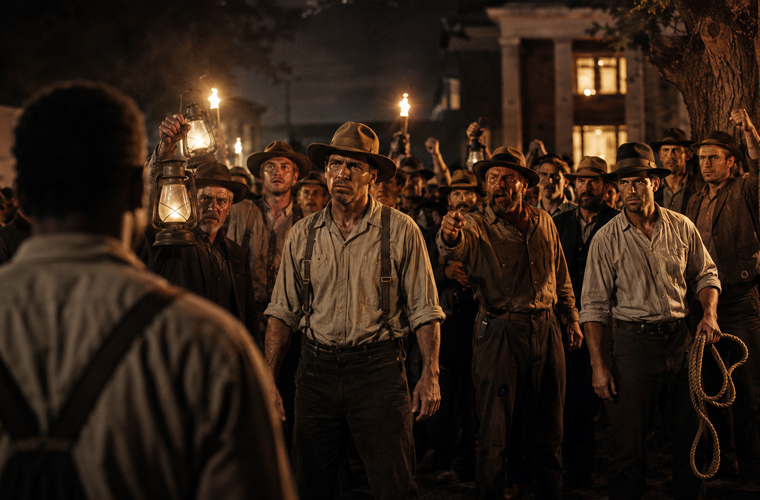
A lynch mob refers to a group of people who take the law into their own hands to punish, often lethally, an individual accused (rightly or wrongly) of a crime or social transgression, bypassing due process. Lynchings typically involve public or semi-public acts of violence—hanging, burning, beating, mutilation, or other forms of torture—intended not only to punish but to intimidate communities and enforce social hierarchies. The practice is an extreme form of vigilante justice or collective punishment and has appeared in societies worldwide during periods of weak institutions, social upheaval, or perceived failures of formal justice systems.
Etymology and Origins
The term “lynching” likely originated in the United States during the American Revolutionary era. It is commonly traced to Charles Lynch (1736–1796), a Virginia planter, justice of the peace, and Patriot militia colonel who led extrajudicial actions against Loyalists (Tories), including imprisonment and corporal punishment. In 1782, he referenced “Lynch’s Law” in correspondence. A similar claim exists for William Lynch of Pittsylvania County, Virginia. These actions were wartime measures, not primarily lethal, and not initially tied to racial violence.
Earlier folk etymologies, such as links to James Lynch FitzStephen (Mayor of Galway, Ireland, 1493) or to the archaic verb “linch” meaning to beat, are generally dismissed by linguists. A 20th-century hoax falsely attributed a brutal slave-control speech to William Lynch. The term evolved to describe mob violence, particularly in frontier settings and, later, racial terror in the post-Civil War South.
Historical Context in the United States
Lynchings occurred in America before and after the Civil War, initially in frontier areas where formal law enforcement was absent. Early victims were often white, and the acts sometimes targeted criminals or outlaws. However, after the emancipation of roughly 4 million enslaved African Americans, lynching became a primary tool of racial terror, especially in the South during the Jim Crow era (late 19th to mid-20th century).
Reconstruction (1865–1877) saw significant violence as white Southerners resisted Black political and economic gains. Lynchings surged after Reconstruction ended, peaking in the 1890s amid economic stress, political disenfranchisement of Black voters, and efforts to enforce white supremacy. They served to terrorize Black communities, suppress voting and labor rights, and maintain segregation.
Statistics and Scale:
- Tuskegee Institute records: 4,743 lynchings from 1882–1968, with 3,446 Black victims (about 72%) and 1,297 white.
- Equal Justice Initiative (EJI) research: At least 4,084 racial terror lynchings in 12 Southern states (1877–1950), plus over 300 elsewhere—hundreds more than previously documented. Mississippi, Georgia, Louisiana, Florida, Arkansas, and Texas had the highest numbers and rates.
- Victims included men, women, and children. Many lynchings were public spectacles attended by hundreds or thousands, with photographs and postcards sold as souvenirs.
Common Patterns and Justifications:
- Accusations: Often dubious or fabricated—sexual transgressions against white women (a major pretext, though only about a quarter of cases), murder, theft, or minor social “transgressions” like disrespecting whites, economic competition, or political activity. Many victims were killed without any accusation.
- Methods: Hanging was common, but victims were also shot, burned alive, castrated, dismembered, or dragged. Mobs sometimes seized prisoners from jails with complicit or passive law enforcement.
- Scale: Some escalated into mass violence against entire Black communities. Groups like the Ku Klux Klan were involved, but ordinary white citizens, including women and children, frequently participated.
Notable examples include:
- The 1916 lynching of Jesse Washington in Waco, Texas (tortured and burned before a crowd).
- The 1918 lynching of Mary Turner in Georgia (pregnant woman hanged, burned, and her unborn child killed).
- The 1930 Marion, Indiana, lynching of Thomas Shipp and Abram Smith (inspired “Strange Fruit“).
- The 1955 murder of Emmett Till, which galvanized the Civil Rights Movement.
Lynchings declined after the 1930s due to activism, migration, shifting public opinion, and greater use of formal (often accelerated) capital punishment. The last “classical” recorded lynching was in the 1950s–60s, though related violence persisted.
Resistance and Anti-Lynching Efforts:
Ida B. Wells documented and crusaded against lynchings. The NAACP investigated cases, published reports (e.g., Thirty Years of Lynching), flew anti-lynching flags, and pushed for federal legislation (e.g., Dyer Bill). Many bills failed due to Southern opposition. The Emmett Till Anti-Lynching Act was signed into law in 2022.
Global Perspectives
Lynching is not uniquely American. Instances of mob violence appear across history:
- Europe: During the French Revolution (September Massacres), 1848 revolutions, and the Russian Civil War. In 20th-century Britain and elsewhere, targeted attacks occurred amid unrest.
- Latin America: Persistent in Mexico and other countries, often tied to crime, weak governance, or rumors. Datasets like LYLA document thousands of incidents in recent decades.
- Asia and Africa: Mob lynchings in India (e.g., cow vigilante attacks, WhatsApp rumor-fueled violence), Indonesia, Nigeria, South Africa (xenophobic attacks), and elsewhere, frequently driven by misinformation, ethnic tensions, or perceived criminality.
These reflect breakdowns in trust in institutions, similar to historical U.S. patterns.
Modern Manifestations and “Digital Lynch Mobs”
Traditional lynchings have largely waned in the U.S. Still, echoes persist in vigilante killings, police-involved deaths framed as modern lynchings by activists (e.g., George Floyd, Ahmaud Arbery), and hate crimes. The term has been extended metaphorically to “cancel culture” or online pile-ons—public shaming, doxxing, and coordinated campaigns that can destroy reputations or livelihoods without due process. Critics see parallels in mob mentality, presumption of guilt, and spectacle (amplified by social media), while defenders view it as accountability for the powerful. Debates continue on its effectiveness versus the risks of injustice.
Legacy and Impact
Lynchings entrenched racial inequality, fueled the Great Migration, shaped distrust in the justice system, and contributed to ongoing disparities in health, wealth, and incarceration. They reinforced narratives of racial difference and white supremacy. Memorials like the National Memorial for Peace and Justice in Montgomery, Alabama, seek to confront this history. Broader lessons include the dangers of eroded trust in institutions, groupthink, rumor-driven violence, and the human capacity for cruelty under the guise of justice. Addressing legacies of such violence requires acknowledgment, education, and strengthening the rule of law.
Lynch mobs represent a dark thread in human history: the substitution of passion and power for impartial justice. Understanding them is essential to preventing their recurrence in old or new forms.